-
-
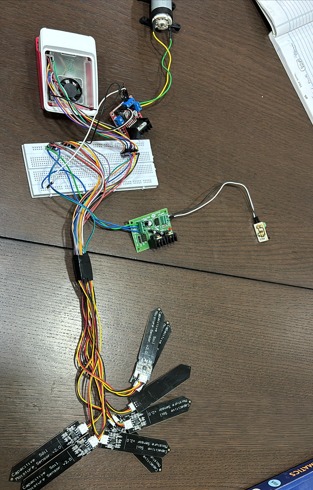
this is the whole project assembled
Inspiration
India faces a critical challenge of over-irrigation due to heavy and unpredictable rainfall, leading to water wastage and reduced crop productivity. This inspired us to create S.A.I, a system that ensures optimal water usage in agriculture.
What it does
S.A.I (Smart Agricultural Irrigation) uses soil moisture sensors, a Raspberry Pi 5, and a weather API to monitor soil conditions and forecast rainfall. If rain is expected in the next 3 days, the system prevents irrigation. If not, it irrigates accordingly.
How we built it
- Sensors: Deployed 8 soil moisture sensors to monitor ground conditions.
- Hardware: Used Raspberry Pi 5 as the central processing unit.
- Software: Integrated a weather API to predict rainfall and automated the irrigation logic.
- coding: Developed scripts to process sensor data and interact with the weather API.
Challenges we ran into
- Calibrating soil moisture sensors for accurate readings.
- Ensuring reliable communication between the sensors and Raspberry Pi.
- Synchronizing irrigation decisions with weather API predictions.
Accomplishments that we're proud of
- Successfully developed a system that reduces over-irrigation.
- Achieved seamless integration of hardware and software components.
- Created a scalable solution that can be adapted to various farm sizes.
What we learned
- The importance of precision in sensor calibration.
- How to effectively integrate IoT systems with real-time APIs.
- Problem-solving under constraints, such as hardware limitations.
What's next for S.A.I
- Adding machine learning to predict rainfall patterns more accurately.
- Expanding the system to include multi-crop irrigation strategies.
- Exploring solar power integration for sustainable operation.
Built With
- ai
- api
- ml
- openweather
- raspberry-pi
- soil


Log in or sign up for Devpost to join the conversation.