-
-
LangDAO logo
-
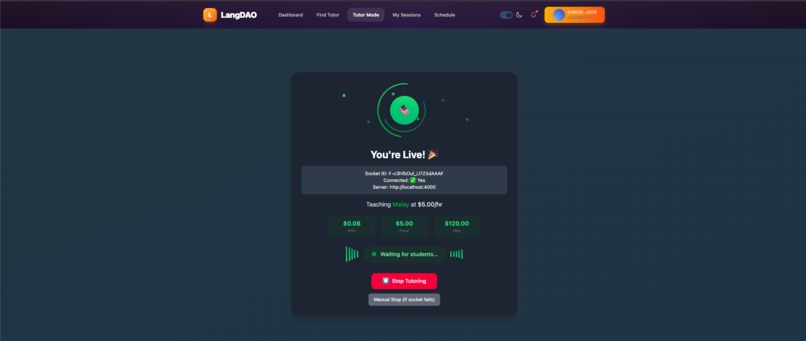
tutor live search broadcast via redis server
-
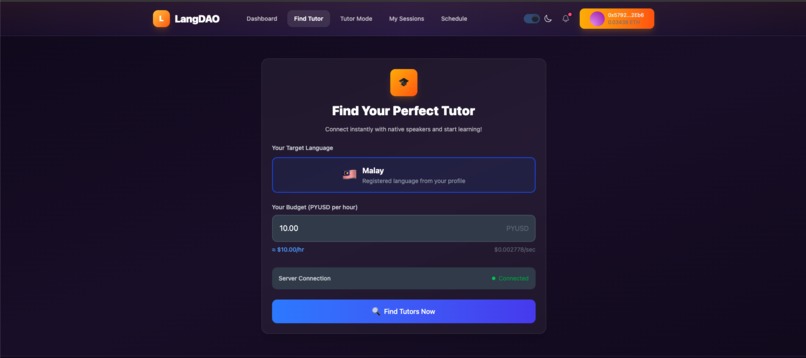
student searching for tutors
-
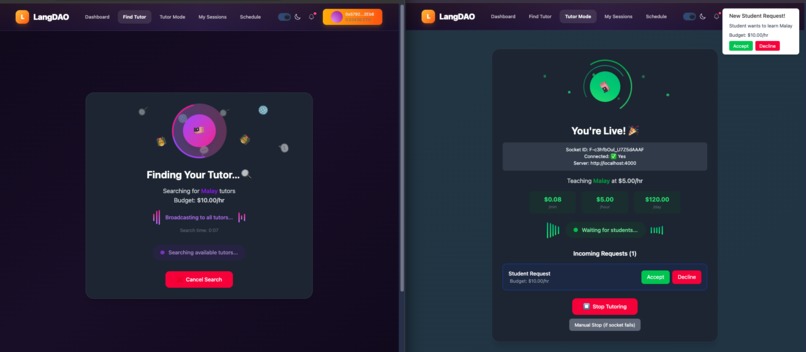
both are connected
-
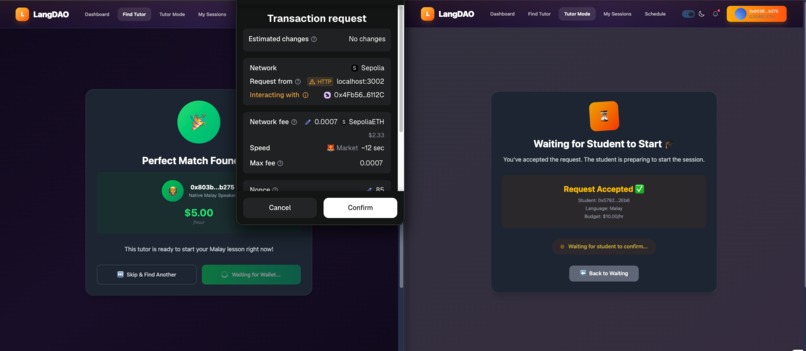
submitting the blockchain tx to start the webrtc
-
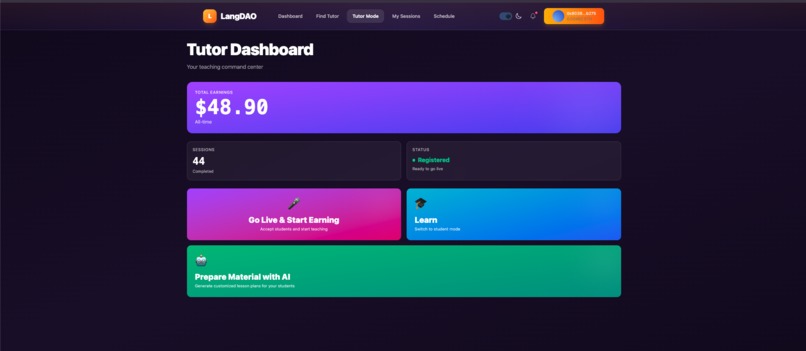
tutor dashboard
-
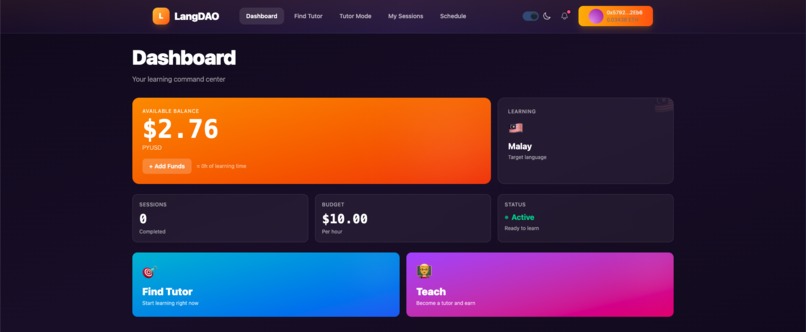
student dashboard
-
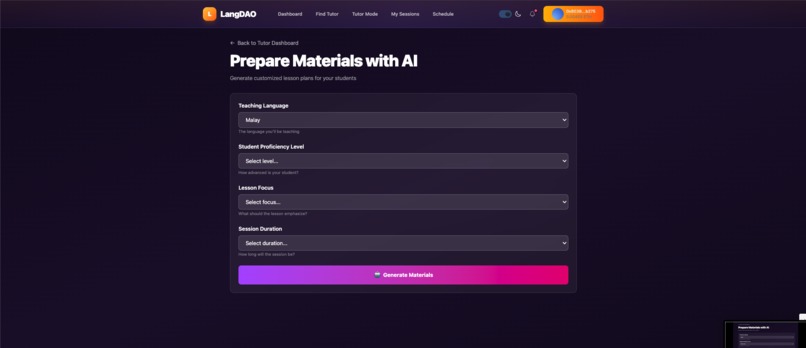
tutor can generate teaching materials with the help of Google Gemini
-
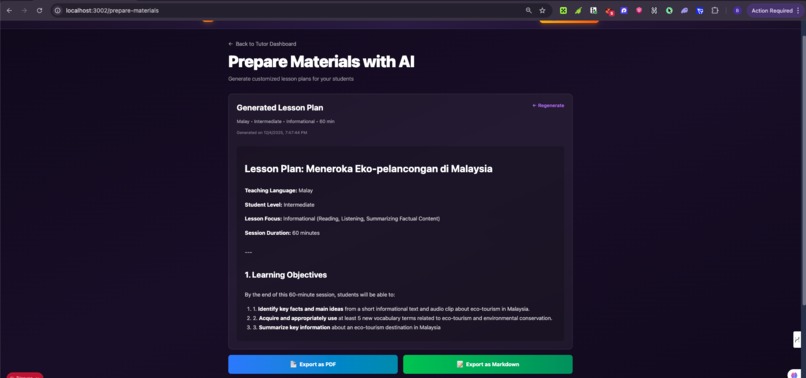
Generated materials
Inspiration
Language learning platforms today are centralized, expensive, and extractive. Native speakers — the actual value creators — earn very little, while platforms take massive cuts.
At the same time, Web3 already provides everything a global learning marketplace needs:
- trustless payments,
- identity,
- real-time peer connections,
- global access.
The problem is: Yet no one has combined these into a decentralized tutoring economy.
LangDAO was born from one idea: Every native speaker should be able to teach and earn directly, per second, without intermediaries.
What it does
LangDAO is a decentralized Web3 tutoring platform with:
- Real-time matching using Socket.io
- Peer-to-peer video sessions via WebRTC
- Per-second PYUSD payments automatically settled on-chain
- 38 supported languages for global accessibility
Students connect their wallet, choose a language, set a budget, and LangDAO instantly matches them with an available tutor. The session starts in seconds, and payment is handled automatically by a smart contract the moment the call ends.
It’s a fully functional, end-to-end Web3 learning marketplace.
How we built it
LangDAO was built using a spec-driven, agentic engineering workflow powered by Kiro.
🧠 Spec-driven development (core of the project)
Inside .kiro/specs/langdao-platform/:
- 18 user stories
- 47 acceptance criteria
- 45 correctness properties
- 60+ implementation tasks
These properties mathematically define system behavior. Example correctness property:
∀student(𝐿,𝐵),MatchedTutor.rate≤𝐵∧MatchedTutor.language=𝐿
Kiro used these properties to generate deterministic implementations across the smart contract, backend services, and frontend components.
⚙️ Agent hooks (automation layer)
Five custom Kiro hooks automated the engineering workflow:
- Code Cop Validator (checks imports, Node version, unused deps)
- Auto-Fix Build Errors
- Deploy Reminder
- Pre-Deploy Checks 5.Lint Check
These hooks acted like automated senior engineers running in the background.
📚 Steering docs
Three steering docs (tech.md, product.md, structure.md) provided persistent project context so Kiro stayed consistent across the entire development process.
🗂 MCP integration
The playwrightMCP server let Kiro:
- create tests for acceptance criteria
- prompt : "Use the Playwright MCP to navigate to http://localhost:3002, interact with thirdweb wallet connection, and verify the registration flow."
Combining MCP + specs created a fully agentic development pipeline.
Challenges we ran into
- Deterministic tutor matching
Redis concurrency, fairness guarantees, budgeting rules, and language filtering required designing strict correctness properties.
- WebRTC stability
Handling browser differences in ICE candidates and reconnection logic was challenging.
- Per-second payment accuracy
Ensuring Solidity-safe billing without overflow required formal definitions like:
Payment=min(duration_seconds×rate, balance)
- Multi-agent coordination
Aligning hooks, specs, and steering docs required iterative refinement so Kiro always used the latest rules.
Accomplishments that we're proud of
- A fully functional Web3 tutoring app with real-time video and instant settlement
- A complete formal specification with 45 correctness properties
- A Redis-based matching engine generated from natural language instructions
- A Solidity contract supporting per-second payments and 38 language codes
- Five automated agent hooks forming a true CI/CD assistant
- Deep integration of specs, hooks, steering docs, and MCP — a full agentic engineering pipeline
Most importantly, LangDAO proves that AI agents + formal specs can build complex distributed systems rapidly and correctly.
What we learned
- Spec-driven development makes complex features easier, not harder
- Correctness properties force clarity and eliminate ambiguity early
- Agent hooks dramatically reduce debugging and manual checks
- Steering docs are essential for keeping AI-generated code consistent
- MCP turns Kiro into more than a coding assistant — it becomes a project manager
- WebRTC + blockchain + real-time matching is a powerful, but intricate, combination
The biggest takeaway: Agentic engineering is a real development methodology, not a demo trick.
What's next for LangDAO
LangDAO is just getting started. Next, we plan to launch mobile support with React Native, expand tutor onboarding to real bilingual communities, and introduce on-chain teaching credentials to build verifiable reputation. We’re also developing AI-powered teaching tools for lesson generation and pronunciation scoring, and creating localized language DAOs to empower community governance. As we scale, we aim to migrate to L2 (base, arbitrium) or adopt account abstraction for cheaper microtransactions. The long-term vision is for LangDAO to become the global decentralized tutoring network — a place where anyone can teach, learn, and earn instantly and permissionlessly.
Built With
- docker
- ethers.js
- express.js
- github
- hardhat
- kiro-agentic-ide
- next.js-15
- node.js
- pyusd
- rainbowkit
- react
- redis
- socket.io
- solidity
- supabase
- typescript
- vercel
- vibe-kanban-mcp
- wagmi
- webrtc


Log in or sign up for Devpost to join the conversation.