Chapter three: Doing policy analysis 1) 2) 3) 3.1. Steps in policy analysis Problem analysis Solution analysis Communicating policy analysis Wear your mask!!! 11/30/2021
3.1. Steps in policy analysis    • The term Policy analysis comes from a Greek word meaning to break down into component parts These components can be specified as a series of steps. There are different steps of the policy analysis process provided by different scholars. The commonly known two steps are; The five step (US government office of Management and Budget) analysis process and the eight step (Eugene Bardach, 2000) policy analysis process. Wear your mask!!! 11/30/2021
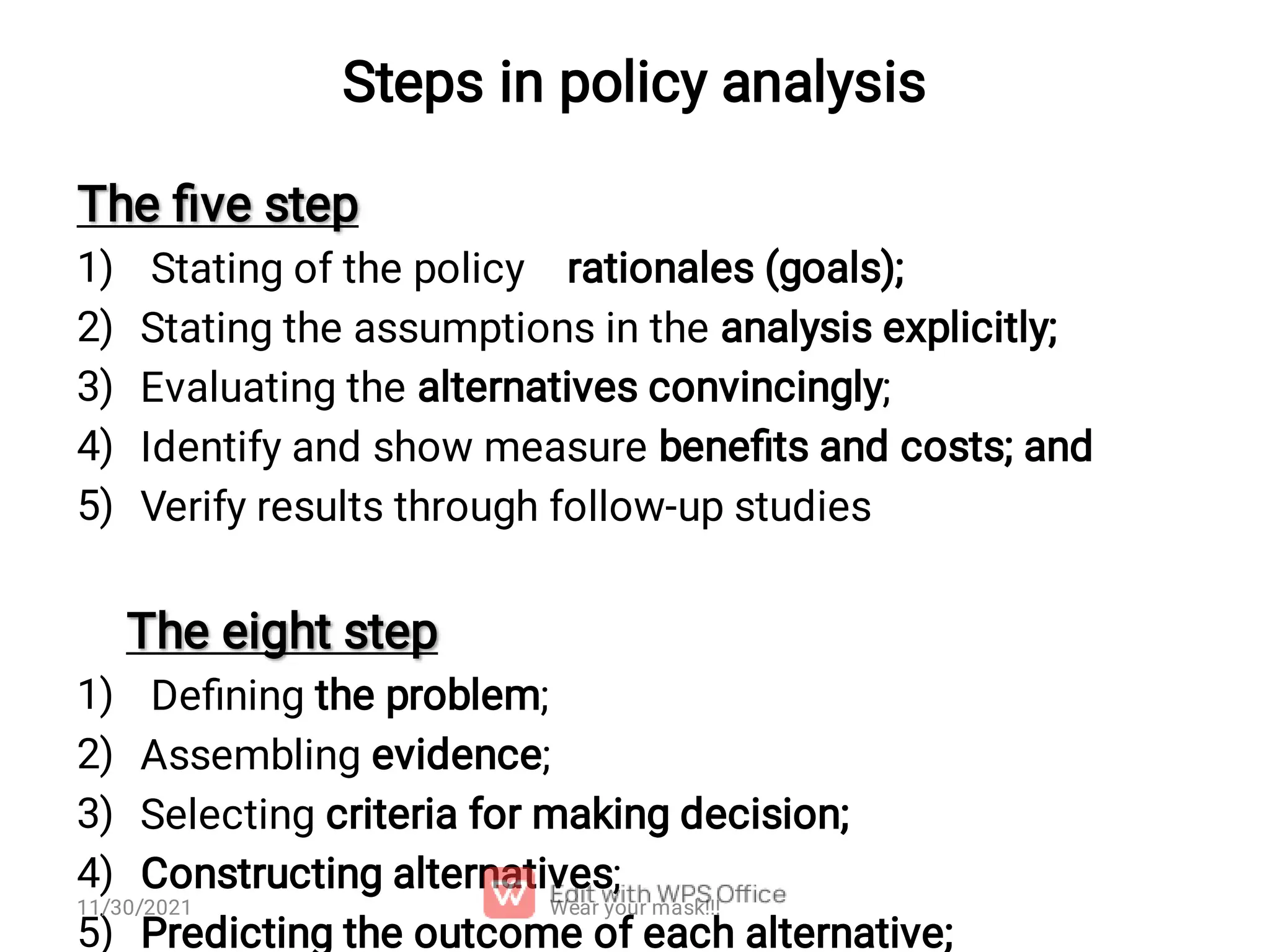
Steps in policy analysis 1) 2) 3) 4) 5) 1) 2) 3) 4) 5) The five step The five step Stating of the policy rationales (goals); Stating the assumptions in the analysis explicitly; Evaluating the alternatives convincingly; Identify and show measure benefits and costs; and Verify results through follow-up studies The eight step The eight step Defining the problem; Assembling evidence; Selecting criteria for making decision; Constructing alternatives; Predicting the outcome of each alternative; Wear your mask!!! 11/30/2021
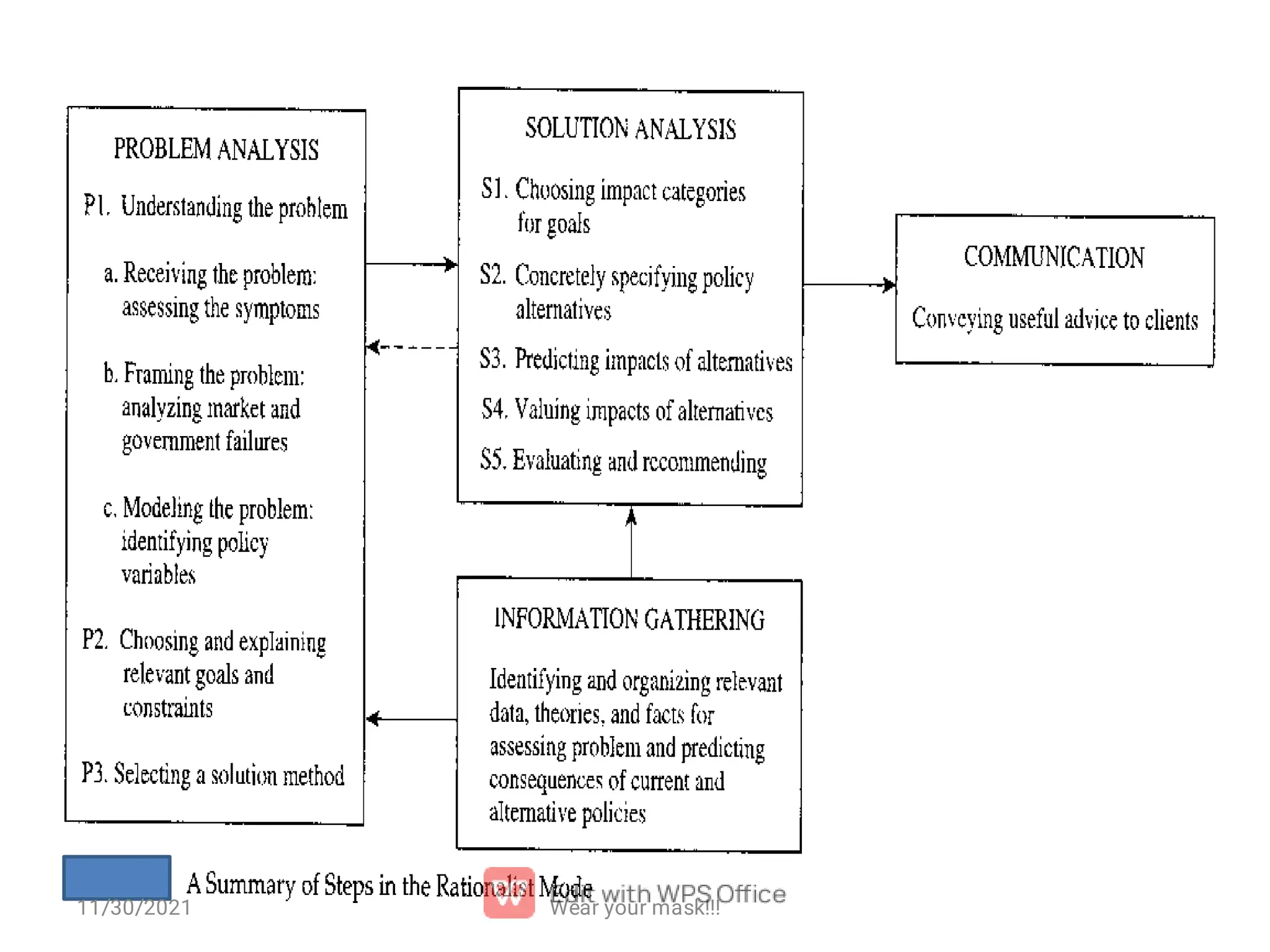
Cont… •   • Weimer and vining (2007) have summarized the policy analysis steps in to two major components: Problem analysis and Solution analysis and the result of these two components will be communicated to the client. And they called it steps in rationalist policy analysis. Wear your mask!!! 11/30/2021
Wear your mask!!! 11/30/2021
Problem Analysis  1. 2. 3. Problem analysis comprises of three major steps: Understanding the problem Choosing and explaining relevant policy goals and constraints, and Choosing a solution method. Wear your mask!!! 11/30/2021
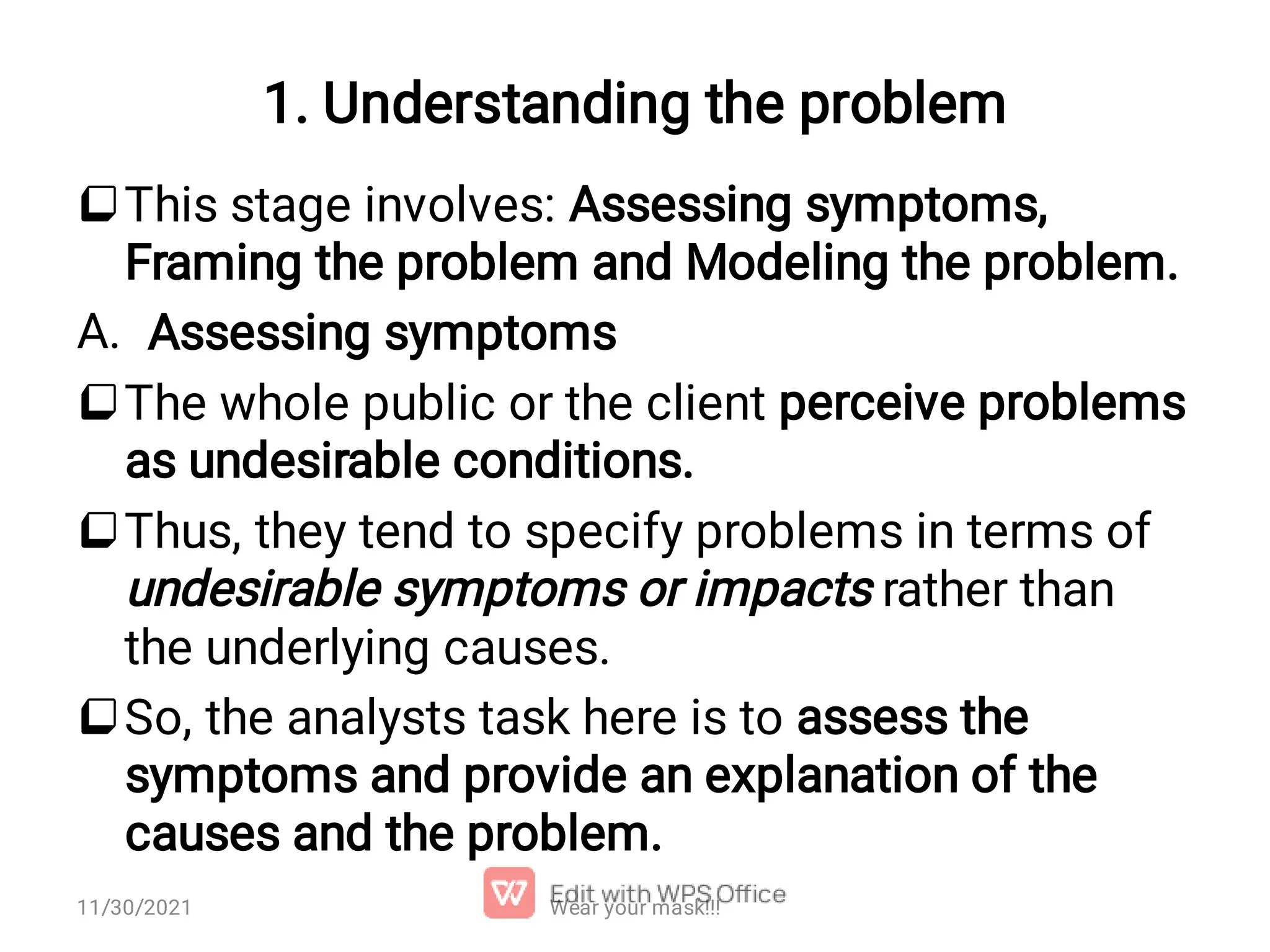
1. Understanding the problem  A.    This stage involves: Assessing symptoms, Framing the problem and Modeling the problem. Assessing symptoms The whole public or the client perceive problems as undesirable conditions. Thus, they tend to specify problems in terms of undesirable symptoms or impacts rather than the underlying causes. So, the analysts task here is to assess the symptoms and provide an explanation of the causes and the problem. Wear your mask!!! 11/30/2021
Cont…   This is done by locating empirical data that can help you put the symptoms in quantitative perspective. e.g. Car Accident Fatalities: Number of such accidents, How the number has changed over time/trend what percentage of total death they comprise and other measures of magnitude, distribution and time trend of the symptom. To do this, collect empirical data, be familiar with the current public discussion about the symptom and the history of existing policy relevant. Wear your mask!!! 11/30/2021
Cont…  How to collect data? What source/type of data? Importance Conveys the relative importance and urgency of the problem and it begins to establish your credibility as some one who is knowledgeable about it./importance and severity of the problem Wear your mask!!! 11/30/2021
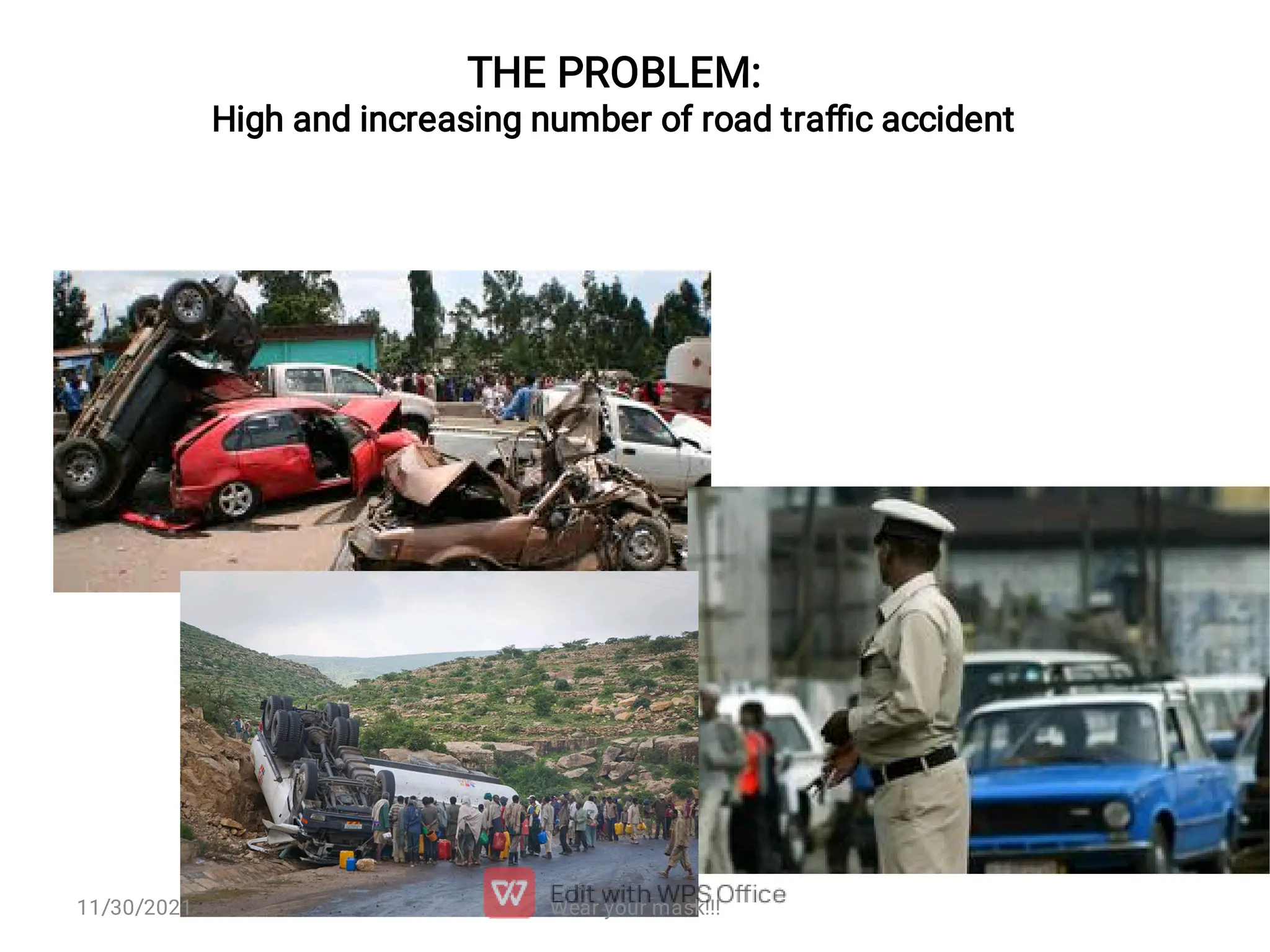
THE PROBLEM: High and increasing number of road traffic accident Wear your mask!!! 11/30/2021
How can the problem be defined? Road Traffic Accidents (RTA) “Accidents which occurred or originated on a way or street open to public traffic and which resulted in one or more persons being killed or injured and in which at least one moving vehicle was involved.” UN Wear your mask!!! 11/30/2021
Current Situation In the world… fatalities / 100,000 people 5.0 5.4 13.9 12.7 11.7 40.5 21.5 41.6 34.4 32.5 34.3 26.0 48.4 35.0 Japan UK United ... Romania Colombia Libya Peru Egypt Kenya Senegal Tanzania Malawi Eritrea Ethiopia 0.0 5.0 10.0 15.0 20.0 25.0 30.0 35.0 40.0 45.0 50.0 Wear your mask!!! 11/30/2021
0.7 1.0 1.7 5.9 10.9 13.7 41.6 73.1 128.6 143.4 240.3 278.0 386.2 1191.9 Japan UK United States Romania Colombia Libya Peru Egypt Kenya Senegal Tanzania Malawi Eritrea Ethiopia 0.0 200.0 400.0 600.0 800.0 1000.0 1200.0 … fatalities / 10,000 licensed vehicles Wear your mask!!! 11/30/2021
ETHIOPIA • • • In Ethiopia car accident is becoming a serious problem and affecting many individuals and families as well as the nation. every month, around 400 people are killed or hospitalized due to RTA 41% of the injuries registered in Addis Ababa’s hospitals are due to RTA Wear your mask!!! 11/30/2021
The trend is upward… Wear your mask!!! 11/30/2021
Localization • • more than 65% of RTA reported in Ethiopia occur in Addis Ababa Most of the accidents occur in the central part of the country (Oromia Regional State and Addis Ababa) Wear your mask!!! 11/30/2021
• • in cities, 90% of the victims are pedestrians most victims are active people and are main breadwinners for their families Who are the victims? Wear your mask!!! 11/30/2021
• • • • • Transportation companies force their employees to drive in long shifts (more than 8 hrs/day), this resulting in tired drivers In 2006, the number of RTA involving mini buses increased by 32.6% (the number for private vehicles only increased by 1.4%) Driving under the influence of alcohol and chat is usual (police does not have devices for alcohol testing) Problems related to roads jaywalking is a habit for pedestrians Who causes the accidents? Wear your mask!!! 11/30/2021
How Much do accidents cost? • • Estimated cost – 1- 4% of GNP / year 350 - 430 million Birr/ year Wear your mask!!! 11/30/2021
B. Framing the problem   • 1) 2) 3) This step is about explaining the problem in terms of market failure or government failure. But what do we mean by Market failure and Government failure? Market failure According to Adam smith’s Laissez- faire states, governments should allow private markets to operate with a free hand. However, he listed three fundamental roles of government: National defense An impartial system of law A set of public works and institutions Wear your mask!!! 11/30/2021
Cont…  • Government policies beyond these minimum functions may be justified by the efficiency losses from imperfect markets or the need of the less fortunate based on equity concerns. What is a perfect market/ perfectly competitive market? Economics start its analysis of competition markets with assumptions. Wear your mask!!! 11/30/2021
Assumptions for perfect competition 1. 2. 3. 4. 5. Many buyers and sellers Perfect information Homogeneous product Freedom of entry and exit/ perfect mobility No collusion Wear your mask!!! 11/30/2021
Cont…    Economist recognize several commonly occurring circumstances of private choice, referred to as Market failure, that violates the assumptions of the competitive economy/market. A market failure occurs when the “invisible hand” pushes in such a way that individual decisions don't lead to socially desirable outcomes. Any time a market failure exists, there is a reason for possible government intervention into markets to improve the outcome. Wear your mask!!! 11/30/2021
Causes of market failure a. b. c. Public goods Externalities Information asymmetry d. Monopoly Wear your mask!!! 11/30/2021
A. Public goods: a good or service that is provided without profit to all members of a society, either by the government or by a private individual or organization. The market can not allocate this particular good efficiently. Wear your mask!!! 11/30/2021
Cont…   • b. Externalities Externalities are the effect of a decision on a third party that is not taken into account by the decision-maker. It is cost or benefit to a party not involved in the production and consumption of a good. Positive or Negative externalities Wear your mask!!! 11/30/2021
Cont… • – – Externalities can be both positive and negative. - Negative externalities second-hand smoke, water and air pollution - Positive externalities innovation, new business formation Wear your mask!!! 11/30/2021
c. Information Asymmetry   •  Perfectly competitive markets assume perfect information. Real-world markets often involve deception, cheating, and inaccurate information. When there is a lack of information, buyers and sellers do not have equal information, markets may not work properly. What Policy measures can you think of in order to deal with informational Problems? Wear your mask!!! 11/30/2021
d. Monopoly • • • • A single seller in a market Gives no choice for customers Sellers are price setters Monopolists charge higher than would exist in competitive market Wear your mask!!! 11/30/2021
 • •    If there is any evidence of market failure then government intervention can be recommended as a solution to the problem. But will government succeed in designing, implementing, and enforcing effective policy responses to market imperfections? The translation of the public interest in to public policy requires several steps: Identifying the public interest through voting or other methods (problem Identification) Creating policies through legislative process (adoption) and ; Administrating policy through a public bureaucracy (Implementation) Wear your mask!!! 11/30/2021
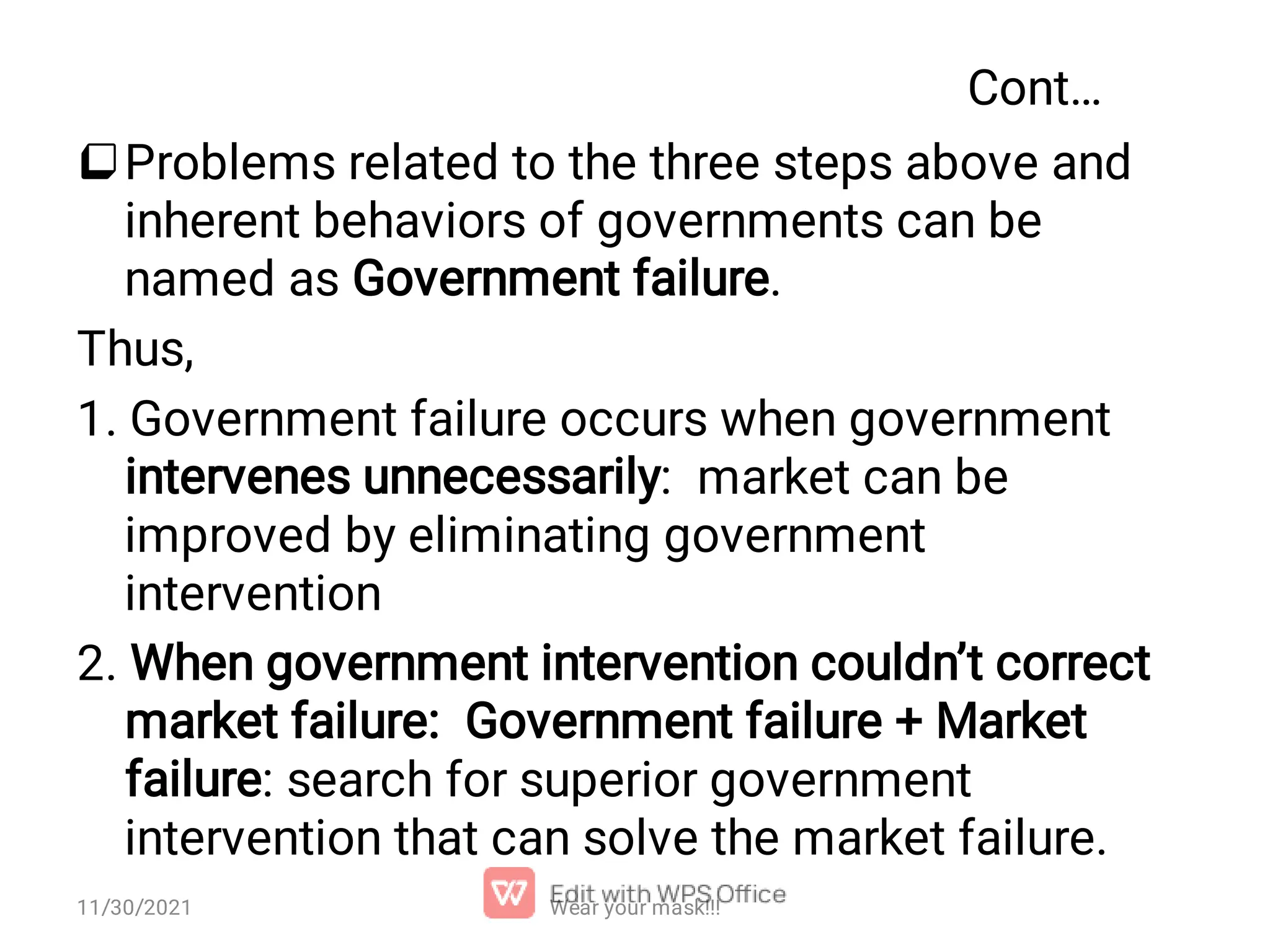
Cont… Problems related to the three steps above and inherent behaviors of governments can be named as Government failure. Thus, 1. Government failure occurs when government intervenes unnecessarily: market can be improved by eliminating government intervention 2. When government intervention couldn’t correct market failure: Government failure + Market failure: search for superior government intervention that can solve the market failure. Wear your mask!!! 11/30/2021
Cont… •   • The example of traffic accident Fatalities has some aspect of government failure and market failure. C. Modeling the problem/ Identifying policy variables policy variables The Linking policy variables to the conditions of concern Developing a behavioral models that relate the conditions of concern to variables that can be manipulated by public policy It goes beyond framing to identify important policy variables Wear your mask!!! 11/30/2021
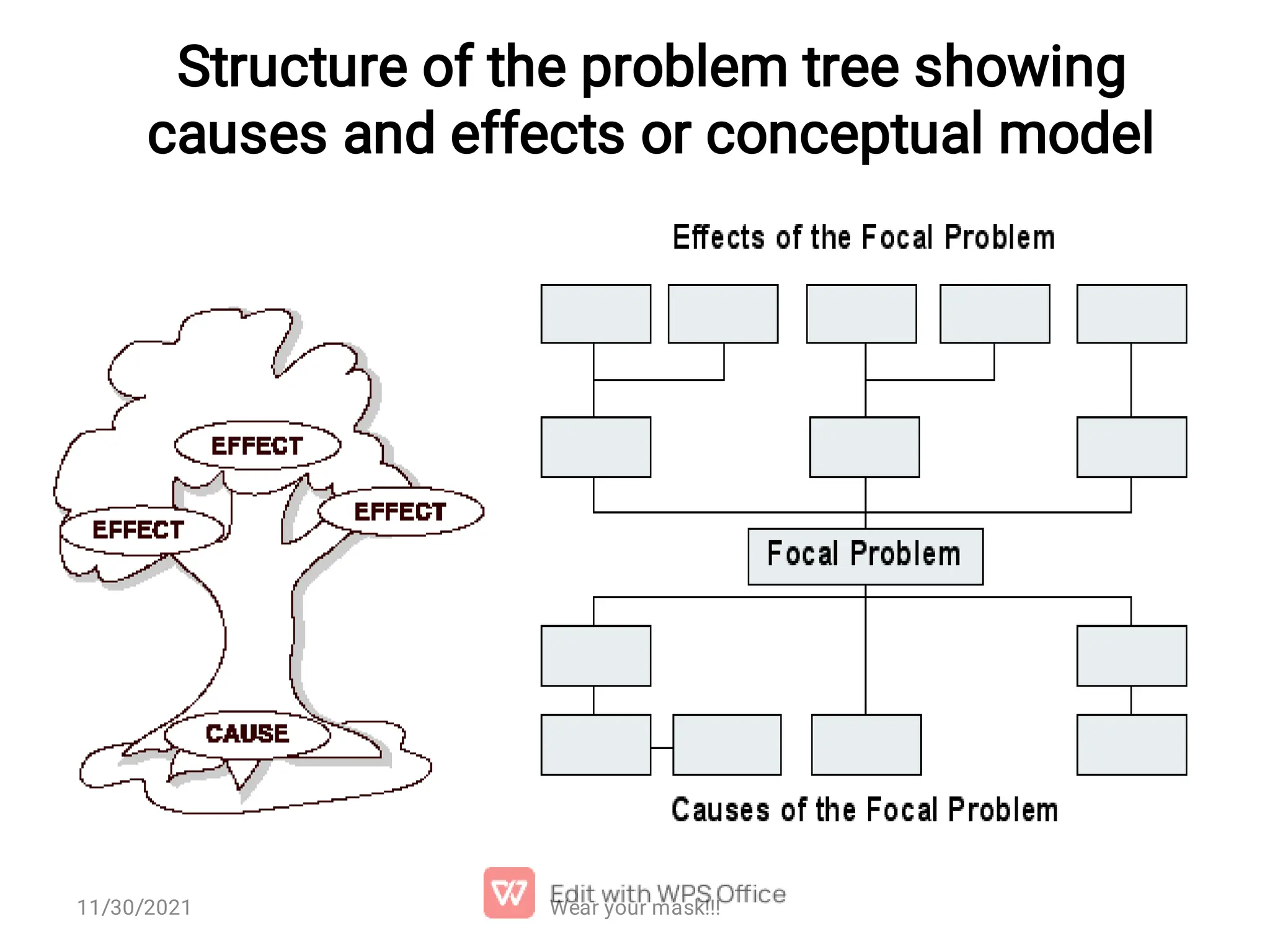
Structure of the problem tree showing causes and effects or conceptual model Wear your mask!!! 11/30/2021
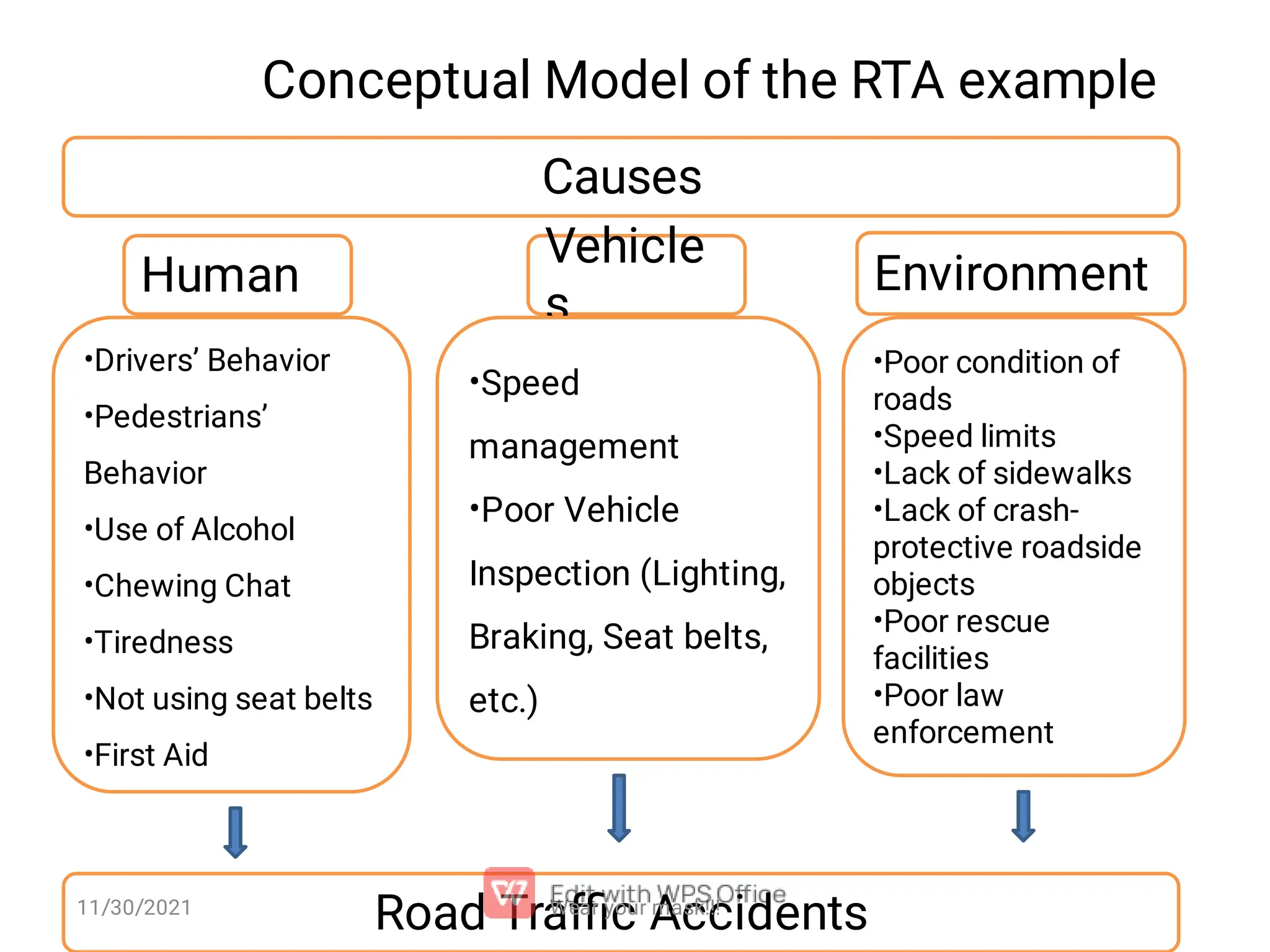
Causes Human Vehicle s Environment • • Speed management Poor Vehicle Inspection (Lighting, Braking, Seat belts, etc.) • • • • • • • Drivers’ Behavior Pedestrians’ Behavior Use of Alcohol Chewing Chat Tiredness Not using seat belts First Aid • • • • • • Poor condition of roads Speed limits Lack of sidewalks Lack of crash- protective roadside objects Poor rescue facilities Poor law enforcement Road Traffic Accidents Conceptual Model of the RTA example Wear your mask!!! 11/30/2021
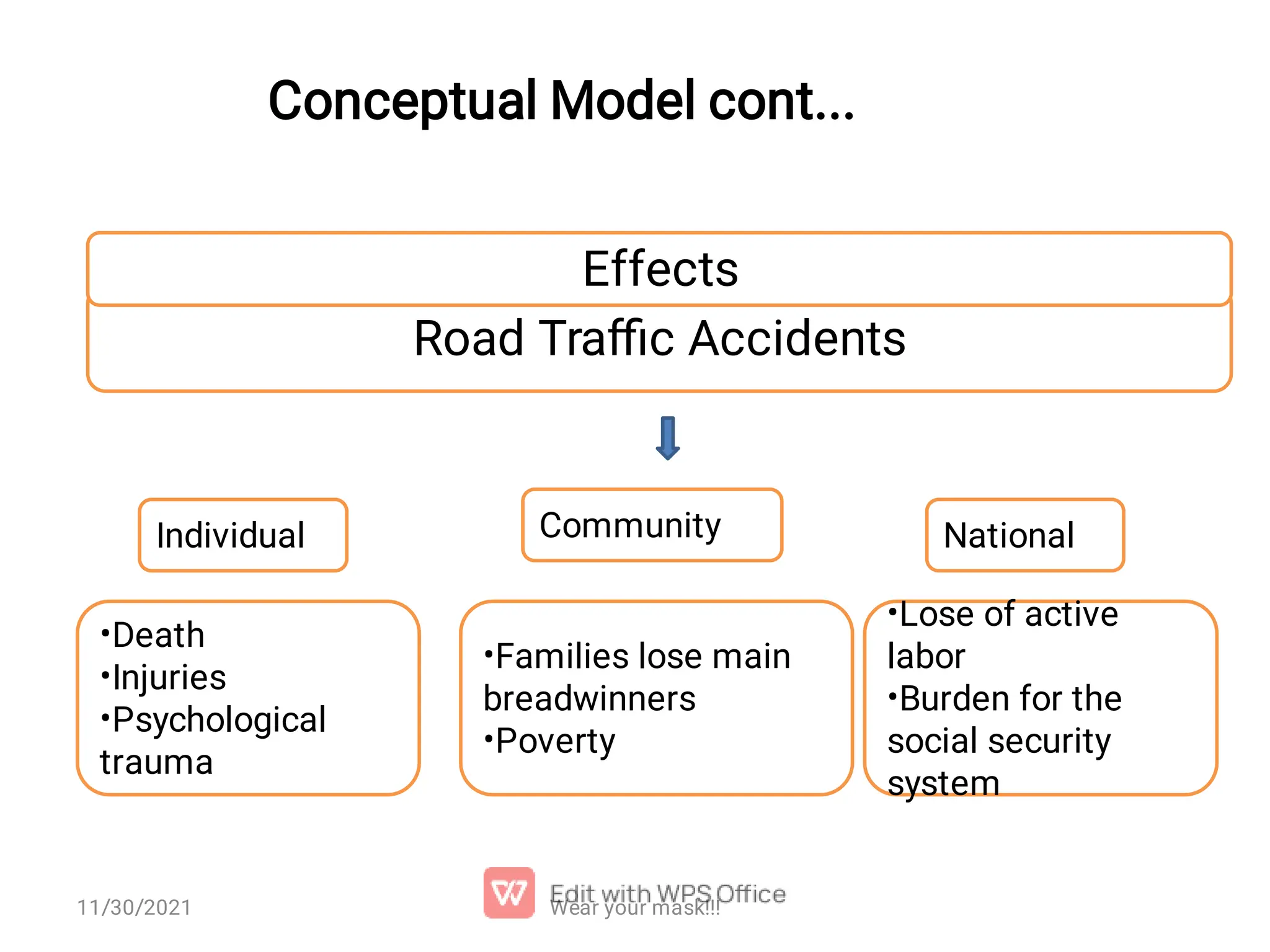
• • • Death Injuries Psychological trauma Road Traffic Accidents Individual Community National • • Families lose main breadwinners Poverty • • Lose of active labor Burden for the social security system Effects Conceptual Model cont... Wear your mask!!! 11/30/2021
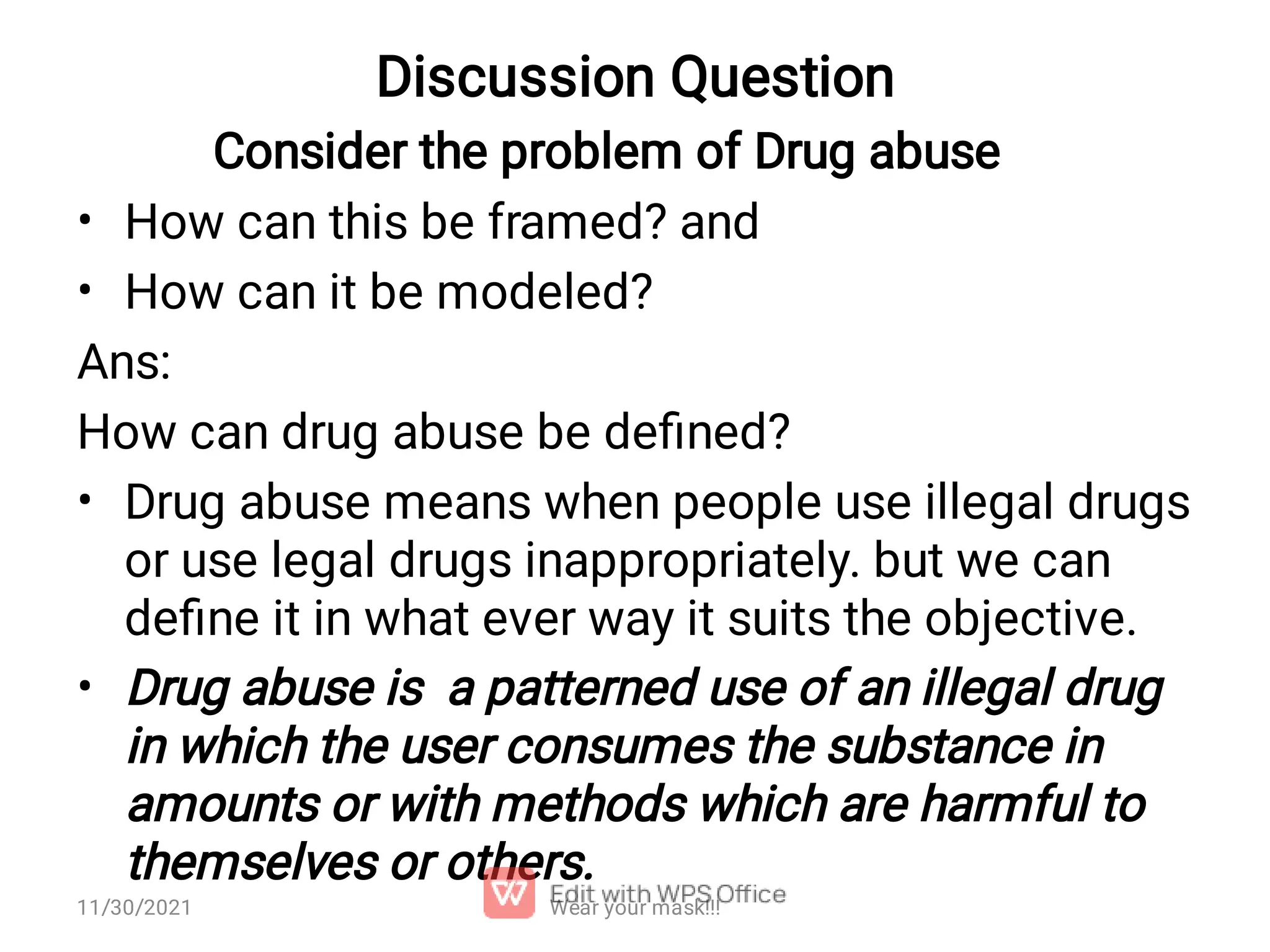
Discussion Question • • • • Consider the problem of Drug abuse How can this be framed? and How can it be modeled? Ans: How can drug abuse be defined? Drug abuse means when people use illegal drugs or use legal drugs inappropriately. but we can define it in what ever way it suits the objective. Drug abuse is a patterned use of an illegal drug in which the user consumes the substance in amounts or with methods which are harmful to themselves or others. Wear your mask!!! 11/30/2021
Cont… •      The symptoms of the problem can be assessed by collecting information about: The number of people using illegal drugs The number and frequency of crimes committed by addicts The estimated amount of health care costs incurred due to use of drugs The estimated amount of revenue forgone due to lost productivity as a result of drug use The number of separated families/affected children due to use of drugs by parents Wear your mask!!! 11/30/2021
Cont… • • • For example, the USA losses about 700 million dollar per year in increased healthcare costs, crime and lost productivity as a result of drug abuse. This shows that drug abuse is nowadays a serious problem in many countries especially the developed ones. How the problem can be framed? The problem of drug abuse can be framed as a negative externality problem (a form of market failure). Why? Because it affects families, individuals/citizens and the whole public/state who are not involved in the consumption or production of illegal drugs through crimes, neglects and costs. Wear your mask!!! 11/30/2021
Conceptual model Crime by addicts Spread of disease Family separation / children abuse Crime in the distributio n Drug Abuse Peer pressure Seems pleasurable Escape from reality Availability in the distribution system Health effects/ costs Lost productivity Cause s effect s Wear your mask!!! 11/30/2021
• – – • Before the problem analysis step arrives at its final stage: the analyst makes a list of the goals/criteria that he/she wants to achieve by means of the policies that he/she will recommend to his/her client explains briefly what each goal means, preferably in a brief and plain style. This is the most difficult step, because goals, especially in ill-structured public problems, are characterized by their multiplicity, conflict and 2. Choosing and explaining relevant policy goals and constraints Wear your mask!!! 11/30/2021
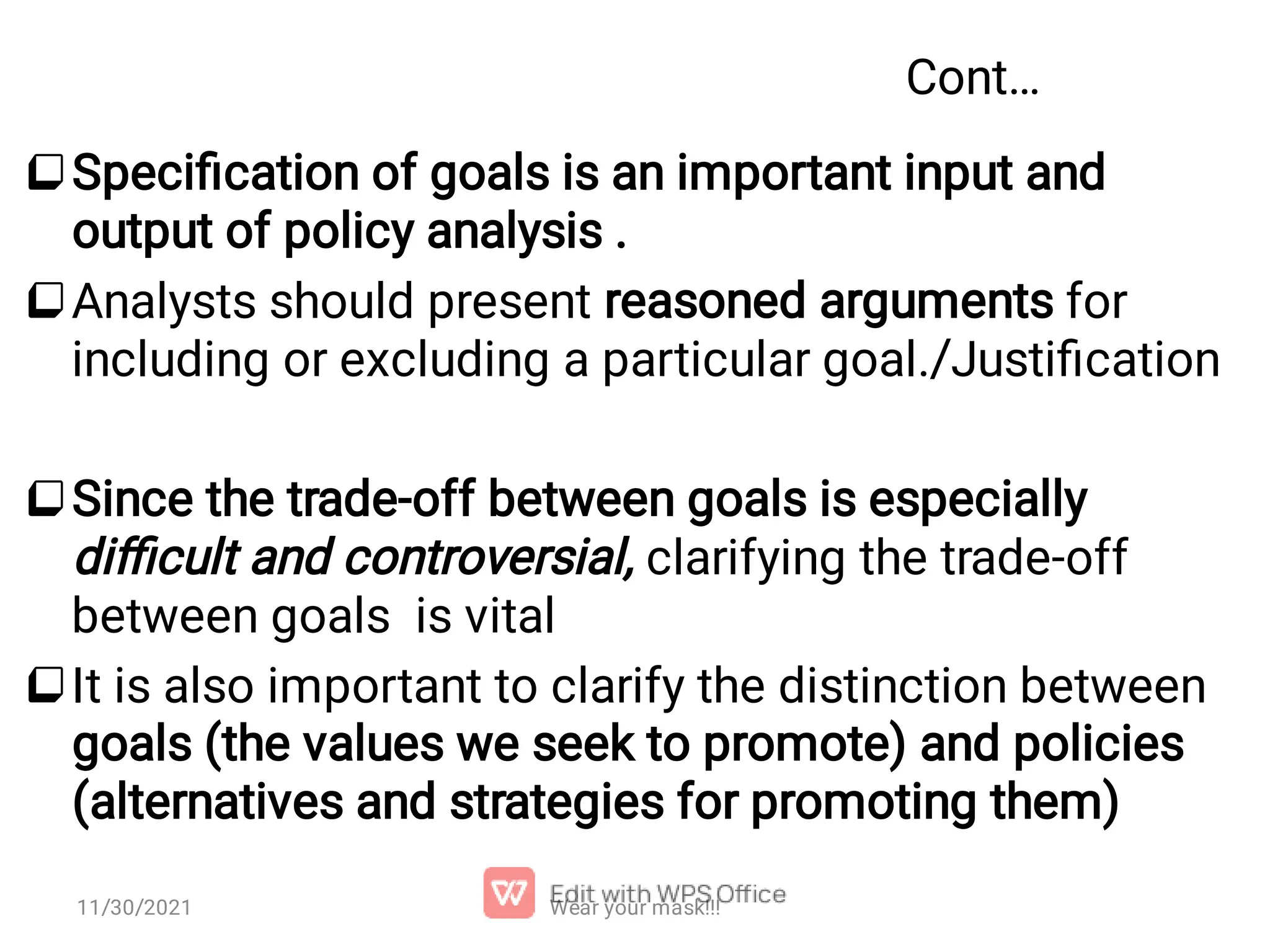
Cont…     Specification of goals is an important input and output of policy analysis . Analysts should present reasoned arguments for including or excluding a particular goal./Justification Since the trade-off between goals is especially difficult and controversial, clarifying the trade-off between goals is vital It is also important to clarify the distinction between goals (the values we seek to promote) and policies (alternatives and strategies for promoting them) Wear your mask!!! 11/30/2021
Cont…    • Goals can be classified in to two: substantive and instrumental goals. Substantive goals represent values such as efficiency and equity that society wishes to secure for their own sake. Instrumental goals are conditions that increase the prospects for achieving substantive goals. Commonly known instrumental goals are political feasibility, resource constraints (as policy analysis is the art of the possible), administrative and technical feasibility. Wear your mask!!! 11/30/2021
Cont… • Instrumental goals often enter the solution analysis as constraints rather than goals. Thus, we call them constraints. Wear your mask!!! 11/30/2021
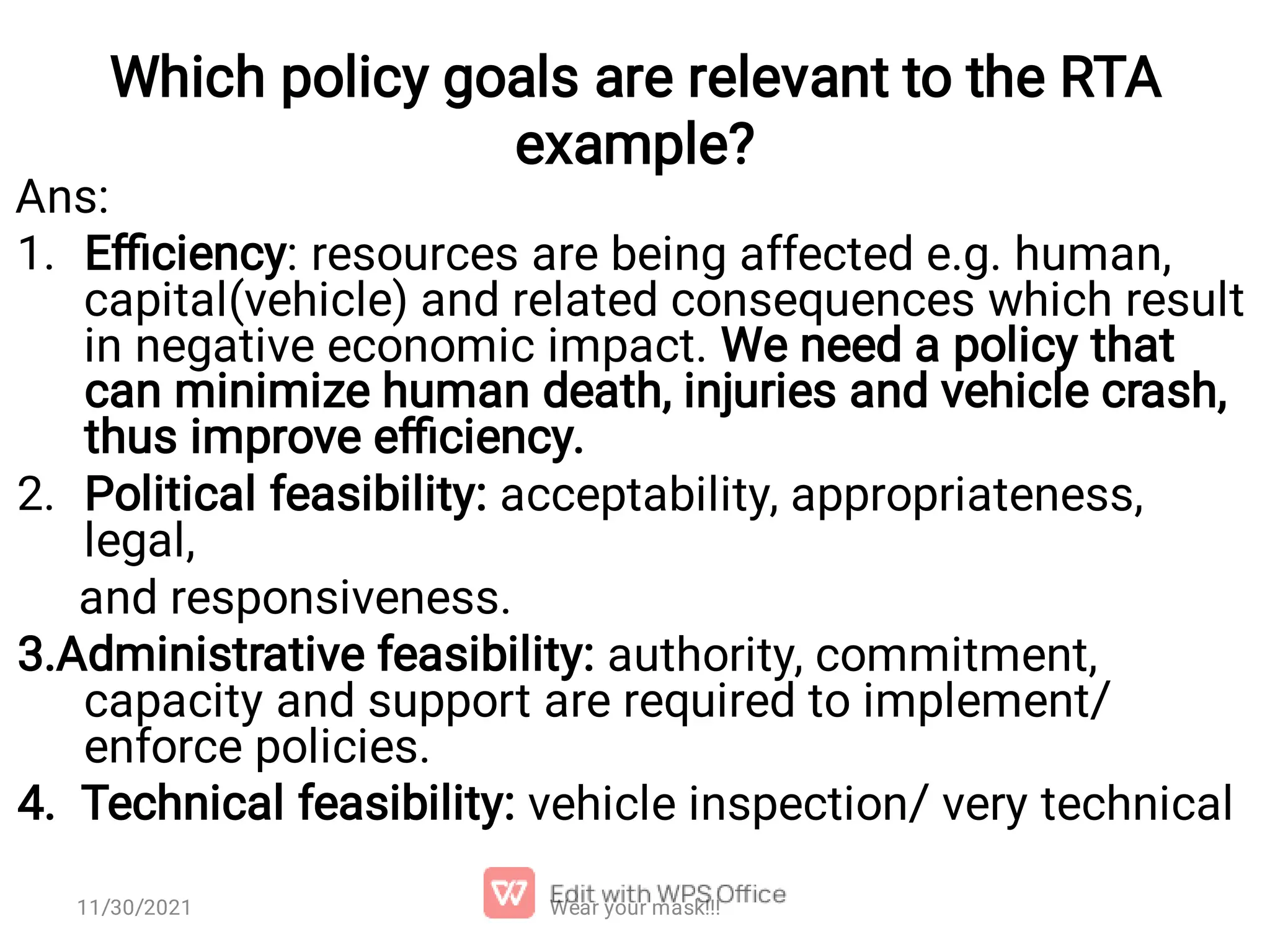
Which policy goals are relevant to the RTA example? 1. 2. Ans: Efficiency: resources are being affected e.g. human, capital(vehicle) and related consequences which result in negative economic impact. We need a policy that can minimize human death, injuries and vehicle crash, thus improve efficiency. Political feasibility: acceptability, appropriateness, legal, and responsiveness. 3.Administrative feasibility: authority, commitment, capacity and support are required to implement/ enforce policies. 4. Technical feasibility: vehicle inspection/ very technical Wear your mask!!! 11/30/2021
Group exercise • Identify the appropriate policy goals in the Drug abuse example. Wear your mask!!! 11/30/2021
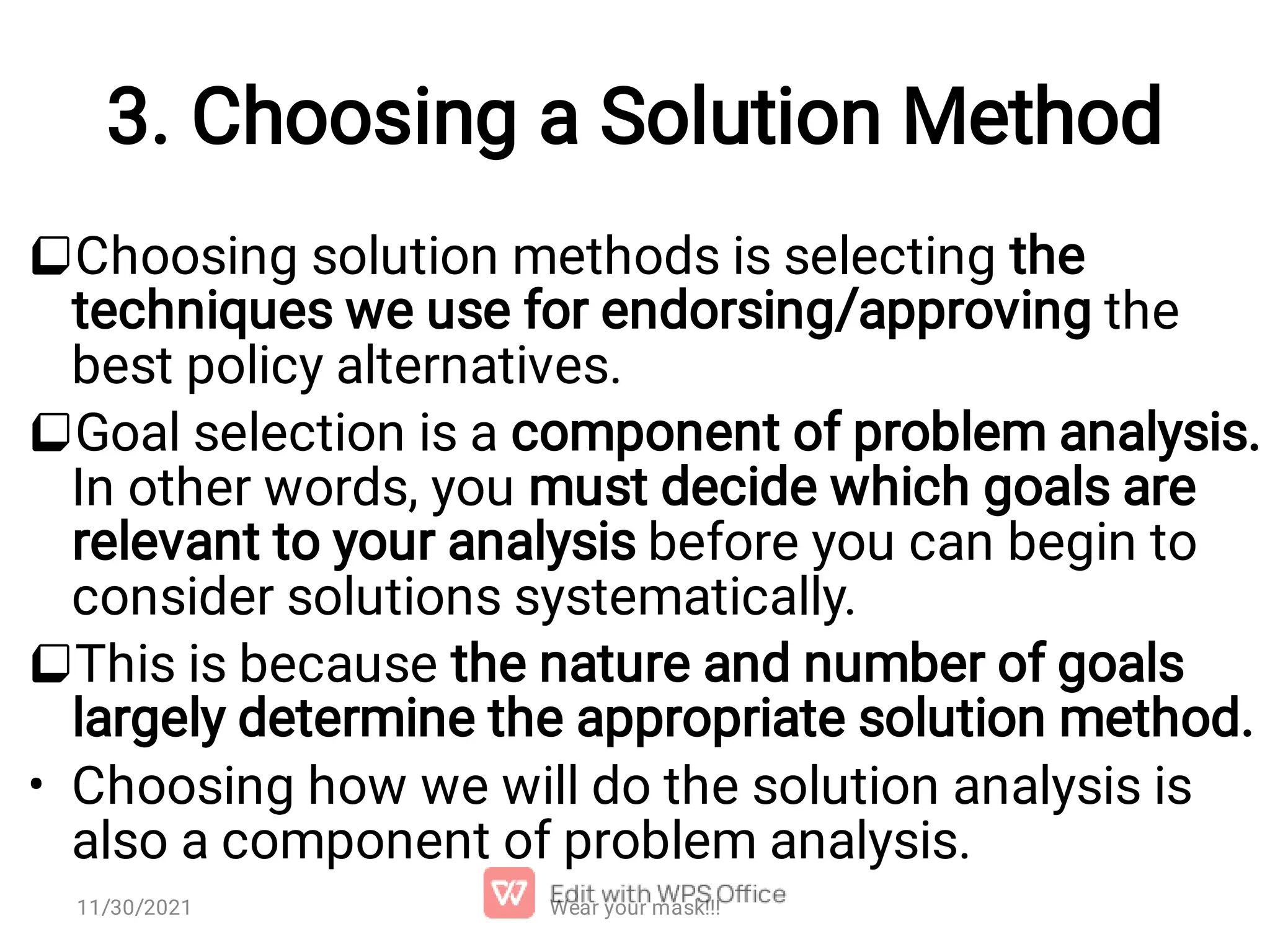
3. Choosing a Solution Method    • Choosing solution methods is selecting the techniques we use for endorsing/approving the best policy alternatives. Goal selection is a component of problem analysis. In other words, you must decide which goals are relevant to your analysis before you can begin to consider solutions systematically. This is because the nature and number of goals largely determine the appropriate solution method. Choosing how we will do the solution analysis is also a component of problem analysis. Wear your mask!!! 11/30/2021
Wear your mask!!! 11/30/2021
  Figure below distinguishes three general goal circumstances: 1. Efficiency is the only relevant goal 2. Efficiency and one other goal are relevant can efficiency and other goal be quantified? A. if yes, other question: can the other goal be monetized? I. if yes, use modified cost benefit analysis as a solution method. II. if no, use cost effectiveness analysis as a solution method. B. If no, use multi-goal analysis as a solution method 3. Efficiency and two or more goals are relevant in this case the multi-goal analysis should be used as a solution method. Wear your mask!!! 11/30/2021
Cost-Benefit Analysis •  •    An analytical framework used to assess the benefits and costs of policy proposals Formal cost-benefit analysis should be your primary solution method when you believe that efficiency is the only relevant goal. Focuses on economic efficiency It reduces all the impacts of a proposed alternative to a common unit of impact, namely dollars/birrs. Calculates the net benefits for each policy proposal Takes a long-term view and incorporates all relevant costs and benefits Wear your mask!!! 11/30/2021
Cont’d……….   Once all the impacts have been reduced to dollars/birrs, the evaluation rule is to choose that alternative that generates the largest aggregate net benefits. Thus, in cost-benefit analysis, although there are different goals, they can be reduced to positive efficiency impacts (benefits) or negative efficiency impacts (costs), which, in turn, can all be measured in dollars/birrs, or monetized. Wear your mask!!! 11/30/2021
Cont’d…………..     Sometimes prices revealed in markets provide a basis for monetization. However, market prices often do not reflect marginal social costs or marginal social benefits because of the distortions caused by market failures and government interventions. There are also many classes of impacts, such as willingness of people, that usually cannot be monetized through estimations based on direct observation of markets. Considerable skills and judgment must be exercised to assess the costs and benefits of these impacts reasonably. Wear your mask!!! 11/30/2021
• •   Qualitative Cost-Benefit Analysis Even when we decide that efficiency is the only relevant goal, we must still determine whether all efficiency impacts can be reasonably monetized. If not, the qualitative cost-benefit is the appropriate solution method. Like standard cost-benefit analysis, it begins with a prediction of impacts. Some of the impacts may be expressed in natural units (example, hours of delay or tons of pollutants), while others may be qualitative (example, a despoiled scenic view). Wear your mask!!! 11/30/2021
•  • • • If we are unable to monetize one or more of these impacts, then we cannot directly calculate the dollar/birr value of net benefits. Instead, we must make qualitative arguments about the orders of magnitude of the various non- monetized impacts. Sometimes impacts cannot be monetized because of technical difficulties in making valuations. When standard procedures do exist for inferring such values, limitations of time, data, and other resources frequently make monetization impractical. Rather than attempt difficult and time-consuming valuations, even highly skilled professionals resort to qualitative cost-benefit analyses to assess orders of magnitude of efficiency impacts. Wear your mask!!! 11/30/2021
• • • • • Ex-post quantitative cost-benefit analyses are available in many policy areas. Elements from these studies can often be used as a source for ex-ante quantitative estimates of costs or benefits, or at least as a guide for estimating their orders of magnitude. When you begin working in a new policy area, spending some time to become familiar with relevant cost-benefit analyses is likely to be a good investment. If the analyst cannot confidently monetize important efficiency impacts to within even orders of magnitude, then he may find it useful to work with the non- monetized impacts as if they were separate goals. For example, analysts may have to decide how to compare certain program costs with highly uncertain benefits, such as environmental or catastrophic failure risks. Thus, the qualitative cost-benefit analysis takes the form of multi-goal analysis. Wear your mask!!! 11/30/2021
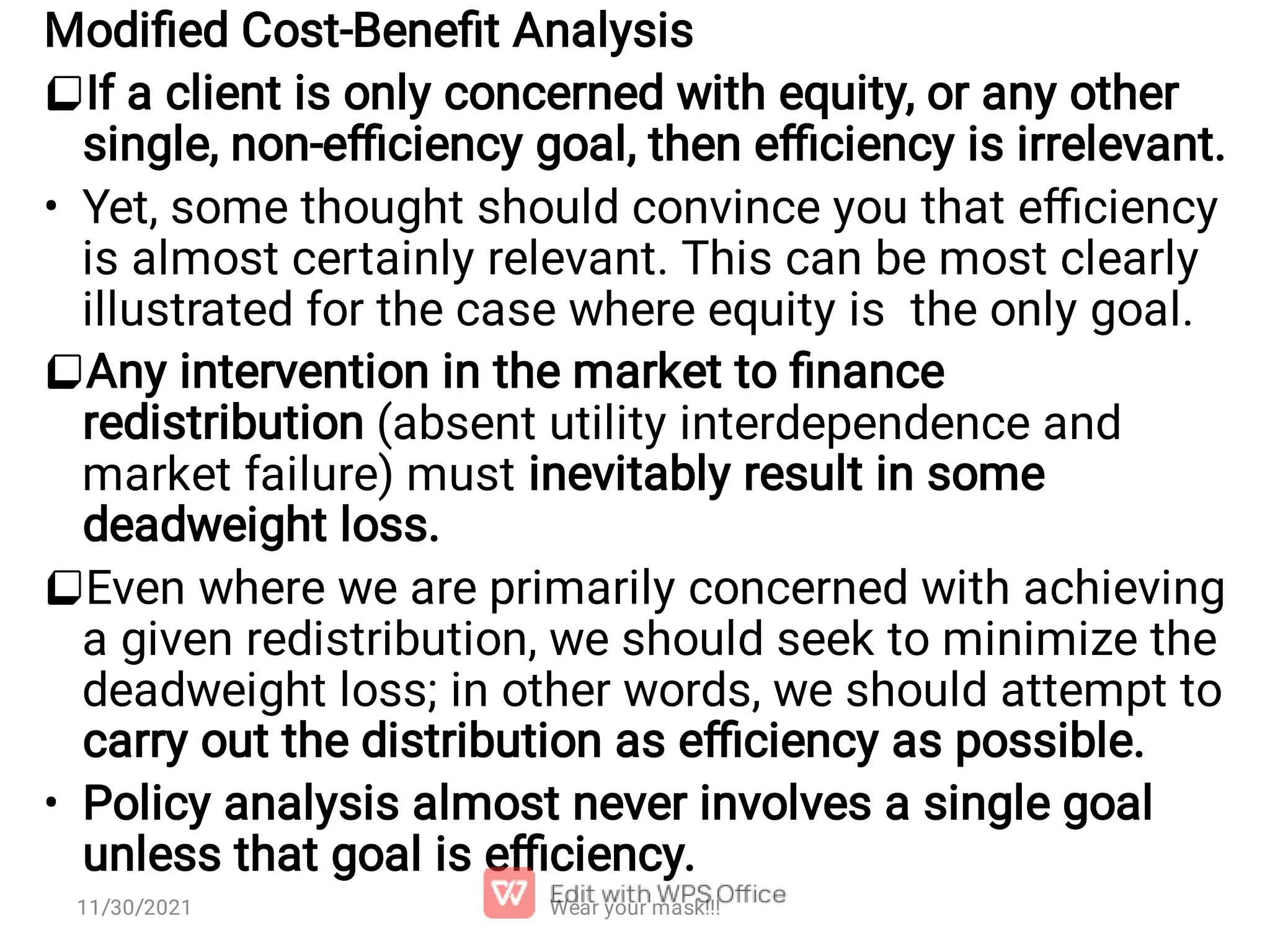
 •   • Modified Cost-Benefit Analysis If a client is only concerned with equity, or any other single, non-efficiency goal, then efficiency is irrelevant. Yet, some thought should convince you that efficiency is almost certainly relevant. This can be most clearly illustrated for the case where equity is the only goal. Any intervention in the market to finance redistribution (absent utility interdependence and market failure) must inevitably result in some deadweight loss. Even where we are primarily concerned with achieving a given redistribution, we should seek to minimize the deadweight loss; in other words, we should attempt to carry out the distribution as efficiency as possible. Policy analysis almost never involves a single goal unless that goal is efficiency. Wear your mask!!! 11/30/2021
•   •  In a particular analysis you may conclude that efficiency and one other goal (most frequently, equity) are appropriate. We can employ modified cost-benefit analysis if we are able and willing to monetize impacts on both efficiency and the other goal. You must be willing to assign dollar/ birr values to various levels of achievement of the other goal. For example, if the other goal is equality of the income distribution, modified cost-benefit analysis weighing costs and benefits accruing to different income groups, resulting distributional weighted cost-benefit analysis. The advantage of such approach is that by incorporating distributional issues into a cost-benefit analysis, we can come up with a single metric for ranking alternatives. The disadvantage is that the metric is achieved only by forcing efficiency and equity to be measurable by the same standards. Wear your mask!!! 11/30/2021
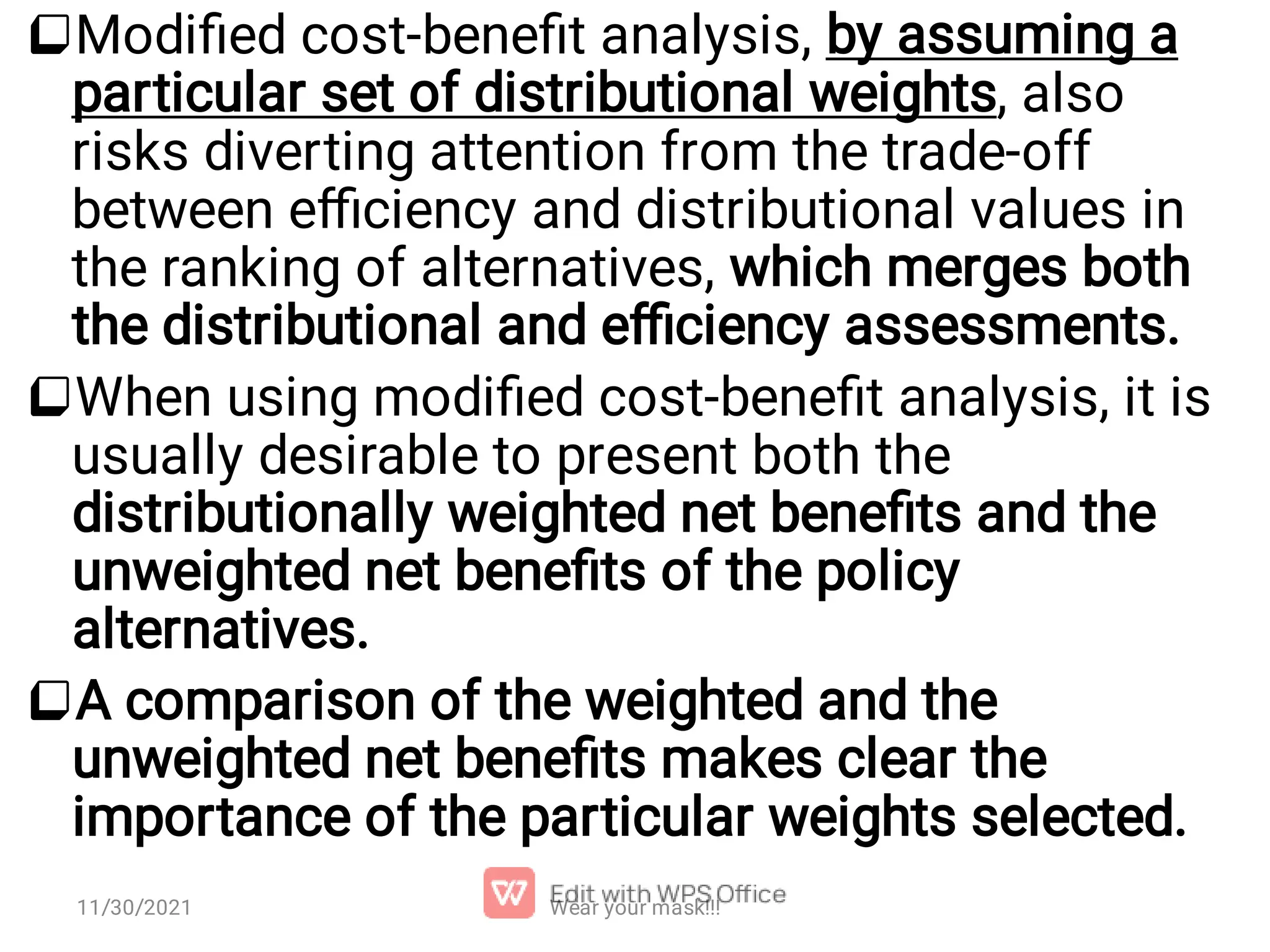
   Modified cost-benefit analysis, by assuming a particular set of distributional weights, also risks diverting attention from the trade-off between efficiency and distributional values in the ranking of alternatives, which merges both the distributional and efficiency assessments. When using modified cost-benefit analysis, it is usually desirable to present both the distributionally weighted net benefits and the unweighted net benefits of the policy alternatives. A comparison of the weighted and the unweighted net benefits makes clear the importance of the particular weights selected. Wear your mask!!! 11/30/2021
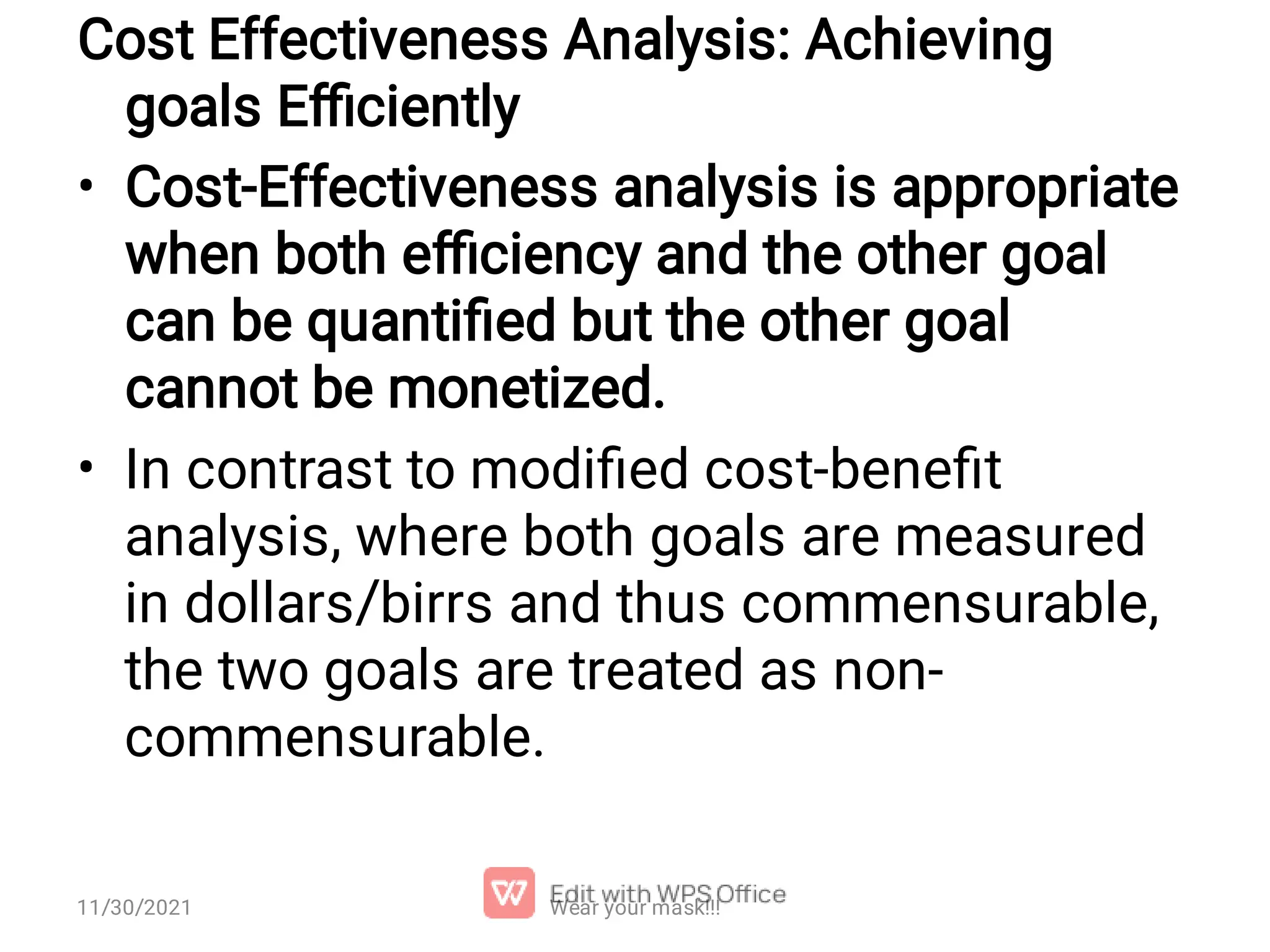
• • Cost Effectiveness Analysis: Achieving goals Efficiently Cost-Effectiveness analysis is appropriate when both efficiency and the other goal can be quantified but the other goal cannot be monetized. In contrast to modified cost-benefit analysis, where both goals are measured in dollars/birrs and thus commensurable, the two goals are treated as non- commensurable. Wear your mask!!! 11/30/2021
If cost – benefit analysis is not applicable, 1) 2) 3) Cost effectiveness analysis Cost minimization analysis: Cost utility analysis 11/30/2021 Wear your mask!!!
a. Cost effectiveness analysis: • 11/30/2021 Wear your mask!!!
b. Cost minimization analysis: • 11/30/2021 Wear your mask!!!
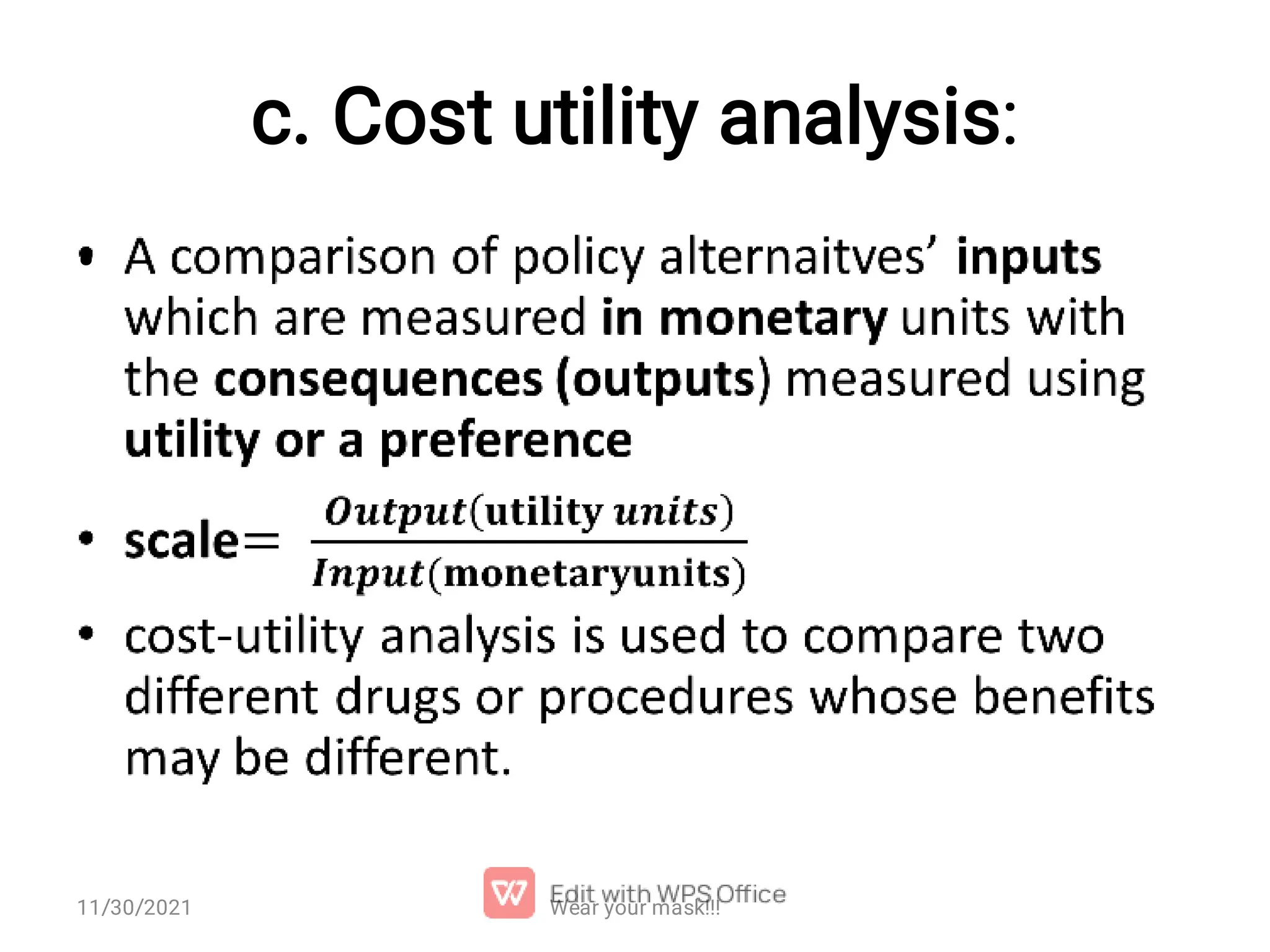
c. Cost utility analysis: • 11/30/2021 Wear your mask!!!
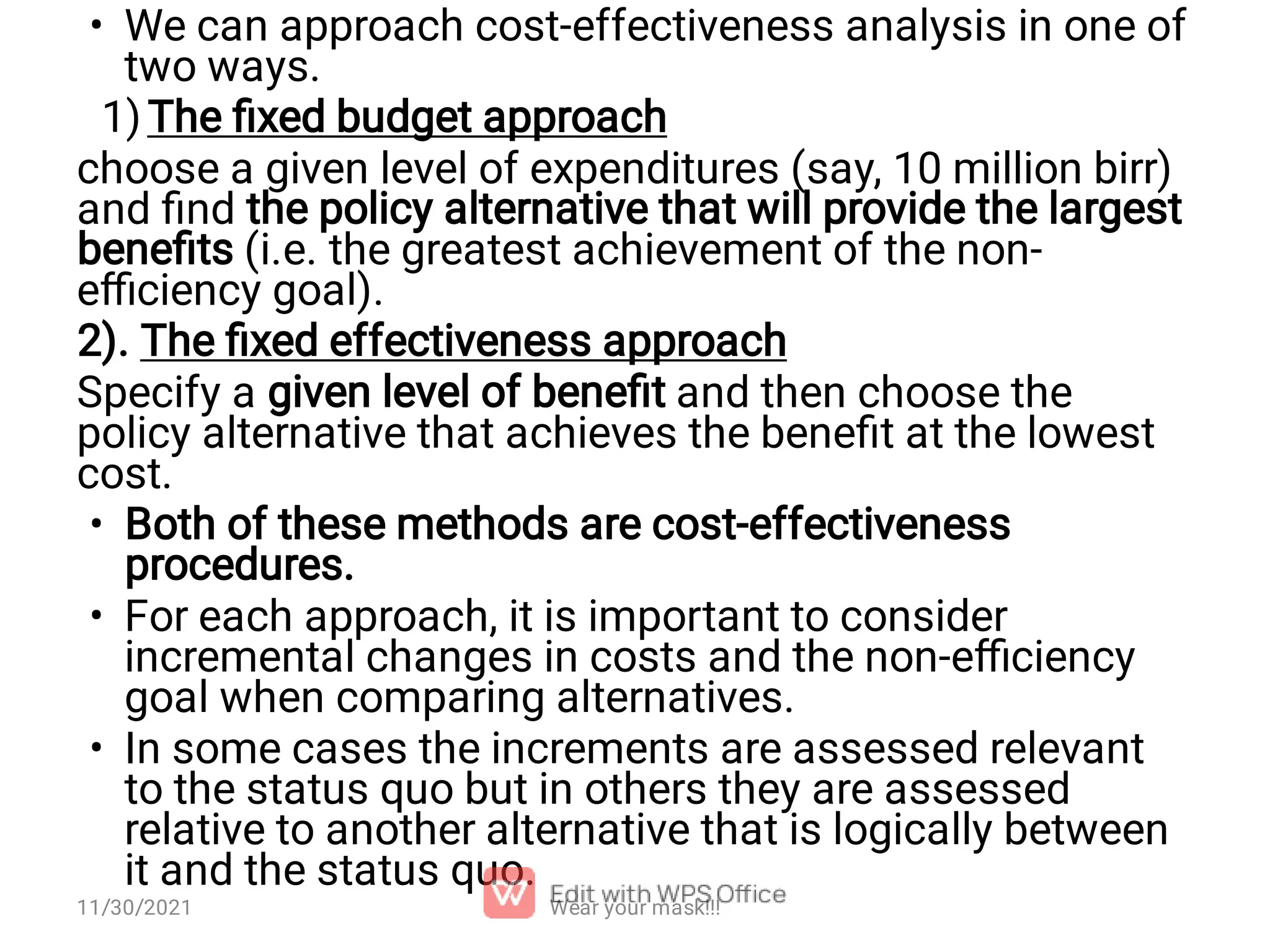
• 1) • • • We can approach cost-effectiveness analysis in one of two ways. The fixed budget approach choose a given level of expenditures (say, 10 million birr) and find the policy alternative that will provide the largest benefits (i.e. the greatest achievement of the non- efficiency goal). 2). The fixed effectiveness approach Specify a given level of benefit and then choose the policy alternative that achieves the benefit at the lowest cost. Both of these methods are cost-effectiveness procedures. For each approach, it is important to consider incremental changes in costs and the non-efficiency goal when comparing alternatives. In some cases the increments are assessed relevant to the status quo but in others they are assessed relative to another alternative that is logically between it and the status quo. Wear your mask!!! 11/30/2021
• • • The crucial distinction between cost-benefit analysis and cost-effectiveness analysis is that: Cost benefit analysis can assess both whether any of the alternatives are worth doing (i.e. whether social benefits exceed social costs) and how alternatives should be ranked if more than one generates positive net social benefits. Cost-effectiveness cannot tell the analyst whether a given alternative is worth doing (this requires a cost-benefit analysis), but if a decision is made to redistribute or achieve some other goal, it can help in deciding which policy alternative will do so most efficiently (with minimum losses of social surplus). Wear your mask!!! 11/30/2021
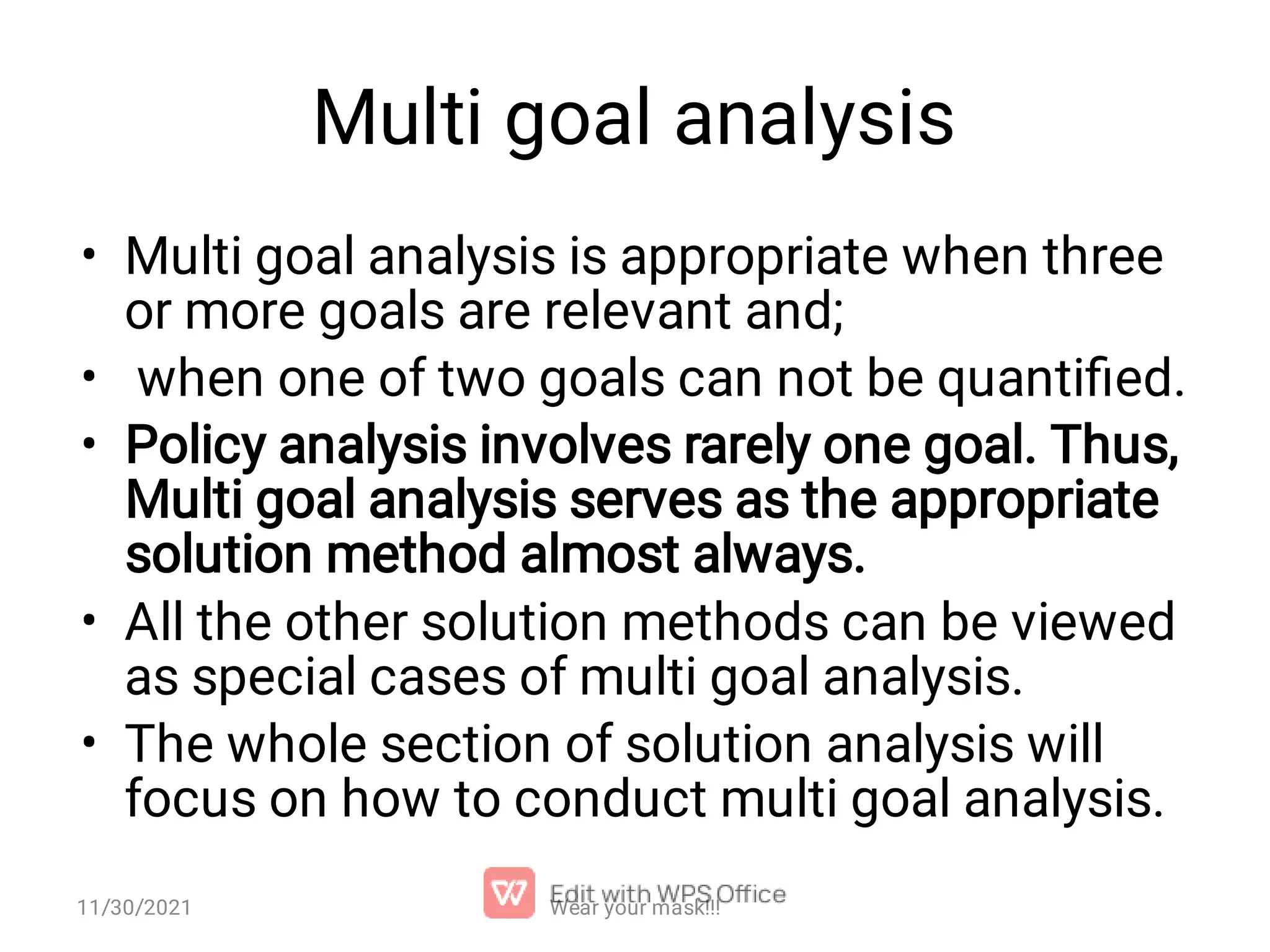
Multi goal analysis • • • • • Multi goal analysis is appropriate when three or more goals are relevant and; when one of two goals can not be quantified. Policy analysis involves rarely one goal. Thus, Multi goal analysis serves as the appropriate solution method almost always. All the other solution methods can be viewed as special cases of multi goal analysis. The whole section of solution analysis will focus on how to conduct multi goal analysis. Wear your mask!!! 11/30/2021
Cost Benefit Analysis • • • • • • Cost Benefit Analysis (CBA) Basic Steps in a CBA Net Present Value Benefit Cost Ratio Internal Rate of Return Pay Back Wear your mask!!! 11/30/2021
Cost-Benefit Analysis • • • • Cost Benefit Analysis (CBA) is helpful in answering the following questions: Is the policy worthwhile financially? Is it the best option? Should it be undertaken at all? Wear your mask!!! 11/30/2021
1. 2. 3. a) b) c) d) Basic Steps in a CBA Identify all Costs & Benefits Discounting Assess policy(ies) by calculating Net Present Value (NPV) Benefit Cost Ratio (BCR) Internal Rate of Return (IRR) Payback Wear your mask!!! 11/30/2021
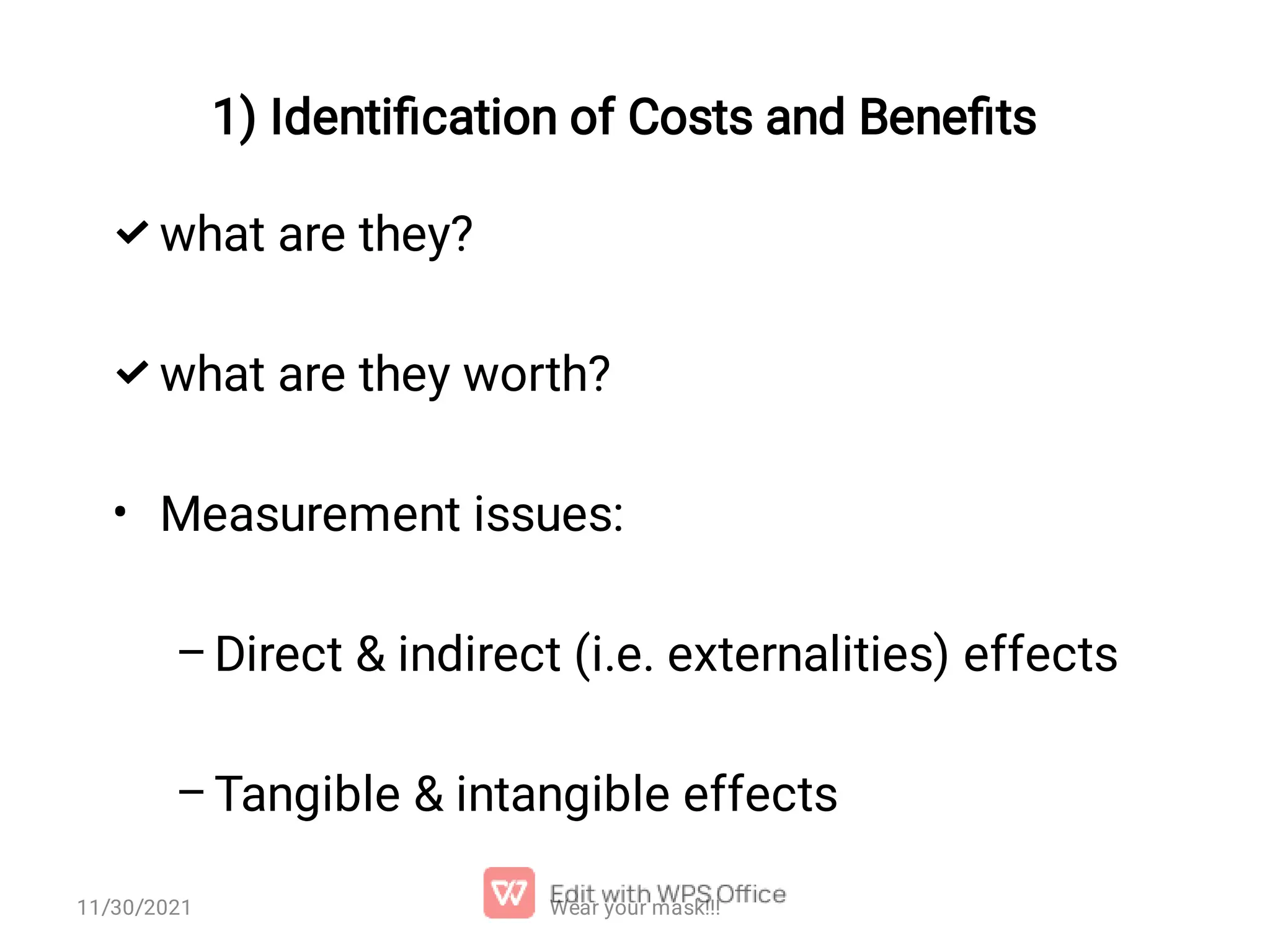
  • – – what are they? what are they worth? Measurement issues: Direct & indirect (i.e. externalities) effects Tangible & intangible effects 1) Identification of Costs and Benefits Wear your mask!!! 11/30/2021
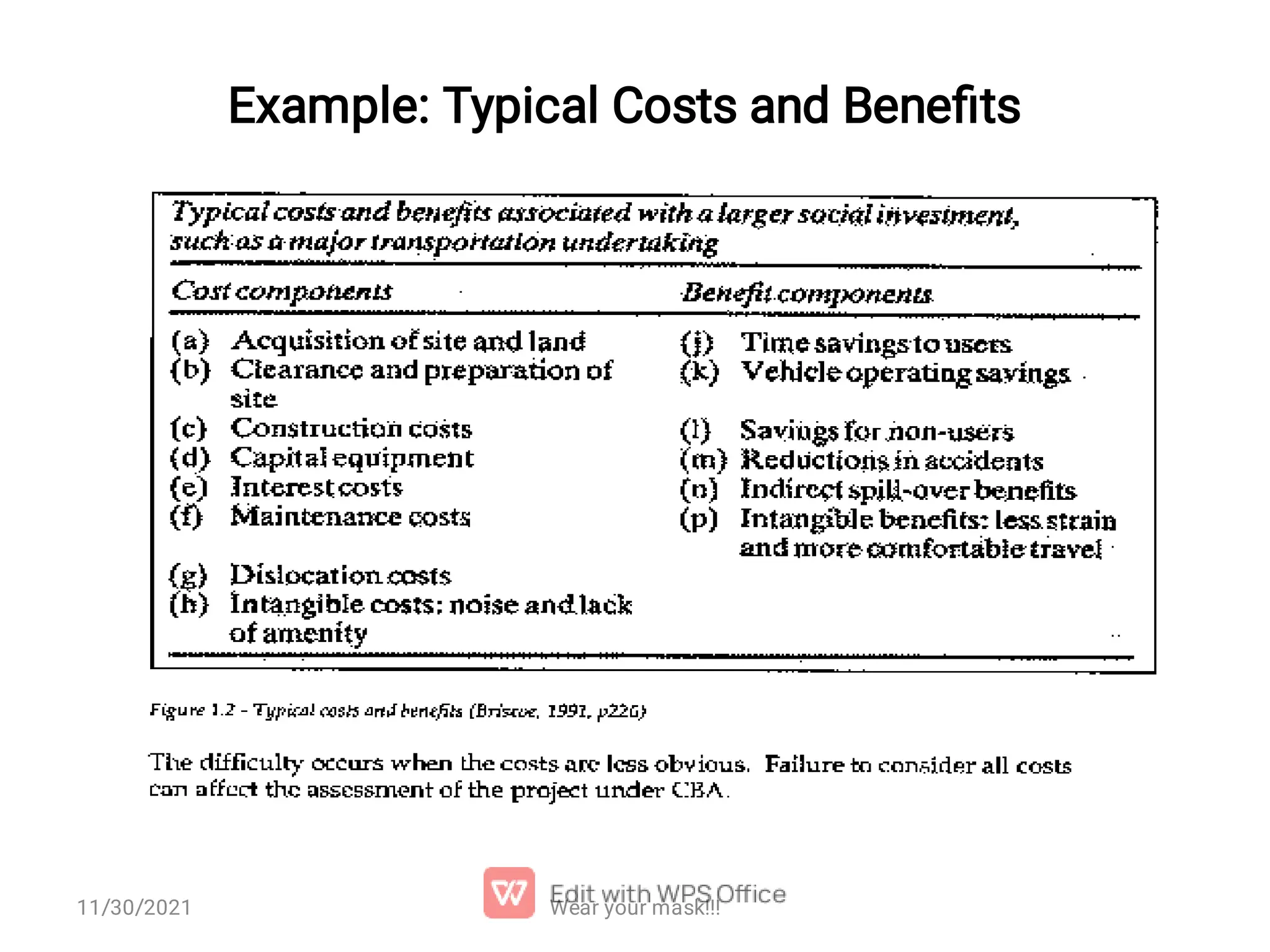
Example: Typical Costs and Benefits Wear your mask!!! 11/30/2021
2) Discounting • • • – • Policies & projects last a long time Frequently costs & benefits occur at different times Money has a time value, i.e. ceteris paribus current Dollars are more valuable than future Dollars Thus, we need to place current & future costs & benefits on an equal basis for comparison Wear your mask!!! 11/30/2021
Cont… • • This is done by “discounting,” that is by reducing future Birr value to present value by applying a discount rate The discount rate is an interest rate a national bank charges depository institutions Wear your mask!!! 11/30/2021
Discount Rate vs. Interest Rate • • Discount Rate means the minimum rate of return to be paid by recipient of financing facilities from central bank (Central bank for commercial banks) Whereas Interest Rate means a rate which is charged or paid for the use of money. (Commercial banks for its customers) Wear your mask!!! 11/30/2021
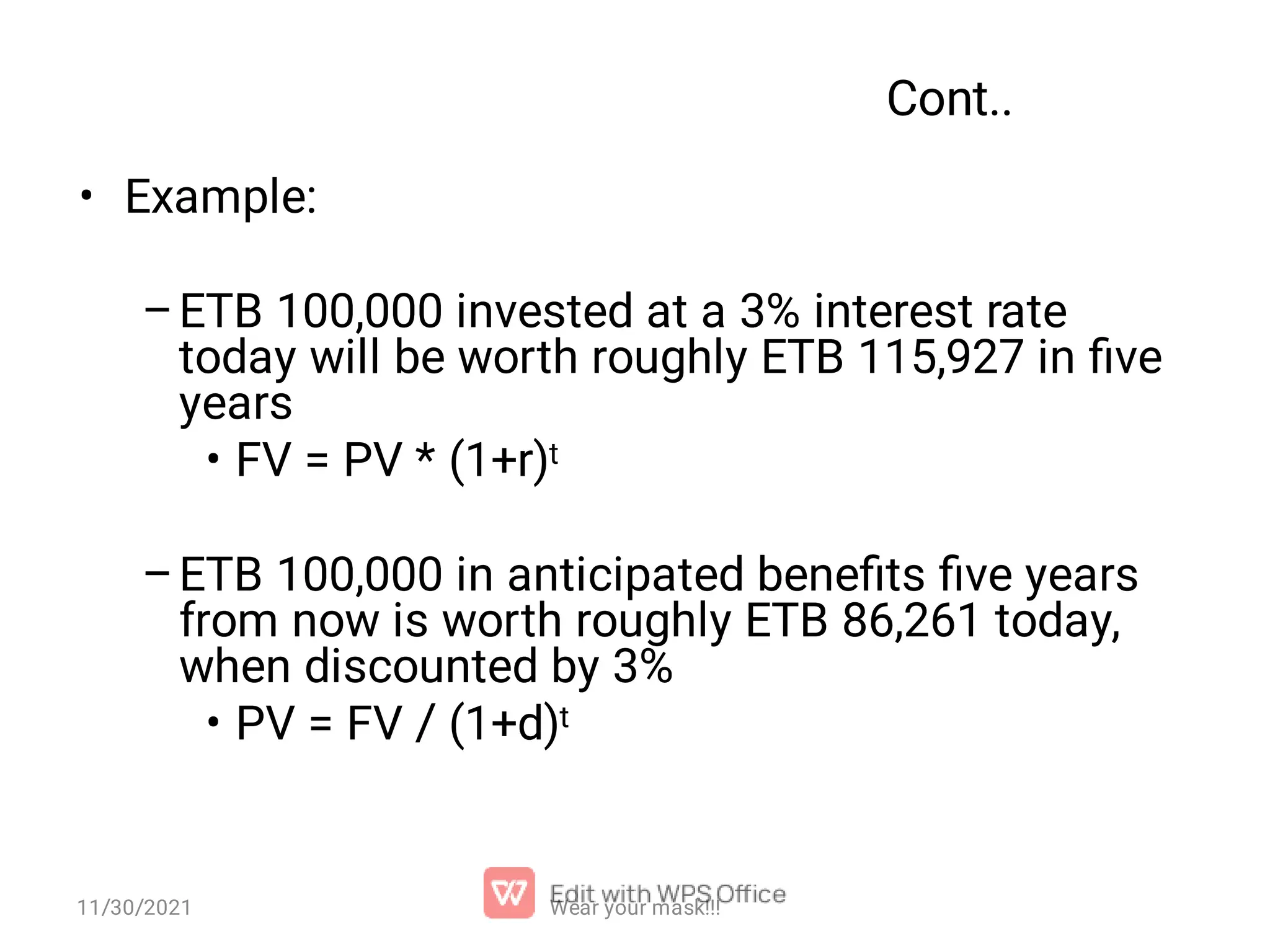
Cont.. • – • – • Example: ETB 100,000 invested at a 3% interest rate today will be worth roughly ETB 115,927 in five years FV = PV * (1+r)t ETB 100,000 in anticipated benefits five years from now is worth roughly ETB 86,261 today, when discounted by 3% PV = FV / (1+d)t Wear your mask!!! 11/30/2021
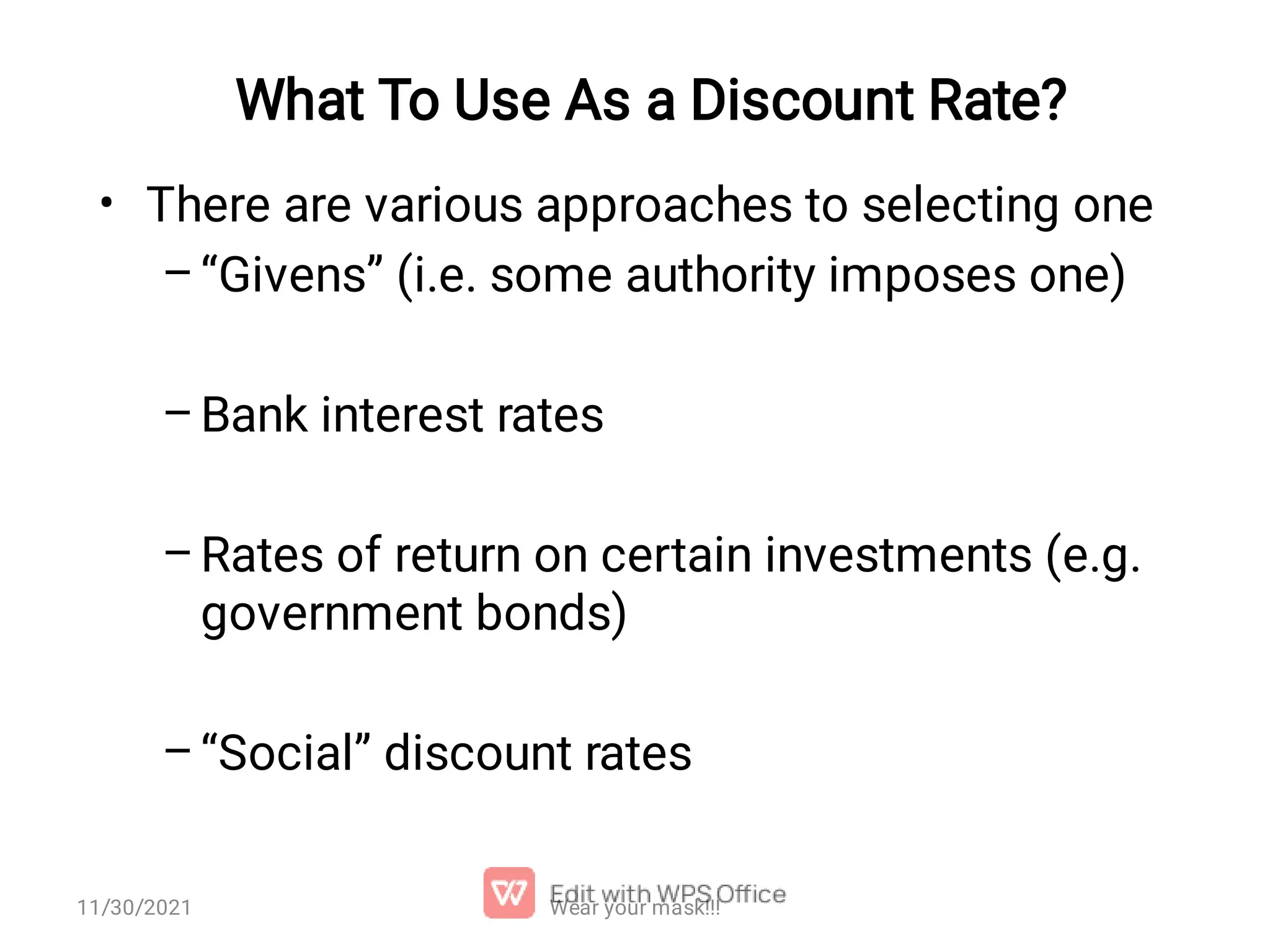
What To Use As a Discount Rate? • – – – – There are various approaches to selecting one “Givens” (i.e. some authority imposes one) Bank interest rates Rates of return on certain investments (e.g. government bonds) “Social” discount rates Wear your mask!!! 11/30/2021
3) Assessing policies a) b) Policies or projects can be assessed by calculating Net Present Value (NPV) Benefit Cost Ratio (BCR) c) Internal Rate of Return (IRR) d) Payback Wear your mask!!! 11/30/2021
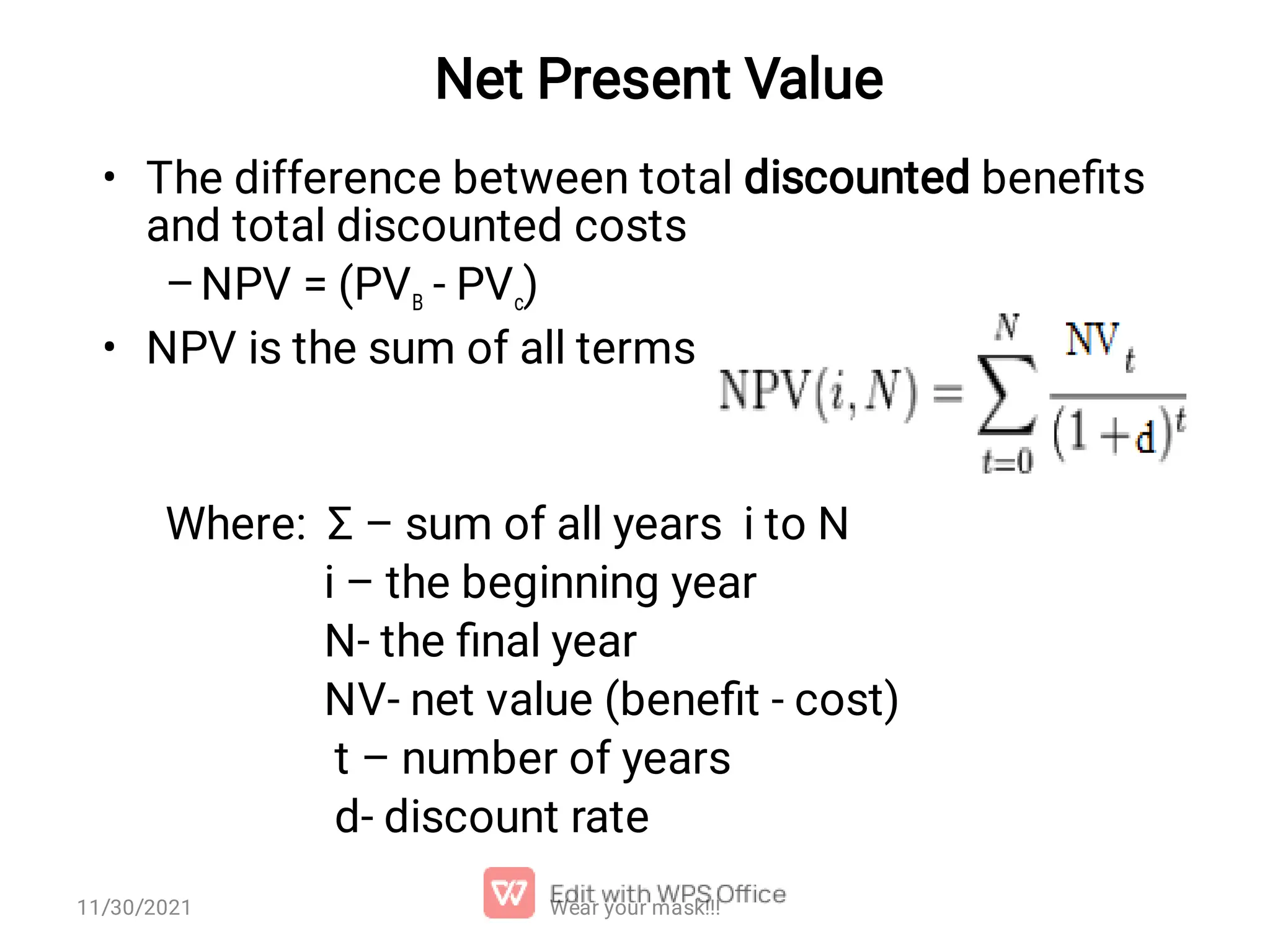
Net Present Value • – • The difference between total discounted benefits and total discounted costs NPV = (PVB ‑ PVc) NPV is the sum of all terms Where: Σ – sum of all years i to N i – the beginning year N- the final year NV- net value (benefit - cost) t – number of years d- discount rate Wear your mask!!! 11/30/2021
Cont.. – • – • NPV: decision criteria For a single policy/project: a positive NPV indicates acceptability For multiple (competing) policies/projects: the project(s) with the highest NPVs should receive highest priority Wear your mask!!! 11/30/2021
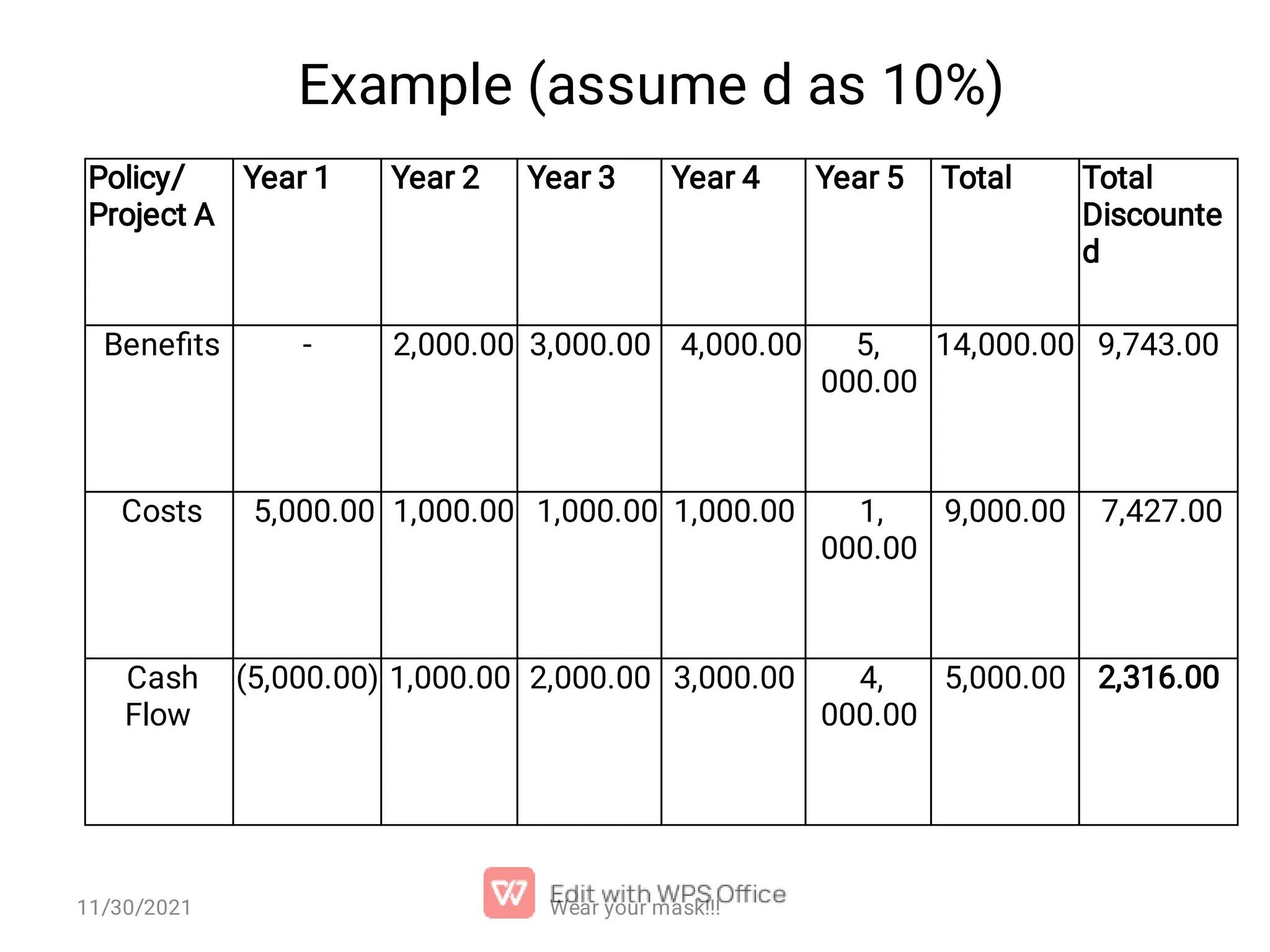
Example (assume d as 10%) Policy/ Project A Year 1 Year 2 Year 3 Year 4 Year 5 Total Total Discounte d Benefits - 2,000.00 3,000.00 4,000.00 5, 000.00 14,000.00 9,743.00 Costs 5,000.00 1,000.00 1,000.00 1,000.00 1, 000.00 9,000.00 7,427.00 Cash Flow (5,000.00) 1,000.00 2,000.00 3,000.00 4, 000.00 5,000.00 2,316.00 Wear your mask!!! 11/30/2021
Policy / project B Year 1 Year 2 Year 3 Year 4 Year 5 Total Total Discounted Benefits 1, 000.00 2,000.00 4,000.00 4, 000.00 4,000.00 15, 000.00 10,783.00 Costs 2, 000.00 2, 000.00 2,000.00 2, 000.00 2, 000.00 10, 000.00 7,582.00 Cash Flow(1,000.00) - 2,000.00 2, 000.00 2,000.00 5,000.00 3,201.00 Wear your mask!!! 11/30/2021
Cont… • – – – – – Project A Year 1 = -5000 * (1 + .1)-1 = -4545 Year 2 = 1000 * (1 + .1)–2 = 826 Year 3 = 2000 * (1 + .1)–3 = 1503 Year 4 = 3000 * (1 + .1)–4 = 2049 Year 5 = 4000 * (1 + .1)–5 = 2484 NPV = 2316 Or = 9743 - 7427 = 2316 Wear your mask!!! 11/30/2021
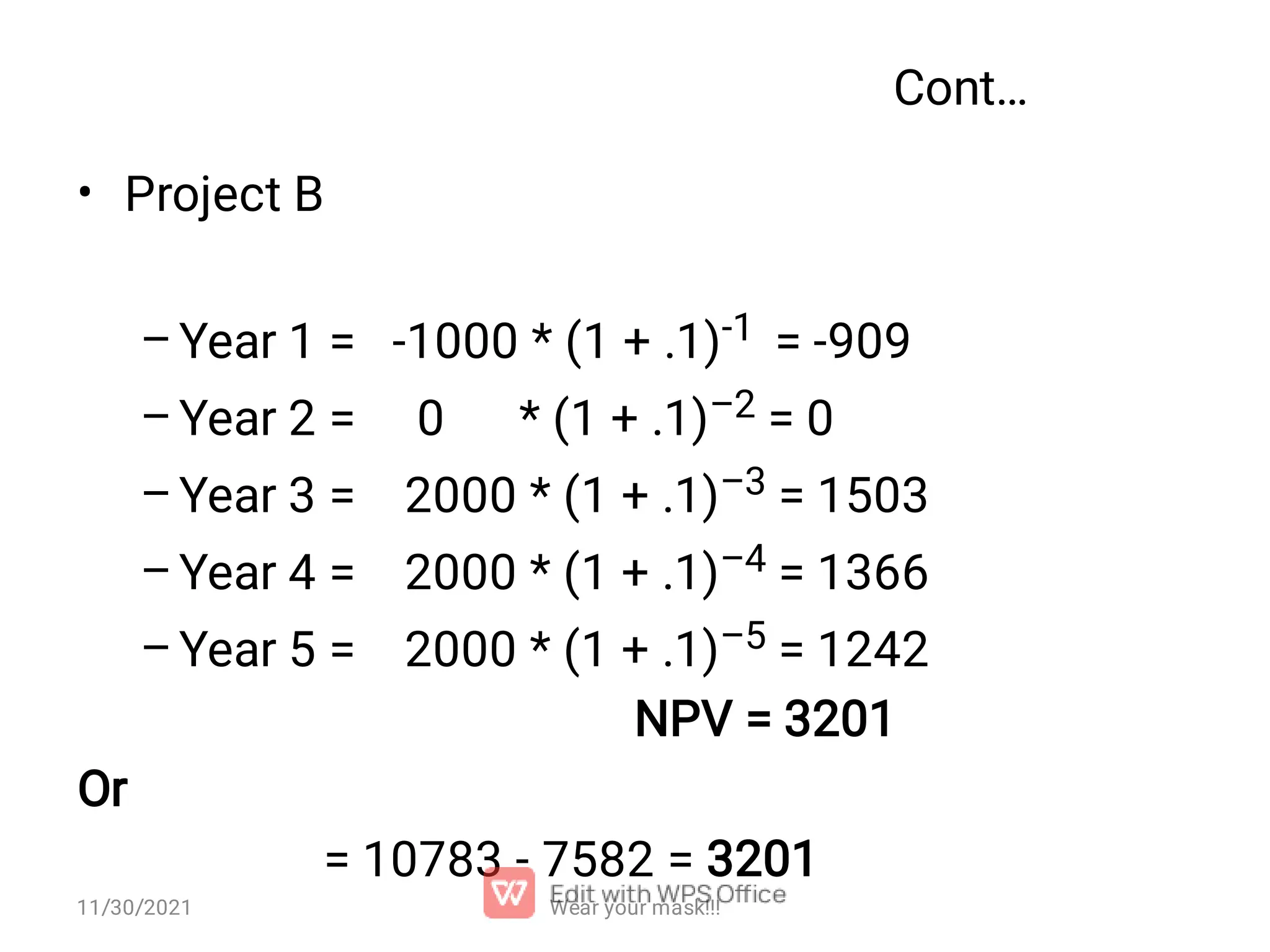
Cont… • – – – – – Project B Year 1 = -1000 * (1 + .1)-1 = -909 Year 2 = 0 * (1 + .1)–2 = 0 Year 3 = 2000 * (1 + .1)–3 = 1503 Year 4 = 2000 * (1 + .1)–4 = 1366 Year 5 = 2000 * (1 + .1)–5 = 1242 NPV = 3201 Or = 10783 - 7582 = 3201 Wear your mask!!! 11/30/2021
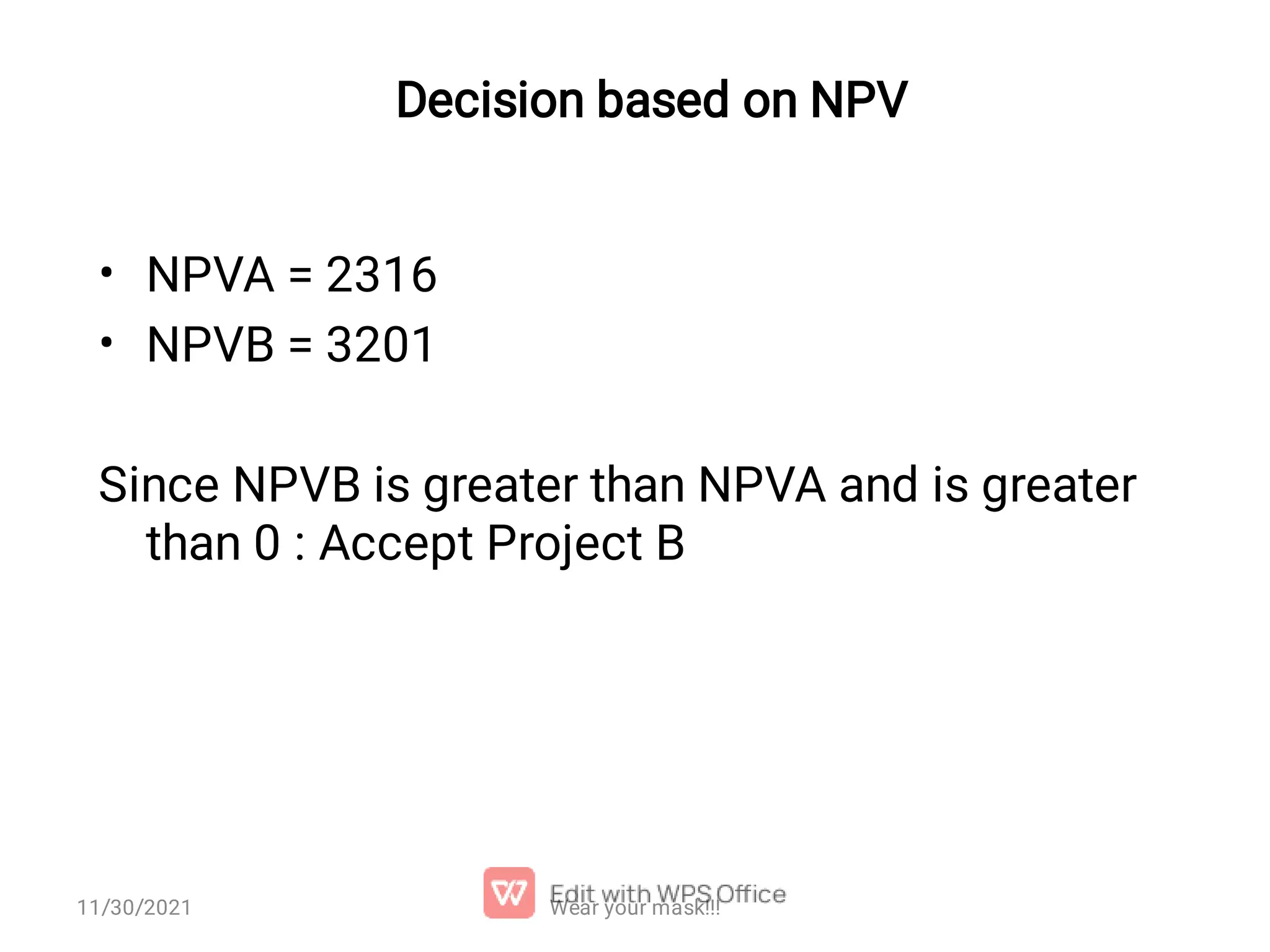
Decision based on NPV • • NPVA = 2316 NPVB = 3201 Since NPVB is greater than NPVA and is greater than 0 : Accept Project B Wear your mask!!! 11/30/2021
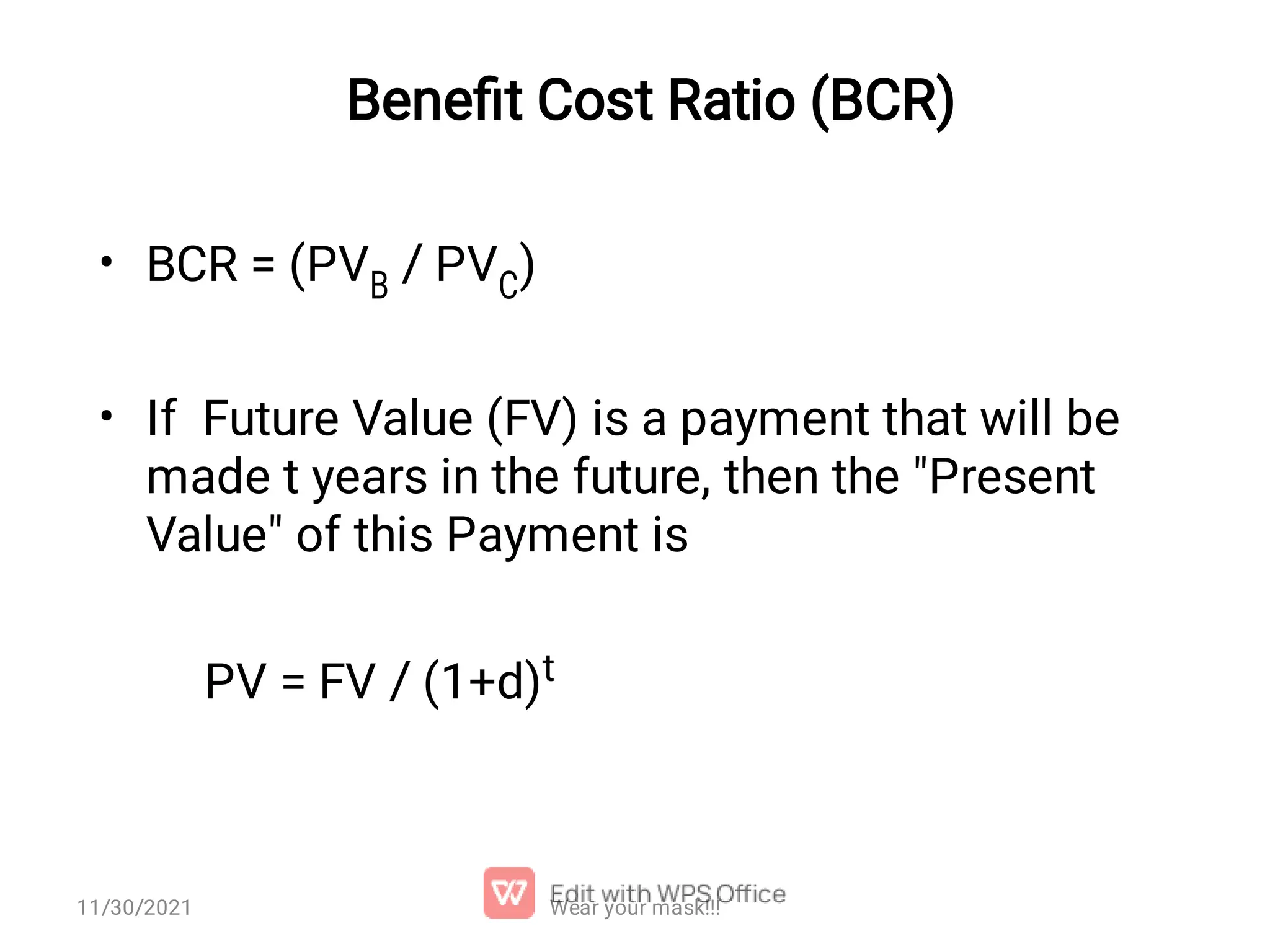
Benefit Cost Ratio (BCR) • • BCR = (PVB / PVC) If Future Value (FV) is a payment that will be made t years in the future, then the "Present Value" of this Payment is PV = FV / (1+d)t Wear your mask!!! 11/30/2021
Cont… • – • – • Benefit Cost ratio: decision criteria For a single policy/ project: a BC R which is greater than 1 indicates acceptability For multiple (competing) policies/ projects: the project(s) with the highest BC ratios (greater than 1) should receive highest priority Wear your mask!!! 11/30/2021
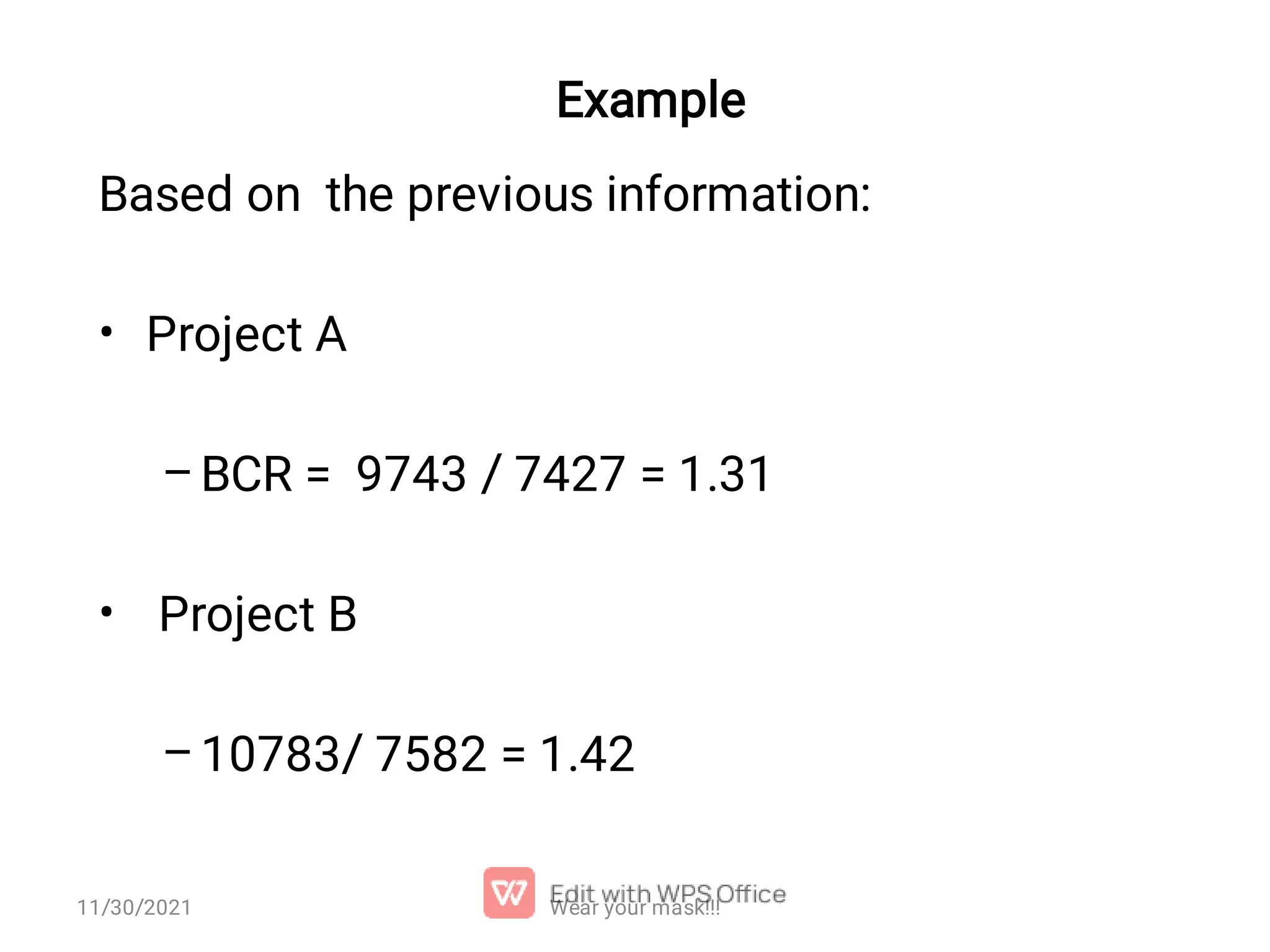
Example • – • – Based on the previous information: Project A BCR = 9743 / 7427 = 1.31 Project B 10783/ 7582 = 1.42 Wear your mask!!! 11/30/2021
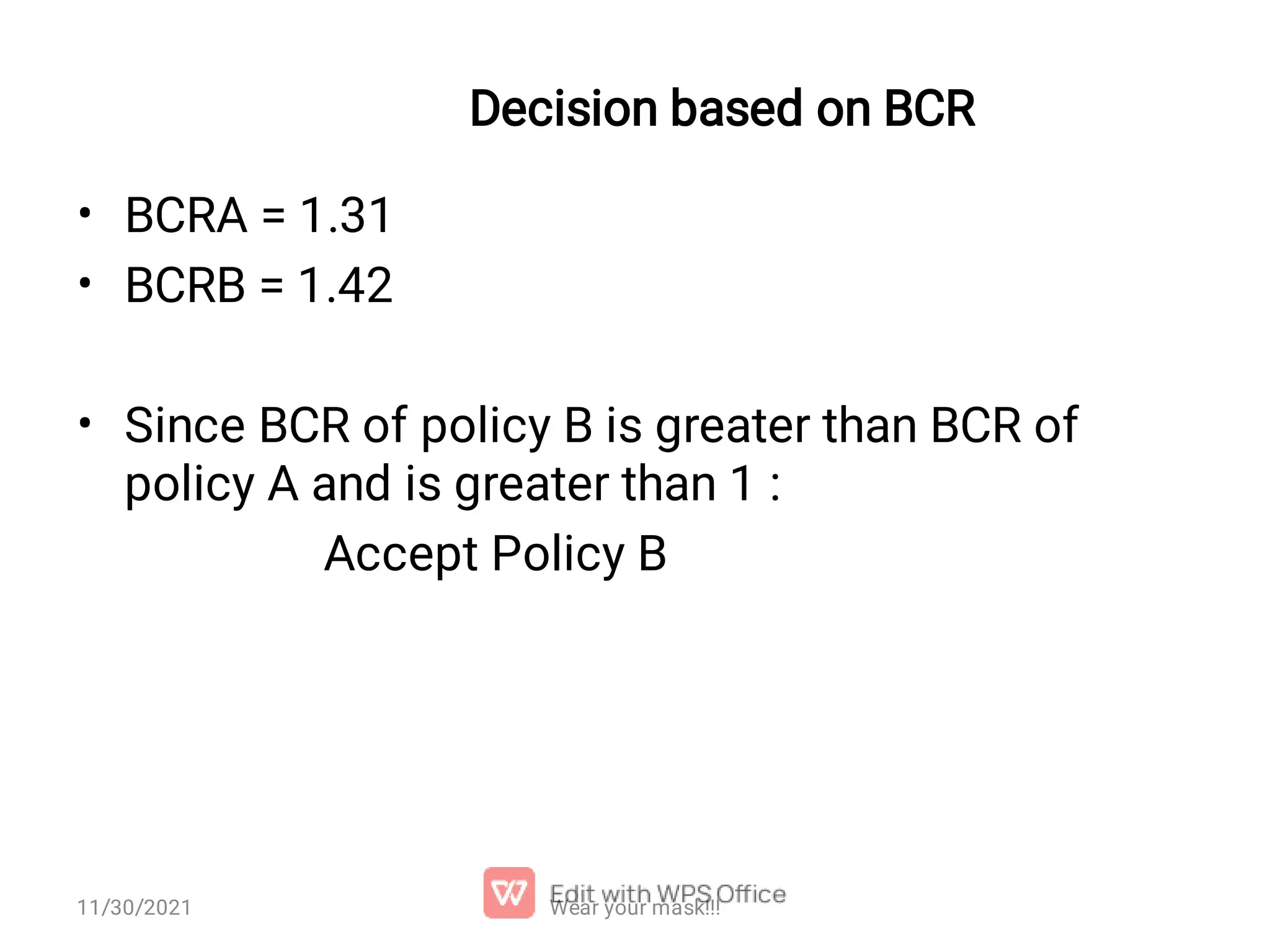
Decision based on BCR • • • BCRA = 1.31 BCRB = 1.42 Since BCR of policy B is greater than BCR of policy A and is greater than 1 : Accept Policy B Wear your mask!!! 11/30/2021
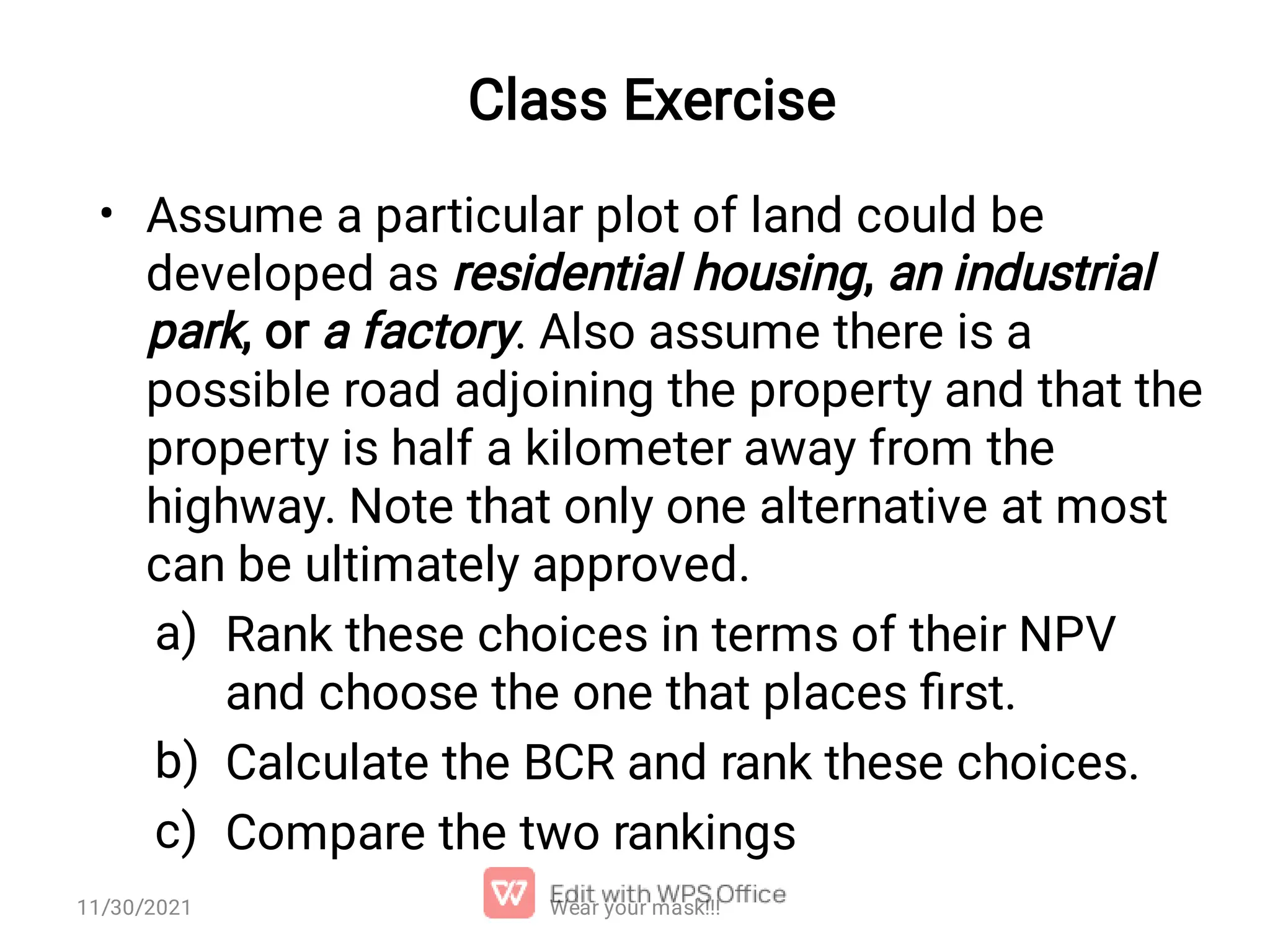
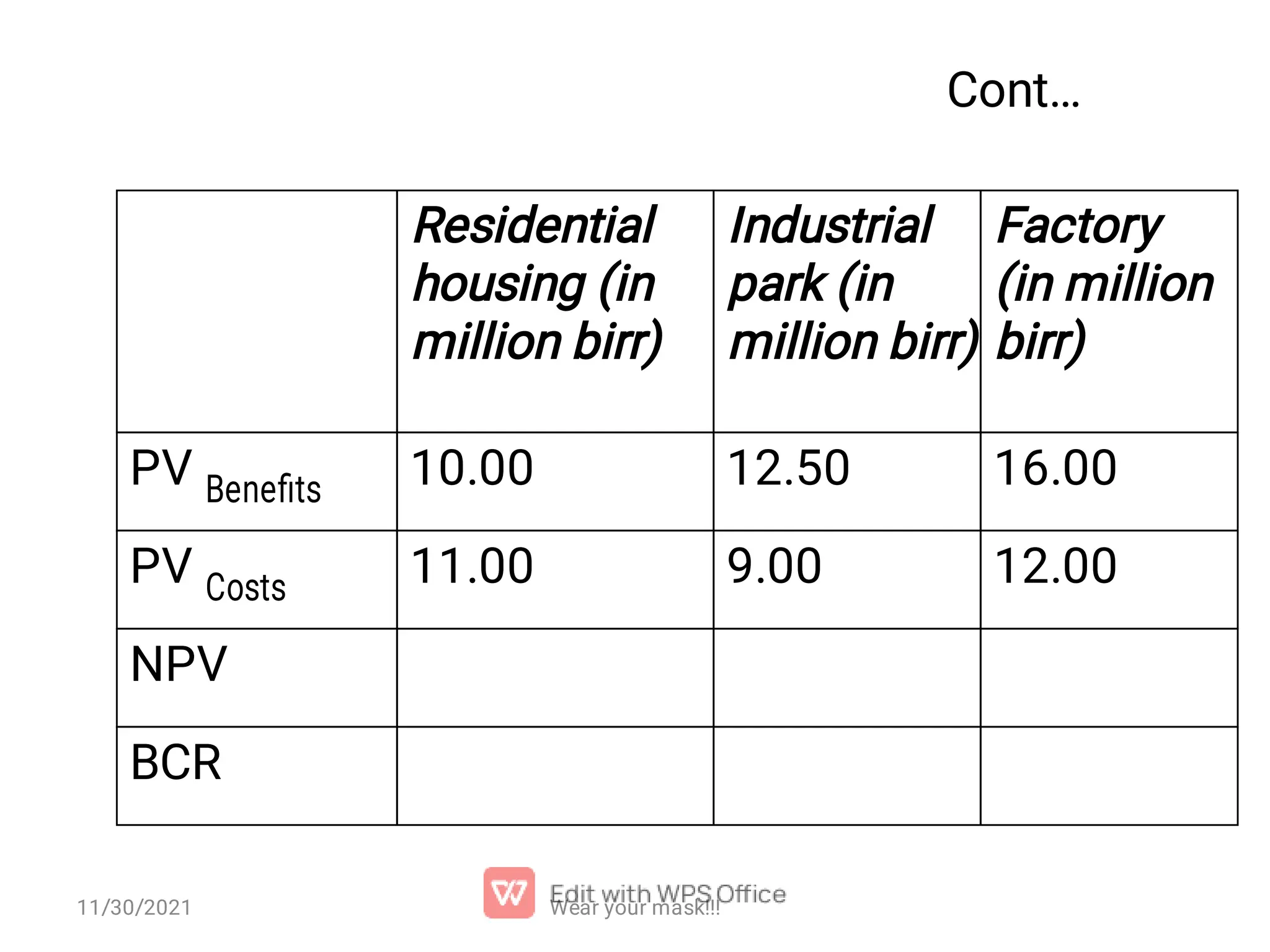
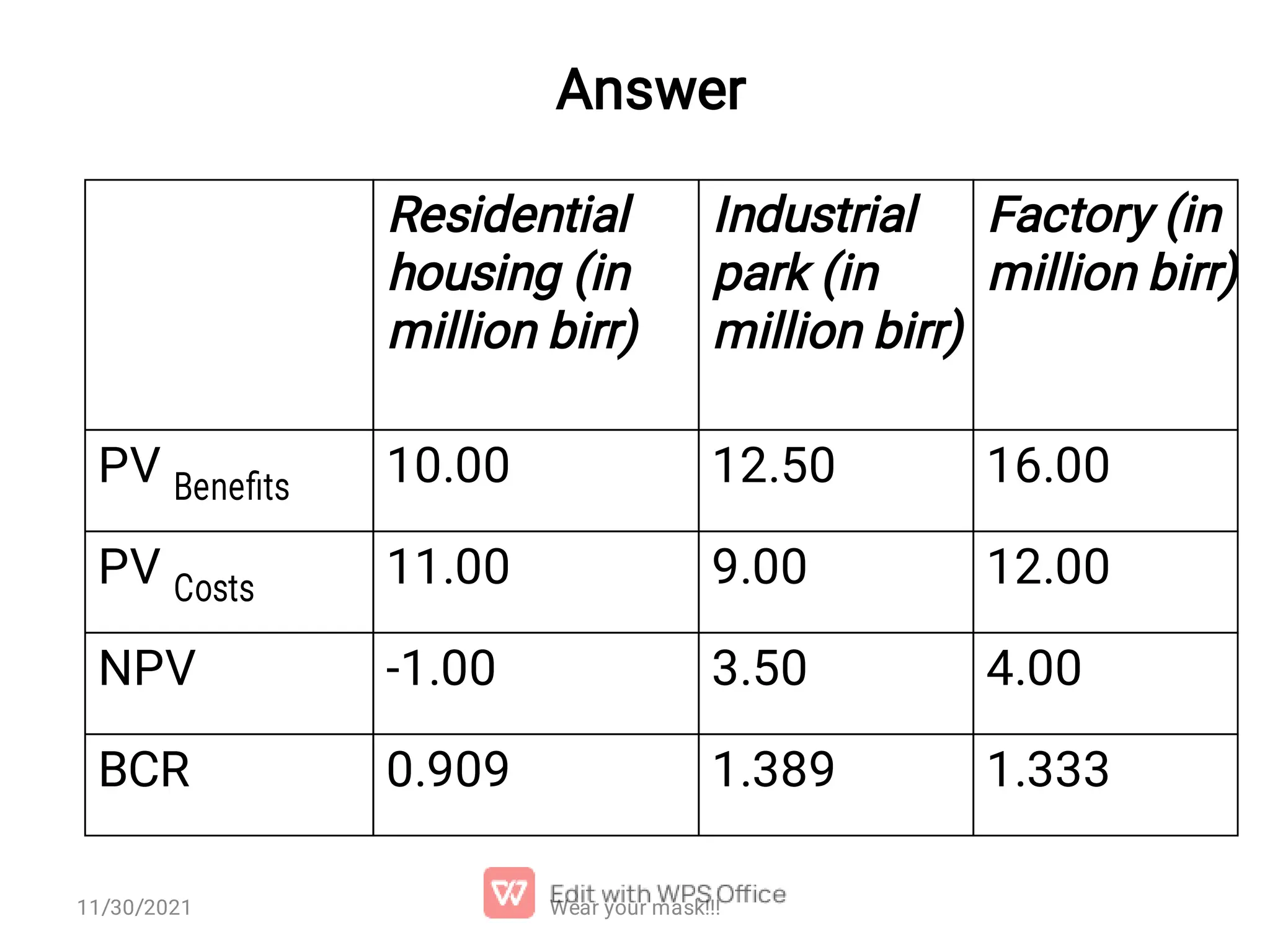
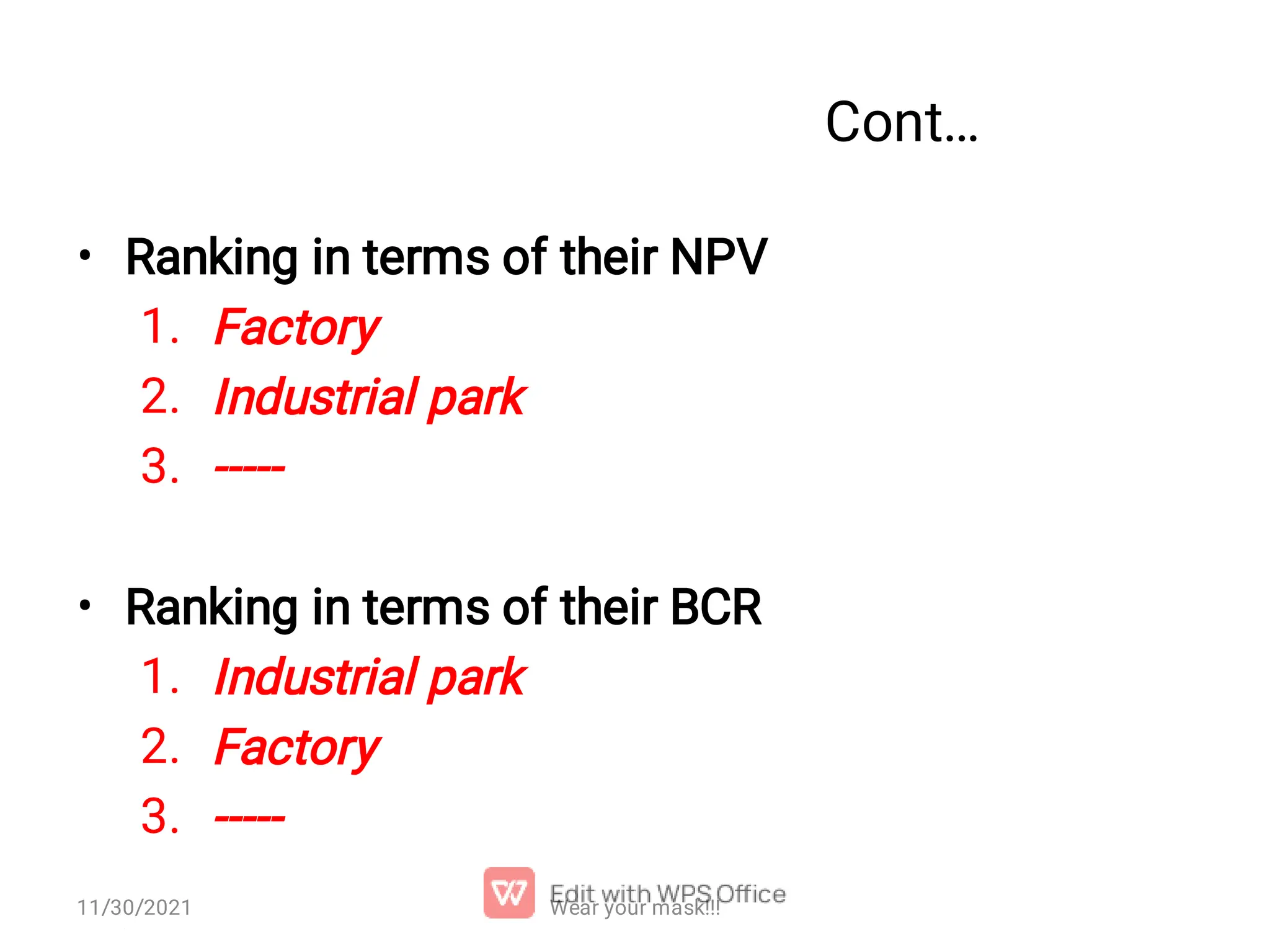
Class Exercise • a) b) c) Assume a particular plot of land could be developed as residential housing, an industrial park, or a factory. Also assume there is a possible road adjoining the property and that the property is half a kilometer away from the highway. Note that only one alternative at most can be ultimately approved. Rank these choices in terms of their NPV and choose the one that places first. Calculate the BCR and rank these choices. Compare the two rankings Wear your mask!!! 11/30/2021
Cont… Residential housing (in million birr) Industrial park (in million birr) Factory (in million birr) PV Benefits 10.00 12.50 16.00 PV Costs 11.00 9.00 12.00 NPV BCR Wear your mask!!! 11/30/2021
Answer Residential housing (in million birr) Industrial park (in million birr) Factory (in million birr) PV Benefits 10.00 12.50 16.00 PV Costs 11.00 9.00 12.00 NPV -1.00 3.50 4.00 BCR 0.909 1.389 1.333 Wear your mask!!! 11/30/2021
Cont… • 1. 2. 3. • 1. 2. 3. Ranking in terms of their NPV Factory Industrial park ----- Ranking in terms of their BCR Industrial park Factory ----- Wear your mask!!! 11/30/2021
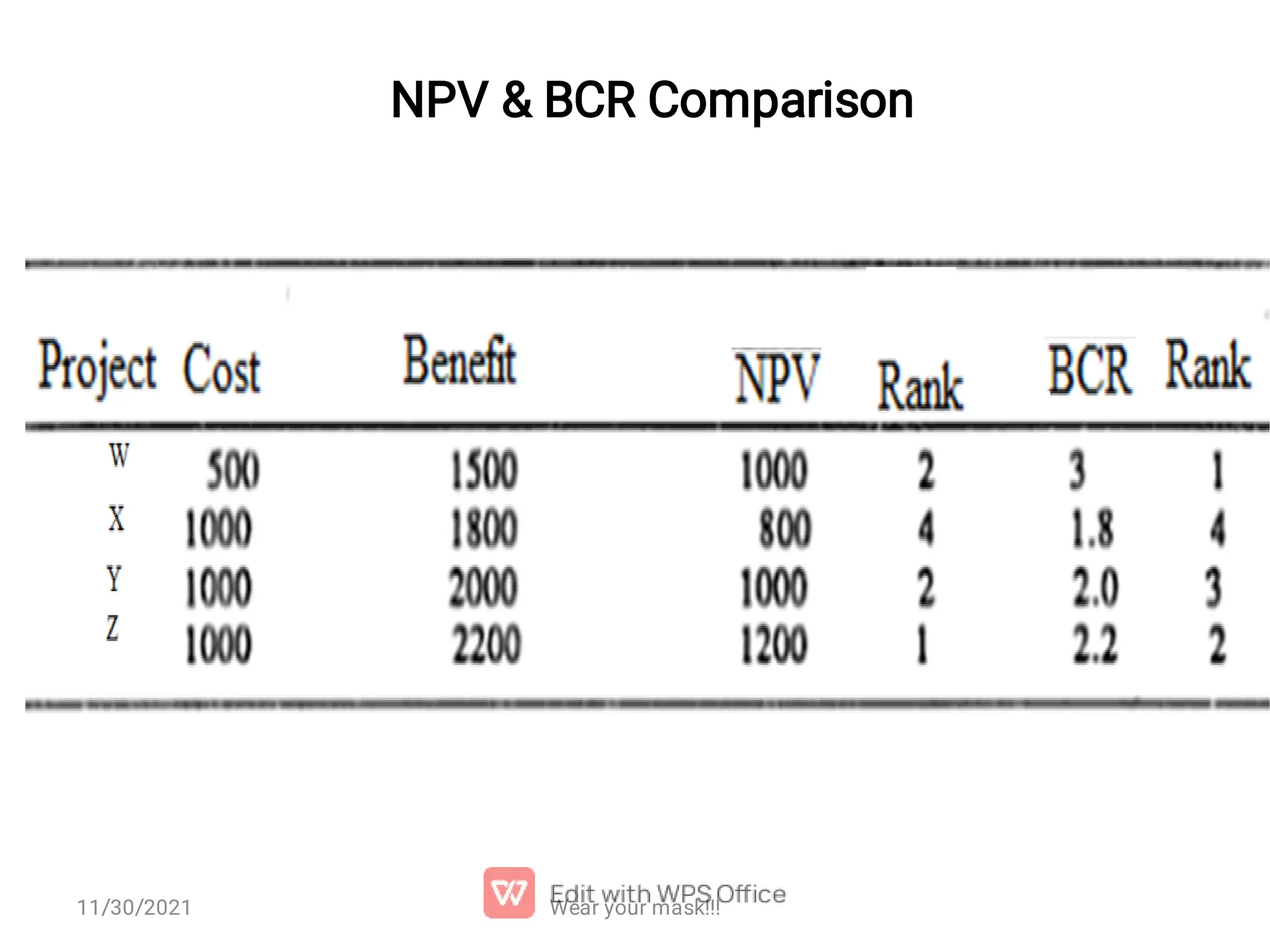
NPV & BCR Comparison • • – – From the above exercise we can understand that there are inconsistencies The main questions are: Why do such inconsistencies arise? Which method is superior? Wear your mask!!! 11/30/2021
NPV & BCR Comparison Wear your mask!!! 11/30/2021
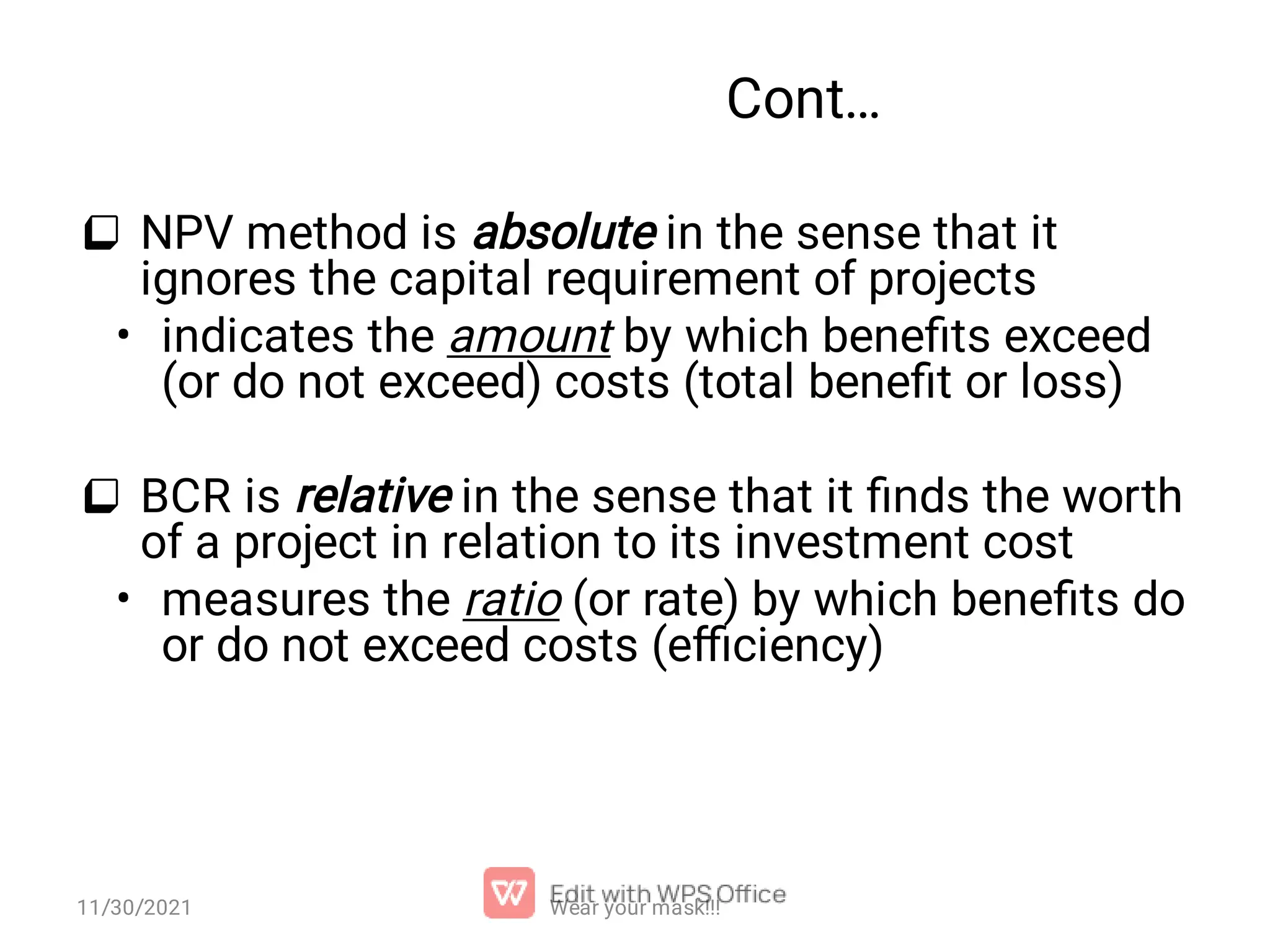
Cont…  •  • NPV method is absolute in the sense that it ignores the capital requirement of projects indicates the amount by which benefits exceed (or do not exceed) costs (total benefit or loss) BCR is relative in the sense that it finds the worth of a project in relation to its investment cost measures the ratio (or rate) by which benefits do or do not exceed costs (efficiency) Wear your mask!!! 11/30/2021
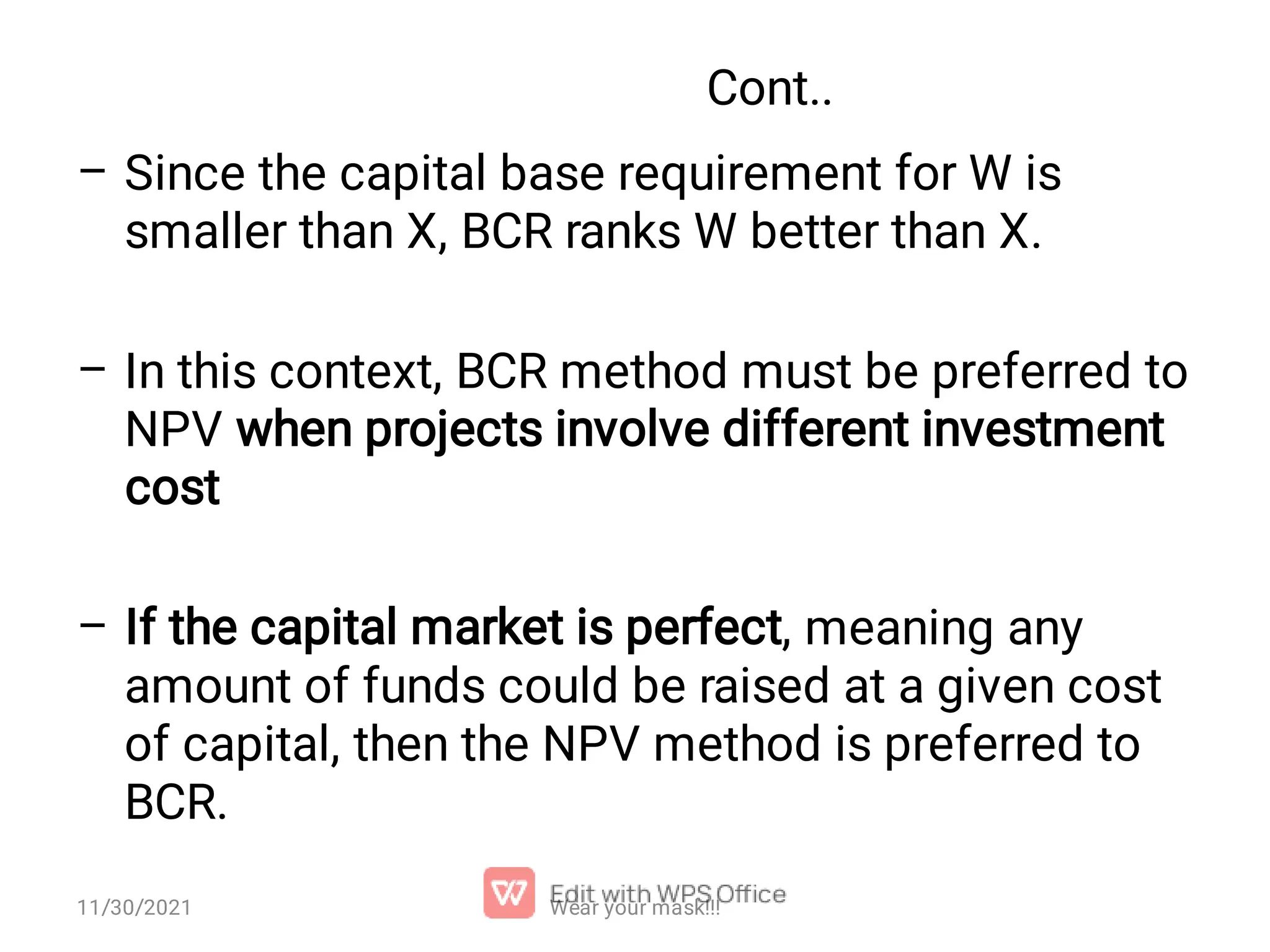
Cont.. – – – Since the capital base requirement for W is smaller than X, BCR ranks W better than X. In this context, BCR method must be preferred to NPV when projects involve different investment cost If the capital market is perfect, meaning any amount of funds could be raised at a given cost of capital, then the NPV method is preferred to BCR. Wear your mask!!! 11/30/2021
Internal Rate of Return • – • The discount rate at which the present value of benefits is equal to the present value of costs The discount rate when NPV = 0 It is used to measure and compare profitability of an investment Wear your mask!!! 11/30/2021
Cont… – • – • Internal Rate of Return: decision criteria For a single project: when IRR is greater than market discount rate, accept the project For multiple (competing) projects: the one with the largest IRR is the most desirable Wear your mask!!! 11/30/2021
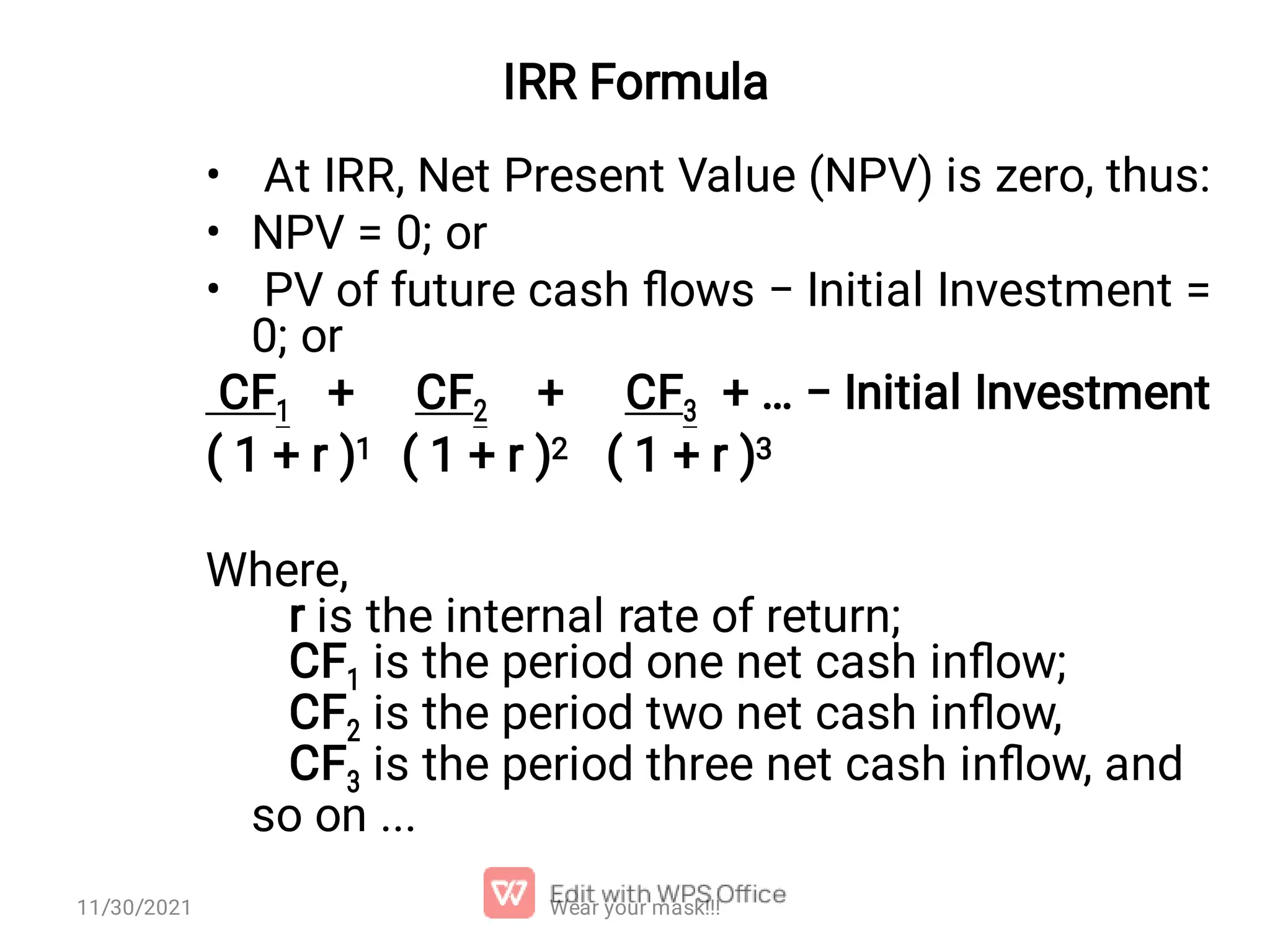
IRR Formula • • • At IRR, Net Present Value (NPV) is zero, thus: NPV = 0; or PV of future cash flows − Initial Investment = 0; or CF1 + CF2 + CF3 + … − Initial Investment ( 1 + r )1 ( 1 + r )2 ( 1 + r )3 Where, r is the internal rate of return; CF1 is the period one net cash inflow; CF2 is the period two net cash inflow, CF3 is the period three net cash inflow, and so on ... Wear your mask!!! 11/30/2021
Cont.. • 1. 2. 3. 4. But the problem is, we cannot isolate the variable r (= IRR) on one side of the above equation. However, there are alternative procedures which can be followed to find IRR. The simplest of them is described below: Guess the value of r and calculate the NPV If NPV is close to zero then IRR is equal to r. If NPV is greater than 0 then increase r and go to step 5. If NPV is smaller than 0 then decrease r and go to step 5. Wear your mask!!! 11/30/2021
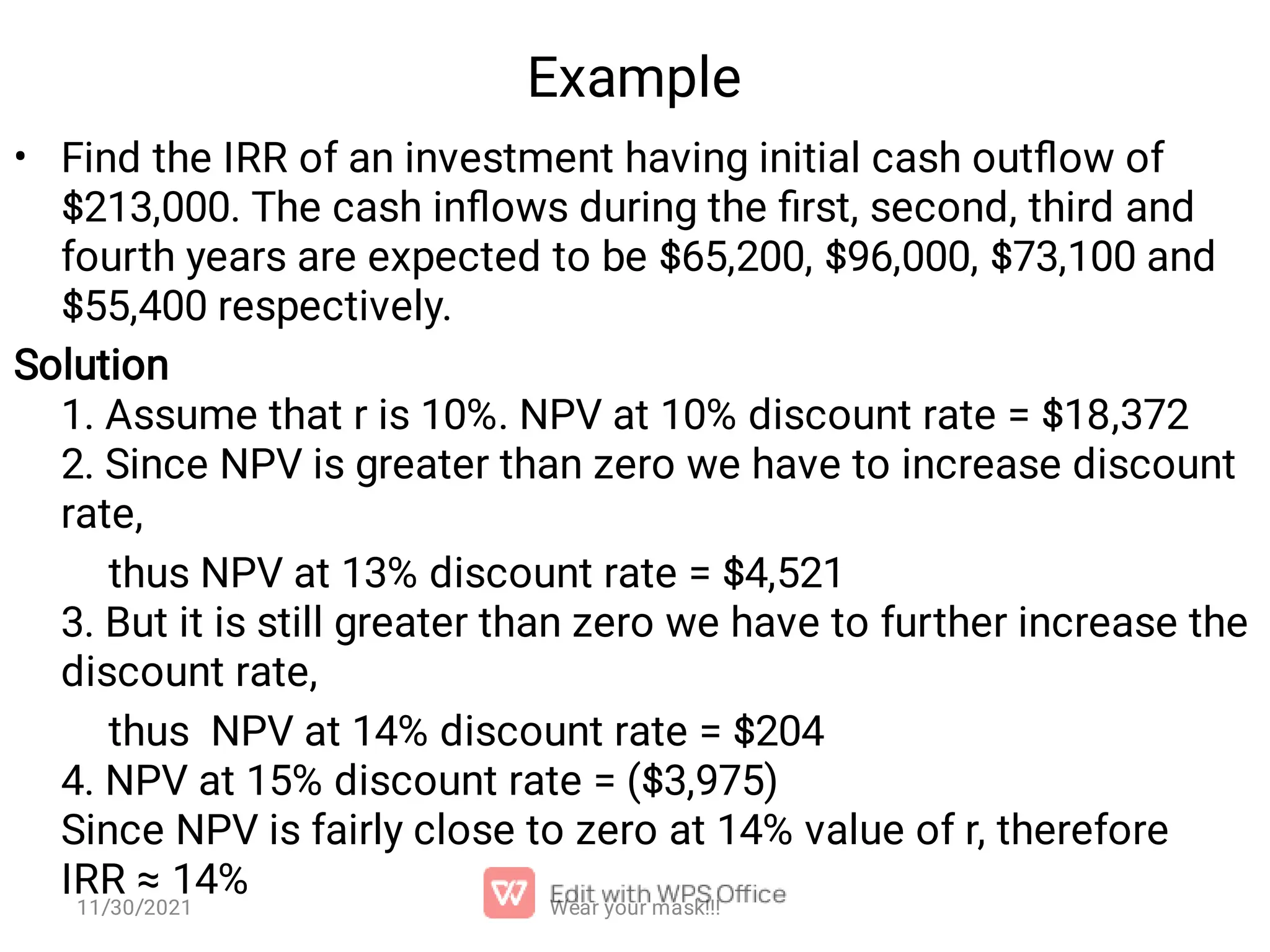
Example • Find the IRR of an investment having initial cash outflow of $213,000. The cash inflows during the first, second, third and fourth years are expected to be $65,200, $96,000, $73,100 and $55,400 respectively. Solution 1. Assume that r is 10%. NPV at 10% discount rate = $18,372 2. Since NPV is greater than zero we have to increase discount rate, thus NPV at 13% discount rate = $4,521 3. But it is still greater than zero we have to further increase the discount rate, thus NPV at 14% discount rate = $204 4. NPV at 15% discount rate = ($3,975) Since NPV is fairly close to zero at 14% value of r, therefore IRR ≈ 14% Wear your mask!!! 11/30/2021
Group exercise Policy A requires $10 million investments and generates $10 million each in year 1 and year 2. Project B requires $1 million investment and generates $2 million in Year 1 and $1 million in Year 2. Rank policy A and policy B using IRR Wear your mask!!! 11/30/2021
Cont… – – – IRR has a certain attraction, but also has some problems The argument that an IRR which is greater than the market/selected discount rate is desirable can be questioned - discount rates can be arbitrary Calculation (by hand) is tedious & prone to error Under certain conditions there may be more than one correct solution to an IRR problem Wear your mask!!! 11/30/2021
Flaws in CBA • • Cost-benefit analysis is a deeply flawed method that repeatedly leads to biased and misleading results. Cost benefit analysis offers no clear advantages in making regulatory policy decisions and often produces inferior results, in terms of both environmental protection and overall social welfare, compared to other approaches (exclude indirect benefits and costs). Wear your mask!!! 11/30/2021
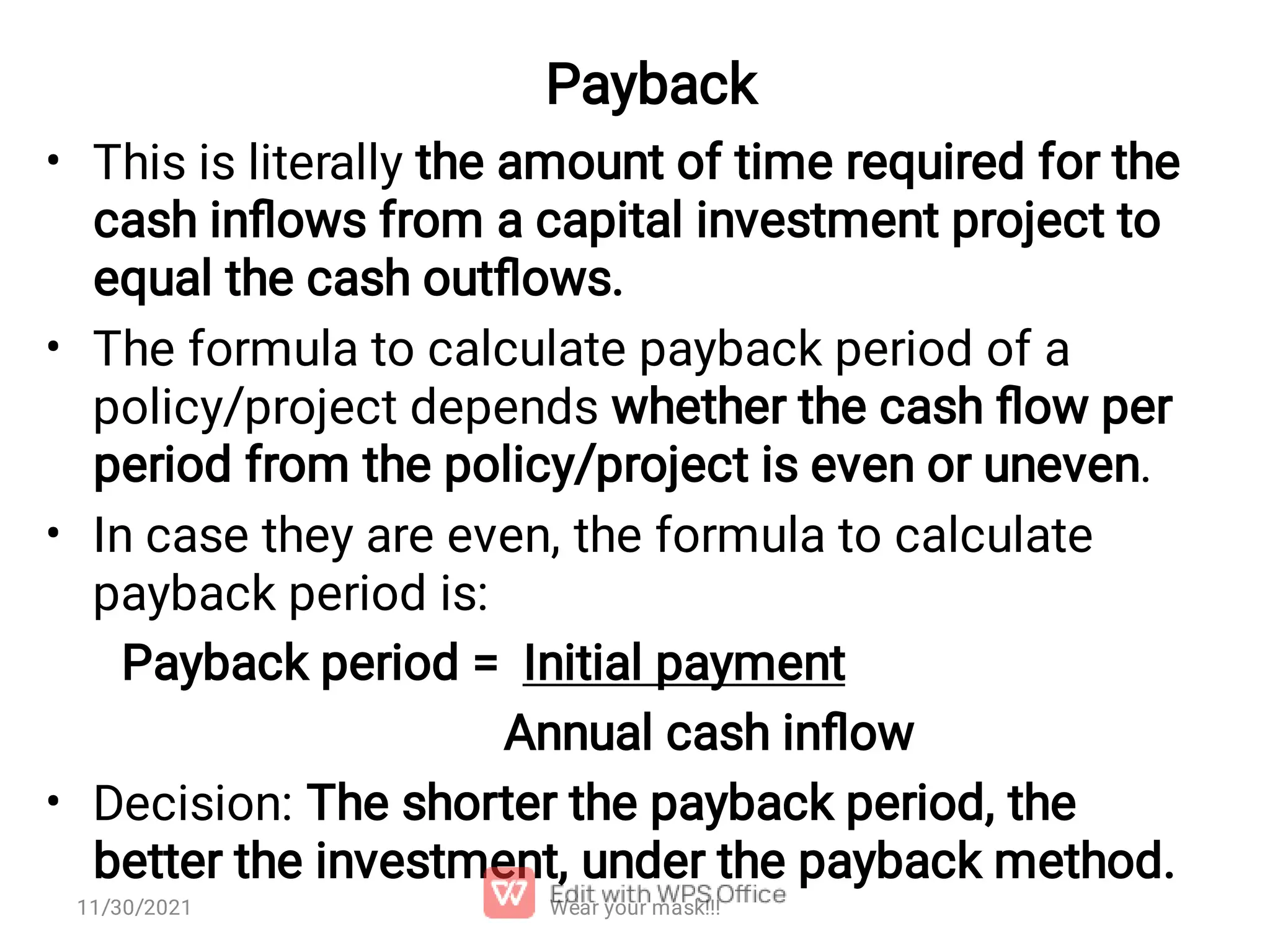
Payback • • • • This is literally the amount of time required for the cash inflows from a capital investment project to equal the cash outflows. The formula to calculate payback period of a policy/project depends whether the cash flow per period from the policy/project is even or uneven. In case they are even, the formula to calculate payback period is: Payback period = Initial payment Annual cash inflow Decision: The shorter the payback period, the better the investment, under the payback method. Wear your mask!!! 11/30/2021
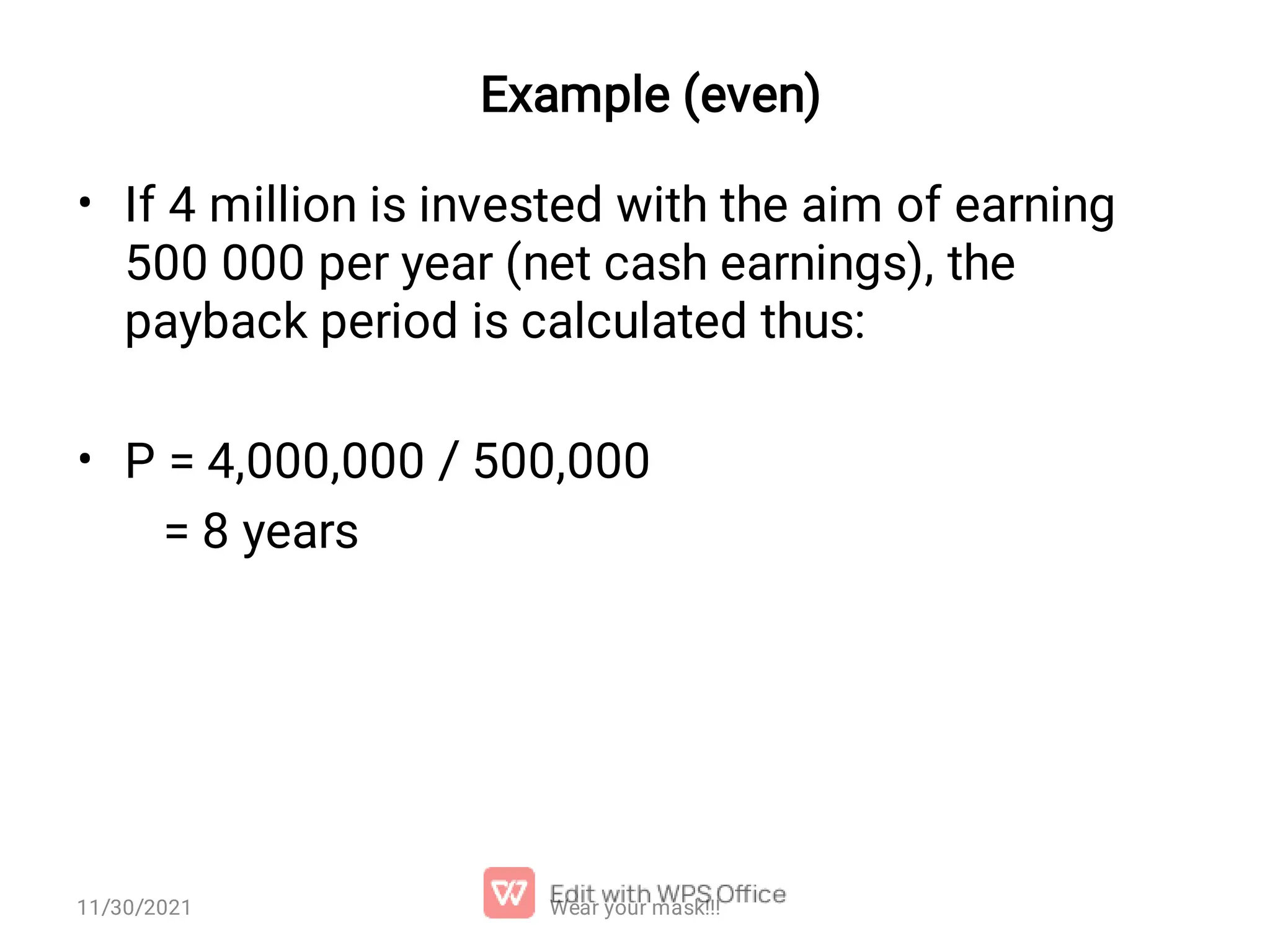
Example (even) • • If 4 million is invested with the aim of earning 500 000 per year (net cash earnings), the payback period is calculated thus: P = 4,000,000 / 500,000 = 8 years Wear your mask!!! 11/30/2021
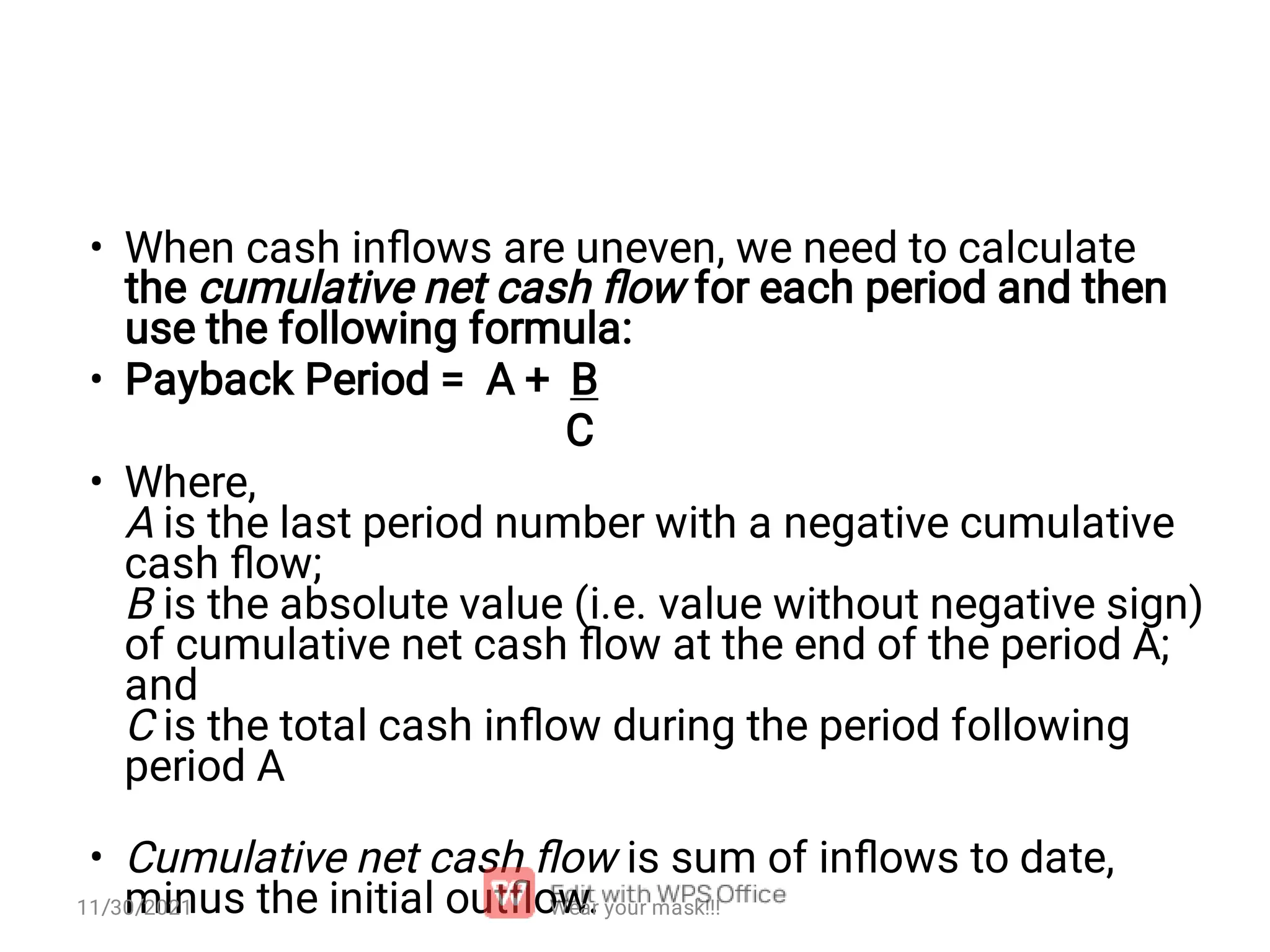
• • • • When cash inflows are uneven, we need to calculate the cumulative net cash flow for each period and then use the following formula: Payback Period = A + B C Where, A is the last period number with a negative cumulative cash flow; B is the absolute value (i.e. value without negative sign) of cumulative net cash flow at the end of the period A; and C is the total cash inflow during the period following period A Cumulative net cash flow is sum of inflows to date, minus the initial outflow. Wear your mask!!! 11/30/2021
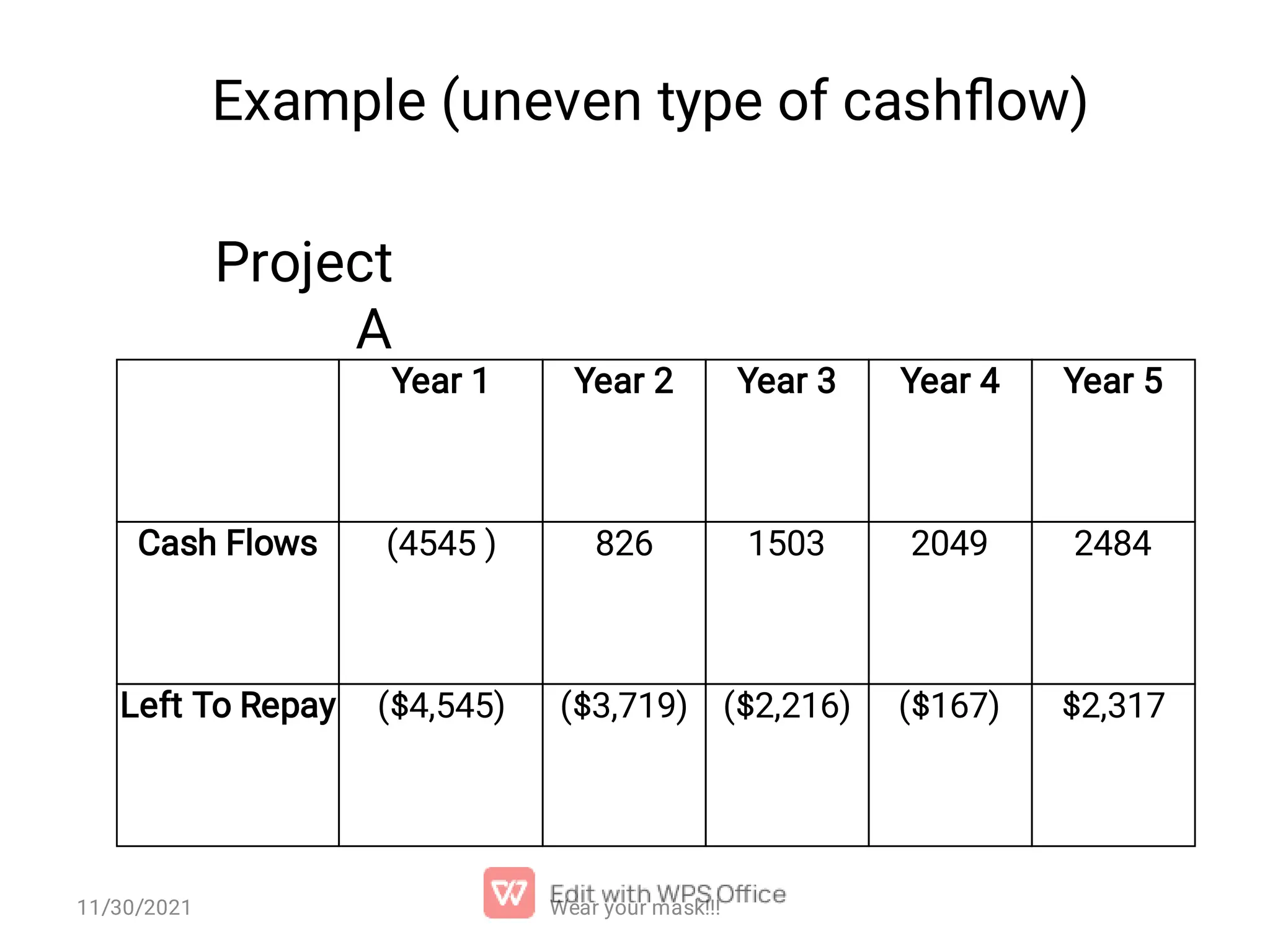
Example (uneven type of cashflow) Year 1 Year 2 Year 3 Year 4 Year 5 Cash Flows (4545 ) 826 1503 2049 2484 Left To Repay ($4,545) ($3,719) ($2,216) ($167) $2,317 Project A Wear your mask!!! 11/30/2021
Example Year 1 Year 2 Year 3 Cash Flows (909) 0 1503 Left To Repay ($909) ($909) 594 Project B Wear your mask!!! 11/30/2021
Cont… • • • PA = 4.07 years PB = 2.6 years Since the payback period for project B is lesser than that of project A: Accept Project B Wear your mask!!! 11/30/2021
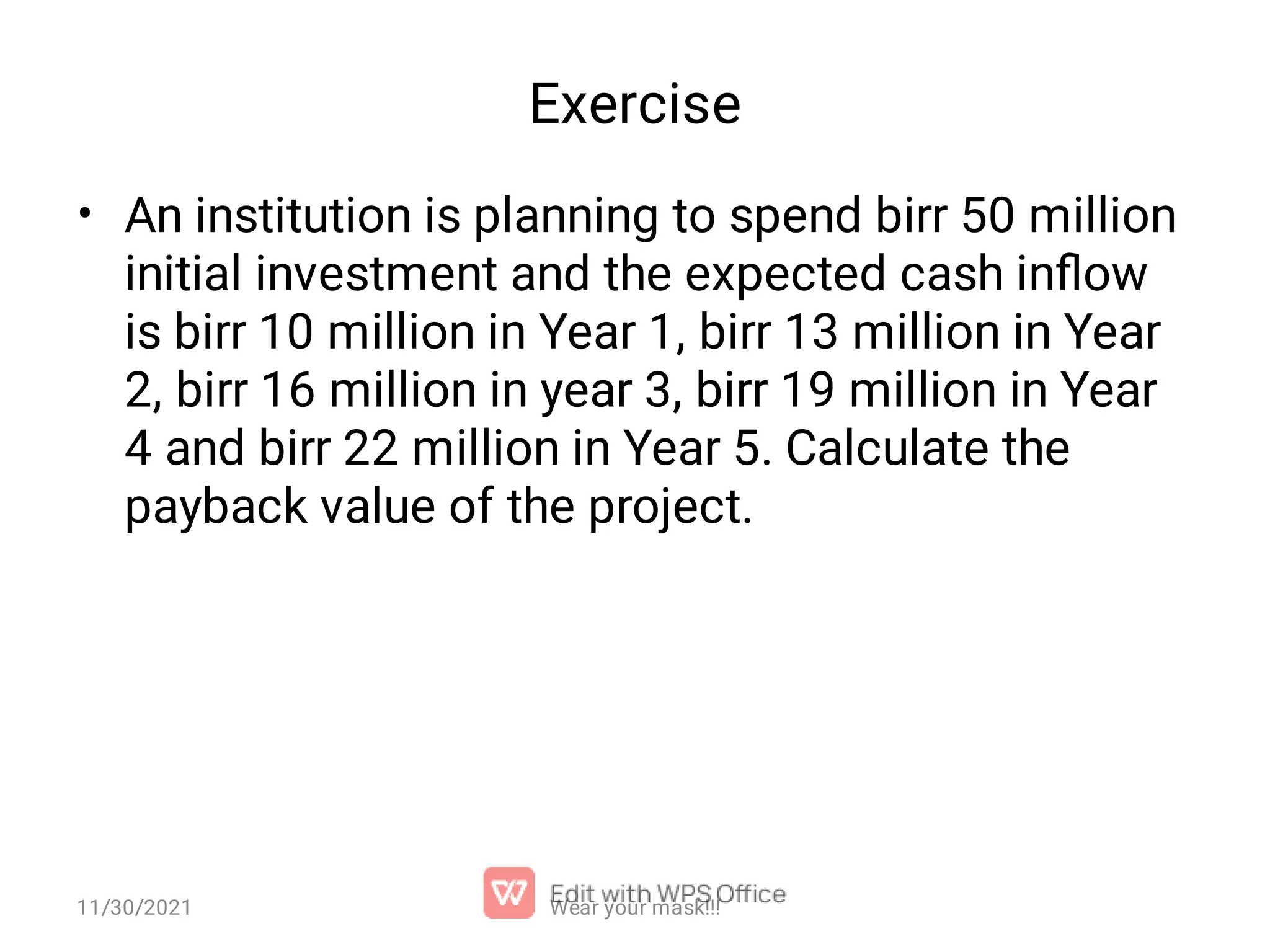
Exercise • An institution is planning to spend birr 50 million initial investment and the expected cash inflow is birr 10 million in Year 1, birr 13 million in Year 2, birr 16 million in year 3, birr 19 million in Year 4 and birr 22 million in Year 5. Calculate the payback value of the project. Wear your mask!!! 11/30/2021
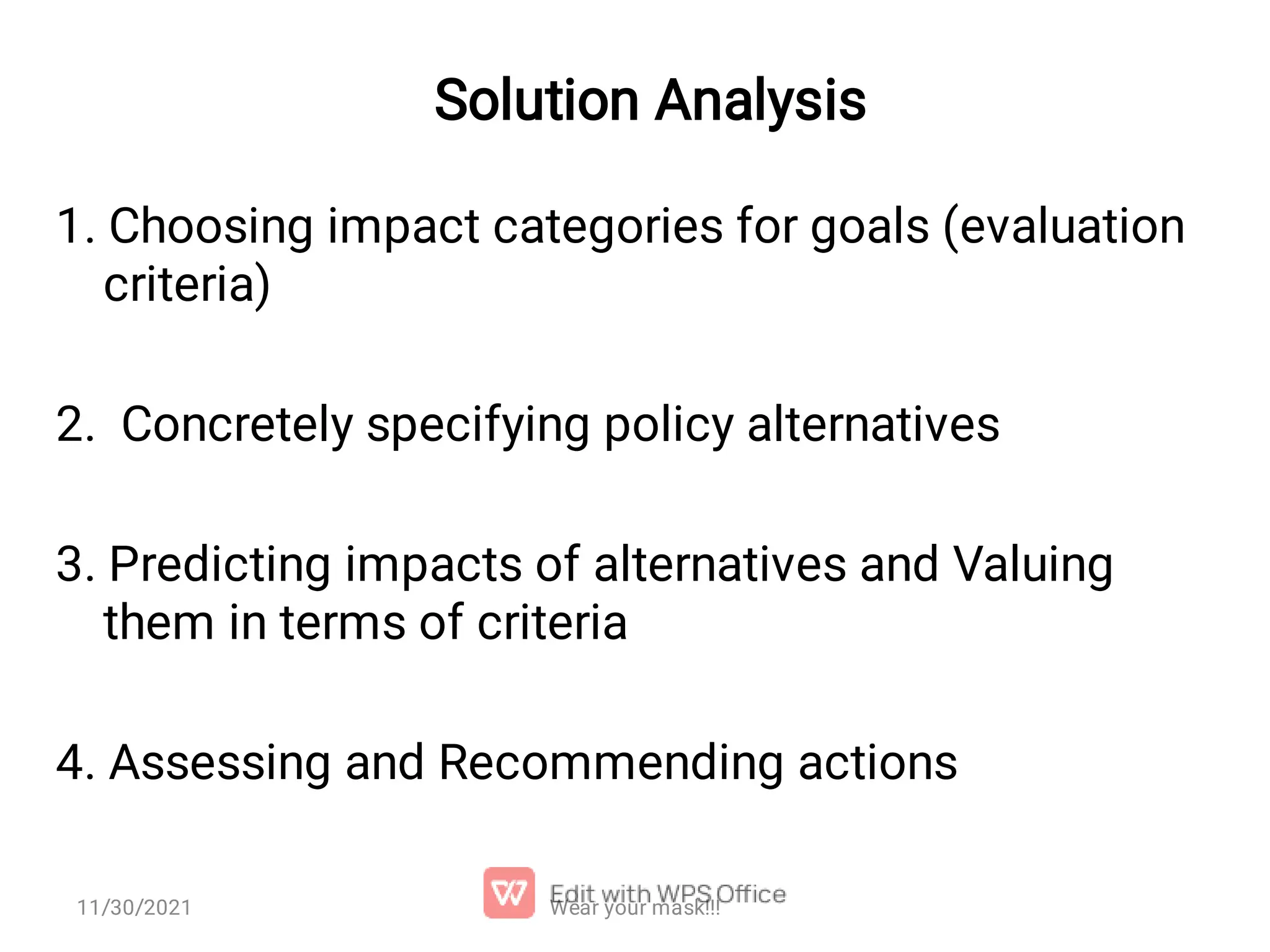
Solution Analysis 1. Choosing impact categories for goals (evaluation criteria) 2. Concretely specifying policy alternatives 3. Predicting impacts of alternatives and Valuing them in terms of criteria 4. Assessing and Recommending actions 11/30/2021 Wear your mask!!!
• • • The first step in solution analysis is specifying relevant impact categories for assessing how well each policy alternative contributes to each of goals. Impact categories are used to measure the contributions of different proposed policy alternatives to the goal’s objectives. Thus, the process of choosing evaluation criteria means in fact moving from generality of goals to specificity of concrete calibrations of these goals. 1.Choosing impact categories for goals (evaluation criteria) 11/30/2021 Wear your mask!!!
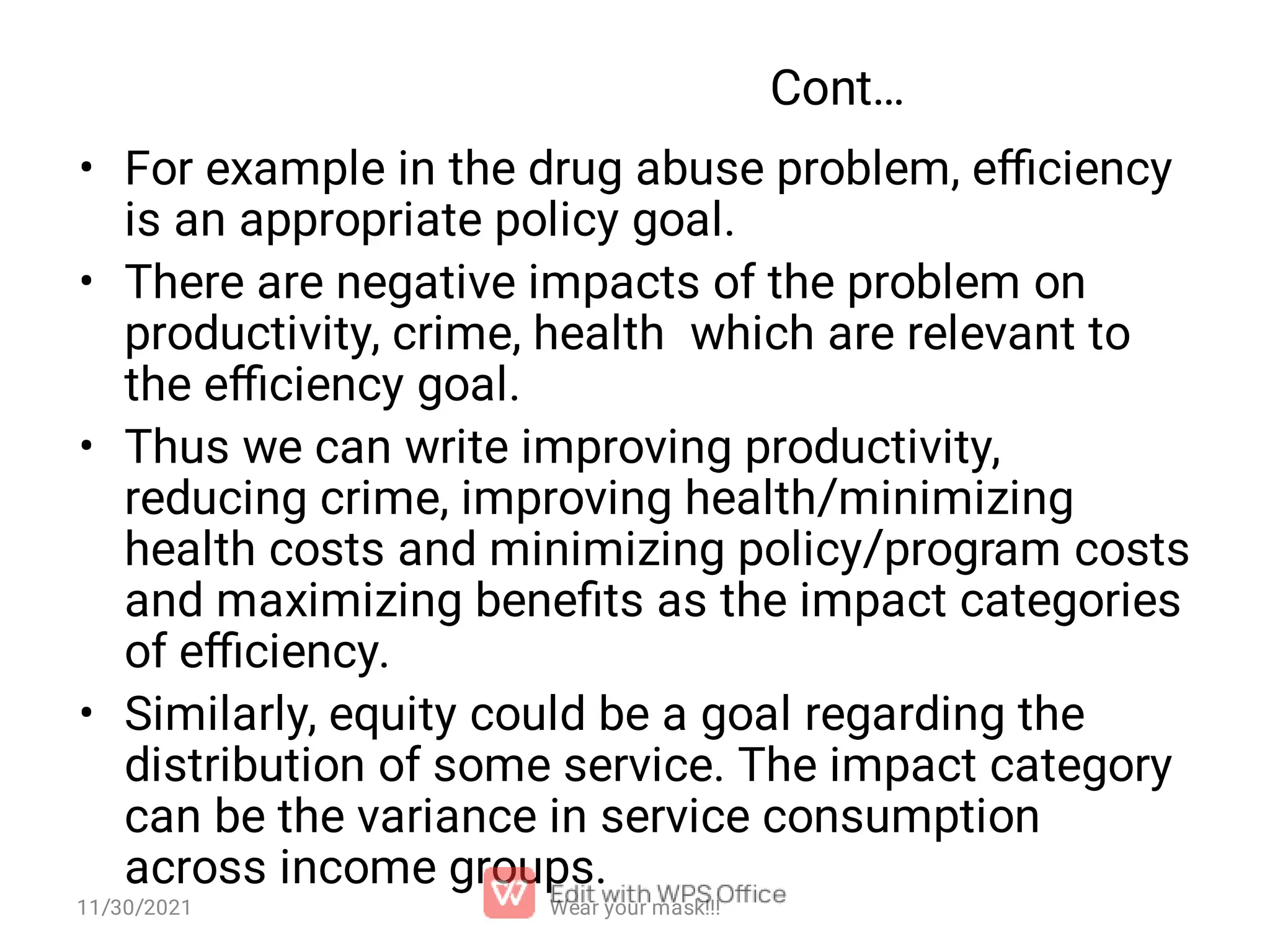
Cont… • • • • For example in the drug abuse problem, efficiency is an appropriate policy goal. There are negative impacts of the problem on productivity, crime, health which are relevant to the efficiency goal. Thus we can write improving productivity, reducing crime, improving health/minimizing health costs and minimizing policy/program costs and maximizing benefits as the impact categories of efficiency. Similarly, equity could be a goal regarding the distribution of some service. The impact category can be the variance in service consumption across income groups. 11/30/2021 Wear your mask!!!
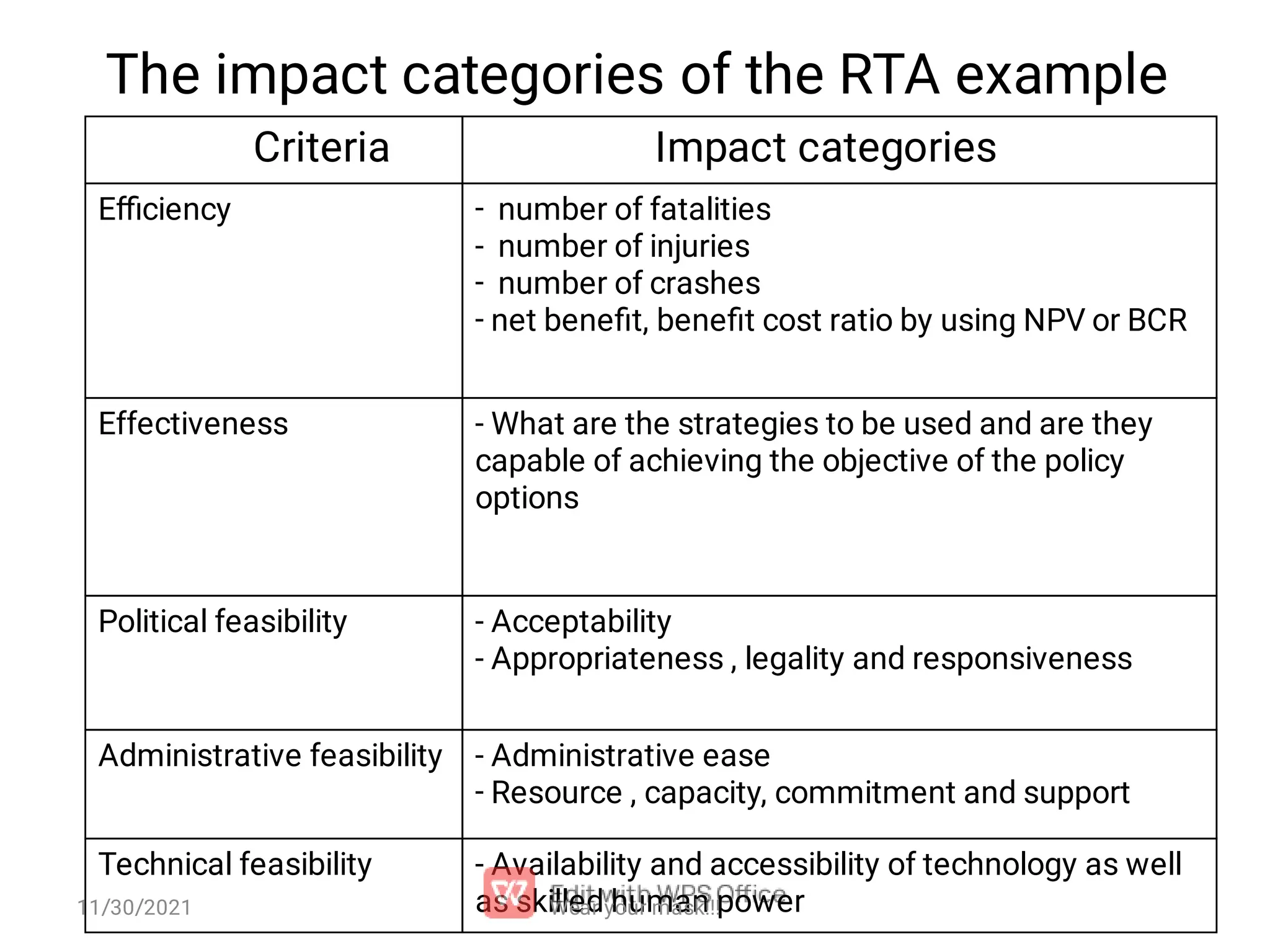
The impact categories of the RTA example Criteria Impact categories Efficiency number of fatalities - number of injuries number of crashes net benefit, benefit cost ratio by using NPV or BCR - - - Effectiveness - What are the strategies to be used and are they capable of achieving the objective of the policy options Political feasibility - Acceptability - Appropriateness , legality and responsiveness Administrative feasibility - Administrative ease Resource , capacity, commitment and support - Technical feasibility - Availability and accessibility of technology as well as skilled human power 11/30/2021 Wear your mask!!!
2. Concretely specifying policy alternatives • • • This step involves the detailed specification of policy alternatives that can achieve policy goals. Policy alternatives are concrete plans and programs consisting of sets of actions designed to provide solutions for the problem at hand. The process of developing policy alternative requires a clear understanding of the real causes of the problem. 11/30/2021 Wear your mask!!!
Cont… • – – • Possible alternatives include: preserving the status quo (do nothing), and any other alternative that can mitigate the undesirable impacts of the problem. It is usually appropriate to include the current policy (status quo) as a policy alternative to avoid the risk of recommending a best alternative that is worse than the current policy. 11/30/2021 Wear your mask!!!
Sources for specifying policy alternatives 1. 2. 3. There are variety of sources : The existing policy proposals: this includes the status quo as well as earlier proposals which are results of earlier analysts. Other jurisdictions: we can borrow policy proposals from other jurisdictions by studying how other cities, states or countries handled policy problems similar to the one that your jurisdiction faces. Generic policies: after generating a portfolio of generic policies, modification can be done to make it fit the particular situation of the policy problem. 11/30/2021 Wear your mask!!!
COMMON GENERIC POLICY INSTRUMENTS Policy types Examples Organization - Based Instruments Direct provision Public enterprises Community and voluntary organizations Market organization (consumers and producers market ) Government reorganization • • • • • Authority- Based Instruments Command and control Delegated or self regulation • • Treasure -Based Instruments Subsides :Grants, tax incentive, Loans Financial Disincentive: Taxes and user charges • • Information- Based Instruments Public information campaigns Advertizing Research Inquiries & investigative commissions • • • 11/30/2021 Wear your mask!!!
Cont…      4. New or unique or custom-made policy alternative: can be issue lurking in the literature or may be product of your imagination/creative solution. Points to remember while crafting alternatives Do not expect to find perfect policy alternative Don’t contrast a preferred policy with a “ dummy” or “straw person” alternatives. Do not have a favorite alternative until you have evaluated all the alternatives in terms of all the goals. Ensure your alternatives are mutually exclusive. Limit the number of alternatives between 3 and 7. 11/30/2021 Wear your mask!!!
Cont…    The alternatives should provide real choices Alternatives should be consistent with available resources policy alternatives should be concrete set of actions 11/30/2021 Wear your mask!!!
Policy alternatives for the RTA example A0 - Status Quo A1 - Standardized Drivers Licensing and Vehicle Inspection A2 - Traffic Law Enforcement A3 - Road Safety Education and Awareness Raising Campaigns 11/30/2021 Wear your mask!!!
3. Predicting impacts of alternatives and Valuing them in terms of criteria • • • • • Evaluating alternative policies according to chosen criteria is the final stage of policy analysis. Relevant impact categories and policy alternatives will come together to facilitate choice. It involves constructing a goal/policy matrix with scores of different alternatives in different criteria. The task here is to forecast how each policy option will perform in terms of each goal and each impact category and value the effect/ the contribution to the goal. If there is uncertainty regarding the effect, do not suppress it. 11/30/2021 Wear your mask!!!
Cont.. – – The decision to select the best alternative is easy when there is either a single criterion, such as efficiency, or an alternative that dominates all other alternatives in all evaluation criteria. 11/30/2021 Wear your mask!!!
Cont… • • This is rarely the case in real-life situations, because different alternatives score high and low scores in different criteria. The analyst job here is to clarify the tradeoffs among different criteria. 11/30/2021 Wear your mask!!!
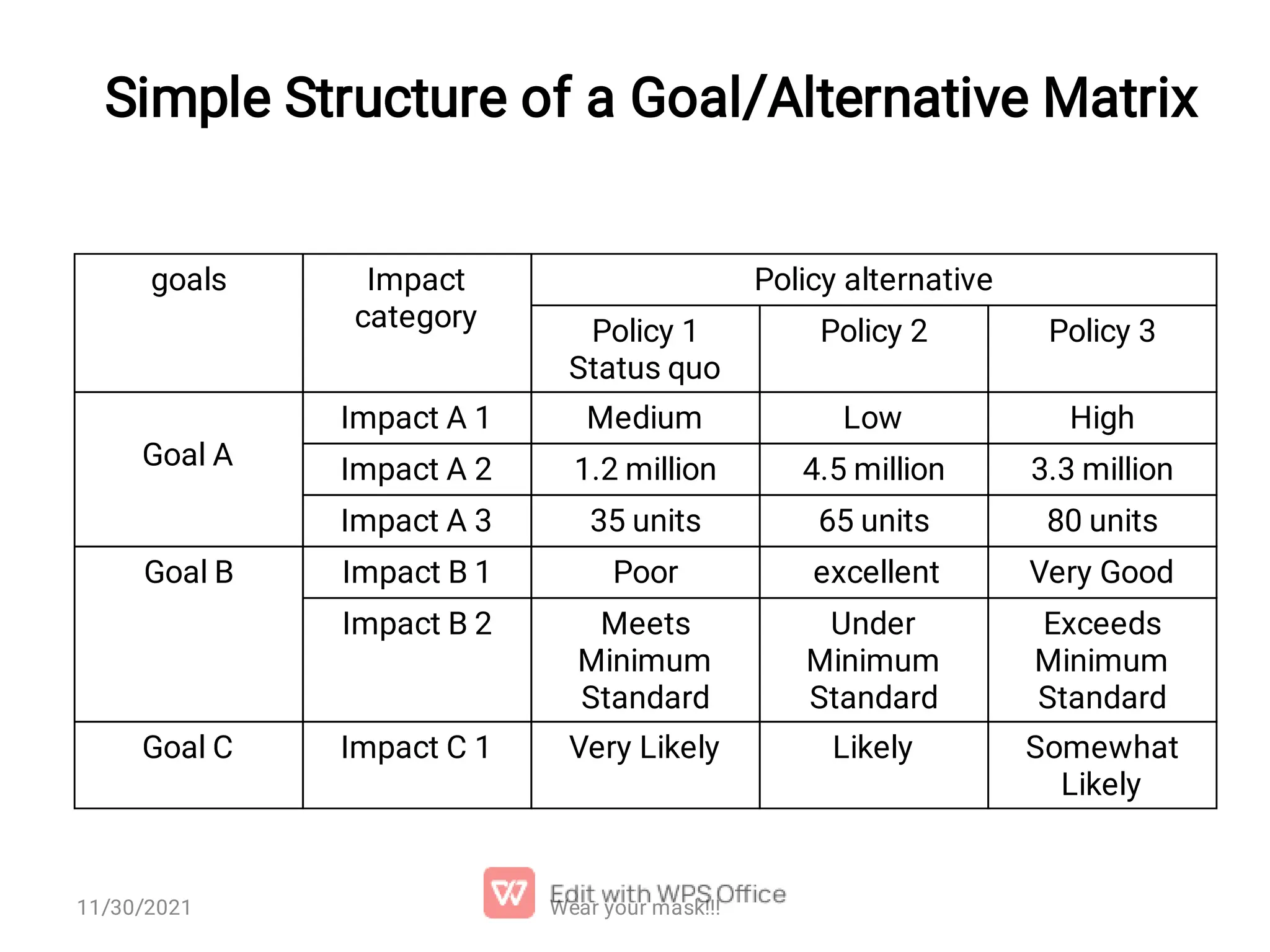
Simple Structure of a Goal/Alternative Matrix goals Impact category Policy alternative Policy 1 Status quo Policy 2 Policy 3 Goal A Impact A 1 Medium Low High Impact A 2 1.2 million 4.5 million 3.3 million Impact A 3 35 units 65 units 80 units Goal B Impact B 1 Poor excellent Very Good Impact B 2 Meets Minimum Standard Under Minimum Standard Exceeds Minimum Standard Goal C Impact C 1 Very Likely Likely Somewhat Likely 11/30/2021 Wear your mask!!!
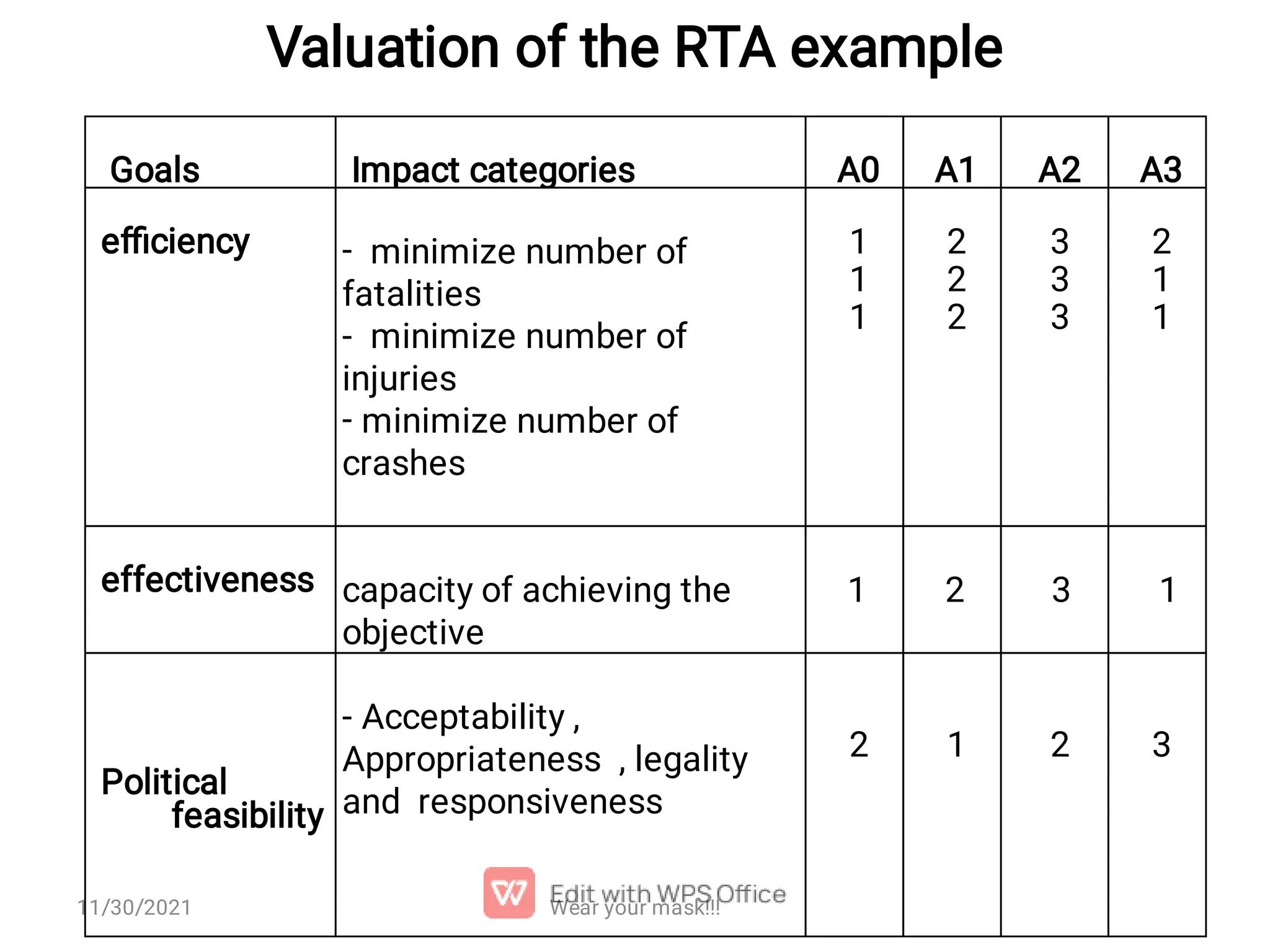
Goals Impact categories A0 A1 A2 A3 efficiency minimize number of fatalities - minimize number of injuries minimize number of crashes - - 1 1 1 2 2 2 3 3 3 2 1 1 effectiveness capacity of achieving the objective 1 2 3 1 Political feasibility - Acceptability , Appropriateness , legality and responsiveness 2 1 2 3 Valuation of the RTA example 11/30/2021 Wear your mask!!!
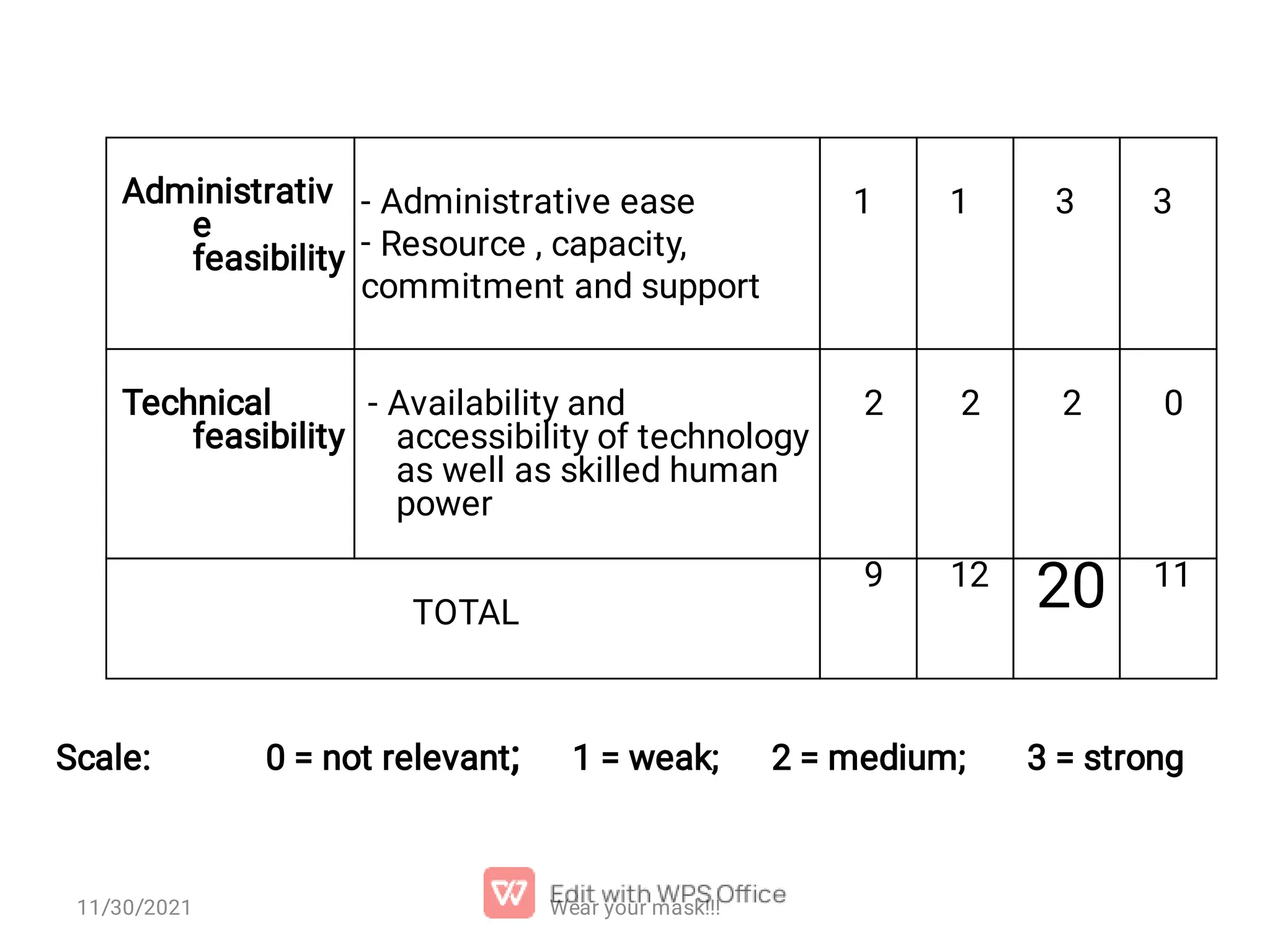
Scale: 0 = not relevant; 1 = weak; 2 = medium; 3 = strong Administrativ e feasibility - Administrative ease Resource , capacity, commitment and support - 1 1 3 3 Technical feasibility - Availability and accessibility of technology as well as skilled human power 2 2 2 0 TOTAL 9 12 20 11 11/30/2021 Wear your mask!!!
4. Assessing and Recommending actions • • Finally, the analyst must assess the alternatives in terms of the goals, identifying the almost inevitable tradeoffs faced in choosing one alternative over the others. The recommendation to adopt a policy alternative should follow directly from this assessment. 11/30/2021 Wear your mask!!!
Cont… • • The analyst should convey the important uncertainties encountered in reaching the recommendation. A competent analysis that carefully considers tradeoffs and uncertainties will often be useful to the client even if the client rejects the recommendation. 11/30/2021 Wear your mask!!!
Public policy analysis trade-offs • • • Trade-Offs: Definition Trade-off: a situation that involves losing one quality or aspect of something in return for gaining another quality or aspect. Opportunity cost concept - Where you have to give up something to get something else. Can’t have both 11/30/2021 Wear your mask!!!
Example • • – – – • Assume that you want to buy a car and there are only two cars (blue and green) in the market. Further assume that: The blue car has airbag but the green car does not Your favorite color is green, and you prefer a car with airbag Obviously, green car with airbag is not one of your options How to decide? 11/30/2021 Wear your mask!!!
Cont’d…………. •     You could make your decision based on color, or on air bag, or you could combine the two attributes into some composite notion of satisfaction such as: Safety, Durability, Maintenance costs, size, etc and decide based up on it. 11/30/2021 Wear your mask!!!
Cont’d……….. • • But remember that there is no way to objectively conclude that one policy alternative is better than another, especially where non-monetary trade-offs are involved. Therefore, the purpose of multi-criteria trade-off methods is to improve the quality of decisions by making the decision making process more explicit, rational, and efficient. 11/30/2021 Wear your mask!!!
Why policy tradeoffs are important? • • Policy-trade-offs are necessary because most policy analysts tend to be engaged in the rational assessment of public problems through economic analysis using quantitative methods with the assumption of coming to logical conclusions. The underlying question to be raised is the other dimension of the use, the democratic process. 11/30/2021 Wear your mask!!!
Cont’d…………. • • • In identifying policy direction there are always competing values to be considered and this becomes the basis for policy trade-offs. policy analyses have become consensual/ mainstream approaches rather than being skewed to either contentious or value critical or paradigm challenging approaches (Kraft and Furlong 2004). Should analysts consistently adhere to consensual norms/mainstream public values, or should they challenge the status quo is a frequently asked question. 11/30/2021 Wear your mask!!!
Cont’d………… • • According to Martin Rein (1976), analysts need to pursue a value critical approach that urges analysts to be skeptical and have to distrust orthodoxy. The scholar, therefore, recommends that policy analysts have to become a “moral critic” who can question the value and belief assumptions behind a given proposition. 11/30/2021 Wear your mask!!!
Critical exercises 1. Explain why public policy analysis has to consider trade-offs? 2. Consider that you are chosen as member of a group of policy analyst in Ethiopia. In your group, there are economists and rationalists who strictly adhere to their discipline principles of efficiency and insisting on the cost-benefit analysis approach. What are some of trade-offs that you are going to present to members of your group that there are also equally non-economic factors to be considered in the analysis? 3. What are the merits and demerits of consensual or mainstream policy analysis? 11/30/2021 Wear your mask!!!
Communicating Analysis • • • – – – The format of your PA plays an important part in determining how effectively you communicate your advice to your client. Clients Vary greatly in their levels of technical and economic sophistication; you should write your analysis accordingly. Guidelines on how you can present your work: Structuring interaction Keeping your clients attention Establishing credibility 11/30/2021 Wear your mask!!!
Communicating Policy Analysis: Dos • • • • • • Remember the Client! Keep in mind that your task is to provide useful advice. Set priorities! Organize your information carefully. (essential material in the text, supporting material in appendices). Decompose your analysis into component parts Use heading that tell a story. Avoid abstract headings Be balanced Acknowledge uncertainty but provide your resolution of it. 11/30/2021 Wear your mask!!!
Cont… • • • • • • Be credible by documenting as extensible as possible Be succinct / to the point Avoid jargon and clearly explain any technical terms Make explicit arguments for importance of goals Favor short and direct sentences, use active voice. Provide clear tables and figures that stand alone. 11/30/2021 Wear your mask!!!
Thank You 11/30/2021 Wear your mask!!!
• Thank you Wear your mask!!! 11/30/2021

public policy analysis for MA chapter 3.pdf

  • 1.
    Chapter three: Doingpolicy analysis 1) 2) 3) 3.1. Steps in policy analysis Problem analysis Solution analysis Communicating policy analysis Wear your mask!!! 11/30/2021
  • 2.
    3.1. Steps inpolicy analysis    • The term Policy analysis comes from a Greek word meaning to break down into component parts These components can be specified as a series of steps. There are different steps of the policy analysis process provided by different scholars. The commonly known two steps are; The five step (US government office of Management and Budget) analysis process and the eight step (Eugene Bardach, 2000) policy analysis process. Wear your mask!!! 11/30/2021
  • 3.
    Steps in policyanalysis 1) 2) 3) 4) 5) 1) 2) 3) 4) 5) The five step The five step Stating of the policy rationales (goals); Stating the assumptions in the analysis explicitly; Evaluating the alternatives convincingly; Identify and show measure benefits and costs; and Verify results through follow-up studies The eight step The eight step Defining the problem; Assembling evidence; Selecting criteria for making decision; Constructing alternatives; Predicting the outcome of each alternative; Wear your mask!!! 11/30/2021
  • 4.
    Cont… •   • Weimer and vining(2007) have summarized the policy analysis steps in to two major components: Problem analysis and Solution analysis and the result of these two components will be communicated to the client. And they called it steps in rationalist policy analysis. Wear your mask!!! 11/30/2021
  • 5.
  • 6.
    Problem Analysis  1. 2. 3. Problem analysiscomprises of three major steps: Understanding the problem Choosing and explaining relevant policy goals and constraints, and Choosing a solution method. Wear your mask!!! 11/30/2021
  • 7.
    1. Understanding theproblem  A.    This stage involves: Assessing symptoms, Framing the problem and Modeling the problem. Assessing symptoms The whole public or the client perceive problems as undesirable conditions. Thus, they tend to specify problems in terms of undesirable symptoms or impacts rather than the underlying causes. So, the analysts task here is to assess the symptoms and provide an explanation of the causes and the problem. Wear your mask!!! 11/30/2021
  • 8.
    Cont…   This is doneby locating empirical data that can help you put the symptoms in quantitative perspective. e.g. Car Accident Fatalities: Number of such accidents, How the number has changed over time/trend what percentage of total death they comprise and other measures of magnitude, distribution and time trend of the symptom. To do this, collect empirical data, be familiar with the current public discussion about the symptom and the history of existing policy relevant. Wear your mask!!! 11/30/2021
  • 9.
    Cont…  How to collectdata? What source/type of data? Importance Conveys the relative importance and urgency of the problem and it begins to establish your credibility as some one who is knowledgeable about it./importance and severity of the problem Wear your mask!!! 11/30/2021
  • 10.
    THE PROBLEM: High andincreasing number of road traffic accident Wear your mask!!! 11/30/2021
  • 11.
    How can theproblem be defined? Road Traffic Accidents (RTA) “Accidents which occurred or originated on a way or street open to public traffic and which resulted in one or more persons being killed or injured and in which at least one moving vehicle was involved.” UN Wear your mask!!! 11/30/2021
  • 12.
    Current Situation In theworld… fatalities / 100,000 people 5.0 5.4 13.9 12.7 11.7 40.5 21.5 41.6 34.4 32.5 34.3 26.0 48.4 35.0 Japan UK United ... Romania Colombia Libya Peru Egypt Kenya Senegal Tanzania Malawi Eritrea Ethiopia 0.0 5.0 10.0 15.0 20.0 25.0 30.0 35.0 40.0 45.0 50.0 Wear your mask!!! 11/30/2021
  • 13.
  • 14.
    ETHIOPIA • • • In Ethiopia caraccident is becoming a serious problem and affecting many individuals and families as well as the nation. every month, around 400 people are killed or hospitalized due to RTA 41% of the injuries registered in Addis Ababa’s hospitals are due to RTA Wear your mask!!! 11/30/2021
  • 15.
    The trend isupward… Wear your mask!!! 11/30/2021
  • 16.
    Localization • • more than 65%of RTA reported in Ethiopia occur in Addis Ababa Most of the accidents occur in the central part of the country (Oromia Regional State and Addis Ababa) Wear your mask!!! 11/30/2021
  • 17.
    • • in cities, 90%of the victims are pedestrians most victims are active people and are main breadwinners for their families Who are the victims? Wear your mask!!! 11/30/2021
  • 18.
    • • • • • Transportation companies forcetheir employees to drive in long shifts (more than 8 hrs/day), this resulting in tired drivers In 2006, the number of RTA involving mini buses increased by 32.6% (the number for private vehicles only increased by 1.4%) Driving under the influence of alcohol and chat is usual (police does not have devices for alcohol testing) Problems related to roads jaywalking is a habit for pedestrians Who causes the accidents? Wear your mask!!! 11/30/2021
  • 19.
    How Much doaccidents cost? • • Estimated cost – 1- 4% of GNP / year 350 - 430 million Birr/ year Wear your mask!!! 11/30/2021
  • 20.
    B. Framing theproblem   • 1) 2) 3) This step is about explaining the problem in terms of market failure or government failure. But what do we mean by Market failure and Government failure? Market failure According to Adam smith’s Laissez- faire states, governments should allow private markets to operate with a free hand. However, he listed three fundamental roles of government: National defense An impartial system of law A set of public works and institutions Wear your mask!!! 11/30/2021
  • 21.
    Cont…  • Government policies beyondthese minimum functions may be justified by the efficiency losses from imperfect markets or the need of the less fortunate based on equity concerns. What is a perfect market/ perfectly competitive market? Economics start its analysis of competition markets with assumptions. Wear your mask!!! 11/30/2021
  • 22.
    Assumptions for perfectcompetition 1. 2. 3. 4. 5. Many buyers and sellers Perfect information Homogeneous product Freedom of entry and exit/ perfect mobility No collusion Wear your mask!!! 11/30/2021
  • 23.
    Cont…    Economist recognize severalcommonly occurring circumstances of private choice, referred to as Market failure, that violates the assumptions of the competitive economy/market. A market failure occurs when the “invisible hand” pushes in such a way that individual decisions don't lead to socially desirable outcomes. Any time a market failure exists, there is a reason for possible government intervention into markets to improve the outcome. Wear your mask!!! 11/30/2021
  • 24.
    Causes of marketfailure a. b. c. Public goods Externalities Information asymmetry d. Monopoly Wear your mask!!! 11/30/2021
  • 25.
    A. Public goods:a good or service that is provided without profit to all members of a society, either by the government or by a private individual or organization. The market can not allocate this particular good efficiently. Wear your mask!!! 11/30/2021
  • 26.
    Cont…   • b. Externalities Externalities arethe effect of a decision on a third party that is not taken into account by the decision-maker. It is cost or benefit to a party not involved in the production and consumption of a good. Positive or Negative externalities Wear your mask!!! 11/30/2021
  • 27.
    Cont… • – – Externalities can beboth positive and negative. - Negative externalities second-hand smoke, water and air pollution - Positive externalities innovation, new business formation Wear your mask!!! 11/30/2021
  • 28.
    c. Information Asymmetry   •  Perfectlycompetitive markets assume perfect information. Real-world markets often involve deception, cheating, and inaccurate information. When there is a lack of information, buyers and sellers do not have equal information, markets may not work properly. What Policy measures can you think of in order to deal with informational Problems? Wear your mask!!! 11/30/2021
  • 29.
    d. Monopoly • • • • A singleseller in a market Gives no choice for customers Sellers are price setters Monopolists charge higher than would exist in competitive market Wear your mask!!! 11/30/2021
  • 30.
     • •    If there isany evidence of market failure then government intervention can be recommended as a solution to the problem. But will government succeed in designing, implementing, and enforcing effective policy responses to market imperfections? The translation of the public interest in to public policy requires several steps: Identifying the public interest through voting or other methods (problem Identification) Creating policies through legislative process (adoption) and ; Administrating policy through a public bureaucracy (Implementation) Wear your mask!!! 11/30/2021
  • 31.
    Cont… Problems related tothe three steps above and inherent behaviors of governments can be named as Government failure. Thus, 1. Government failure occurs when government intervenes unnecessarily: market can be improved by eliminating government intervention 2. When government intervention couldn’t correct market failure: Government failure + Market failure: search for superior government intervention that can solve the market failure. Wear your mask!!! 11/30/2021
  • 32.
    Cont… •   • The example oftraffic accident Fatalities has some aspect of government failure and market failure. C. Modeling the problem/ Identifying policy variables policy variables The Linking policy variables to the conditions of concern Developing a behavioral models that relate the conditions of concern to variables that can be manipulated by public policy It goes beyond framing to identify important policy variables Wear your mask!!! 11/30/2021
  • 33.
    Structure of theproblem tree showing causes and effects or conceptual model Wear your mask!!! 11/30/2021
  • 34.
    Causes Human Vehicle s Environment • • Speed management Poor Vehicle Inspection (Lighting, Braking,Seat belts, etc.) • • • • • • • Drivers’ Behavior Pedestrians’ Behavior Use of Alcohol Chewing Chat Tiredness Not using seat belts First Aid • • • • • • Poor condition of roads Speed limits Lack of sidewalks Lack of crash- protective roadside objects Poor rescue facilities Poor law enforcement Road Traffic Accidents Conceptual Model of the RTA example Wear your mask!!! 11/30/2021
  • 35.
    • • • Death Injuries Psychological trauma Road Traffic Accidents IndividualCommunity National • • Families lose main breadwinners Poverty • • Lose of active labor Burden for the social security system Effects Conceptual Model cont... Wear your mask!!! 11/30/2021
  • 36.
    Discussion Question • • • • Consider theproblem of Drug abuse How can this be framed? and How can it be modeled? Ans: How can drug abuse be defined? Drug abuse means when people use illegal drugs or use legal drugs inappropriately. but we can define it in what ever way it suits the objective. Drug abuse is a patterned use of an illegal drug in which the user consumes the substance in amounts or with methods which are harmful to themselves or others. Wear your mask!!! 11/30/2021
  • 37.
    Cont… •      The symptoms ofthe problem can be assessed by collecting information about: The number of people using illegal drugs The number and frequency of crimes committed by addicts The estimated amount of health care costs incurred due to use of drugs The estimated amount of revenue forgone due to lost productivity as a result of drug use The number of separated families/affected children due to use of drugs by parents Wear your mask!!! 11/30/2021
  • 38.
    Cont… • • • For example, theUSA losses about 700 million dollar per year in increased healthcare costs, crime and lost productivity as a result of drug abuse. This shows that drug abuse is nowadays a serious problem in many countries especially the developed ones. How the problem can be framed? The problem of drug abuse can be framed as a negative externality problem (a form of market failure). Why? Because it affects families, individuals/citizens and the whole public/state who are not involved in the consumption or production of illegal drugs through crimes, neglects and costs. Wear your mask!!! 11/30/2021
  • 39.
    Conceptual model Crime by addicts Spreadof disease Family separation / children abuse Crime in the distributio n Drug Abuse Peer pressure Seems pleasurable Escape from reality Availability in the distribution system Health effects/ costs Lost productivity Cause s effect s Wear your mask!!! 11/30/2021
  • 40.
    • – – • Before the problemanalysis step arrives at its final stage: the analyst makes a list of the goals/criteria that he/she wants to achieve by means of the policies that he/she will recommend to his/her client explains briefly what each goal means, preferably in a brief and plain style. This is the most difficult step, because goals, especially in ill-structured public problems, are characterized by their multiplicity, conflict and 2. Choosing and explaining relevant policy goals and constraints Wear your mask!!! 11/30/2021
  • 41.
    Cont…     Specification of goalsis an important input and output of policy analysis . Analysts should present reasoned arguments for including or excluding a particular goal./Justification Since the trade-off between goals is especially difficult and controversial, clarifying the trade-off between goals is vital It is also important to clarify the distinction between goals (the values we seek to promote) and policies (alternatives and strategies for promoting them) Wear your mask!!! 11/30/2021
  • 42.
    Cont…    • Goals can beclassified in to two: substantive and instrumental goals. Substantive goals represent values such as efficiency and equity that society wishes to secure for their own sake. Instrumental goals are conditions that increase the prospects for achieving substantive goals. Commonly known instrumental goals are political feasibility, resource constraints (as policy analysis is the art of the possible), administrative and technical feasibility. Wear your mask!!! 11/30/2021
  • 43.
    Cont… • Instrumental goalsoften enter the solution analysis as constraints rather than goals. Thus, we call them constraints. Wear your mask!!! 11/30/2021
  • 44.
    Which policy goalsare relevant to the RTA example? 1. 2. Ans: Efficiency: resources are being affected e.g. human, capital(vehicle) and related consequences which result in negative economic impact. We need a policy that can minimize human death, injuries and vehicle crash, thus improve efficiency. Political feasibility: acceptability, appropriateness, legal, and responsiveness. 3.Administrative feasibility: authority, commitment, capacity and support are required to implement/ enforce policies. 4. Technical feasibility: vehicle inspection/ very technical Wear your mask!!! 11/30/2021
  • 45.
    Group exercise • Identifythe appropriate policy goals in the Drug abuse example. Wear your mask!!! 11/30/2021
  • 46.
    3. Choosing aSolution Method    • Choosing solution methods is selecting the techniques we use for endorsing/approving the best policy alternatives. Goal selection is a component of problem analysis. In other words, you must decide which goals are relevant to your analysis before you can begin to consider solutions systematically. This is because the nature and number of goals largely determine the appropriate solution method. Choosing how we will do the solution analysis is also a component of problem analysis. Wear your mask!!! 11/30/2021
  • 47.
  • 48.
      Figure below distinguishesthree general goal circumstances: 1. Efficiency is the only relevant goal 2. Efficiency and one other goal are relevant can efficiency and other goal be quantified? A. if yes, other question: can the other goal be monetized? I. if yes, use modified cost benefit analysis as a solution method. II. if no, use cost effectiveness analysis as a solution method. B. If no, use multi-goal analysis as a solution method 3. Efficiency and two or more goals are relevant in this case the multi-goal analysis should be used as a solution method. Wear your mask!!! 11/30/2021
  • 49.
    Cost-Benefit Analysis •  •    An analyticalframework used to assess the benefits and costs of policy proposals Formal cost-benefit analysis should be your primary solution method when you believe that efficiency is the only relevant goal. Focuses on economic efficiency It reduces all the impacts of a proposed alternative to a common unit of impact, namely dollars/birrs. Calculates the net benefits for each policy proposal Takes a long-term view and incorporates all relevant costs and benefits Wear your mask!!! 11/30/2021
  • 50.
    Cont’d……….   Once all theimpacts have been reduced to dollars/birrs, the evaluation rule is to choose that alternative that generates the largest aggregate net benefits. Thus, in cost-benefit analysis, although there are different goals, they can be reduced to positive efficiency impacts (benefits) or negative efficiency impacts (costs), which, in turn, can all be measured in dollars/birrs, or monetized. Wear your mask!!! 11/30/2021
  • 51.
    Cont’d…………..     Sometimes prices revealedin markets provide a basis for monetization. However, market prices often do not reflect marginal social costs or marginal social benefits because of the distortions caused by market failures and government interventions. There are also many classes of impacts, such as willingness of people, that usually cannot be monetized through estimations based on direct observation of markets. Considerable skills and judgment must be exercised to assess the costs and benefits of these impacts reasonably. Wear your mask!!! 11/30/2021
  • 52.
    • •   Qualitative Cost-Benefit Analysis Evenwhen we decide that efficiency is the only relevant goal, we must still determine whether all efficiency impacts can be reasonably monetized. If not, the qualitative cost-benefit is the appropriate solution method. Like standard cost-benefit analysis, it begins with a prediction of impacts. Some of the impacts may be expressed in natural units (example, hours of delay or tons of pollutants), while others may be qualitative (example, a despoiled scenic view). Wear your mask!!! 11/30/2021
  • 53.
    •  • • • If we areunable to monetize one or more of these impacts, then we cannot directly calculate the dollar/birr value of net benefits. Instead, we must make qualitative arguments about the orders of magnitude of the various non- monetized impacts. Sometimes impacts cannot be monetized because of technical difficulties in making valuations. When standard procedures do exist for inferring such values, limitations of time, data, and other resources frequently make monetization impractical. Rather than attempt difficult and time-consuming valuations, even highly skilled professionals resort to qualitative cost-benefit analyses to assess orders of magnitude of efficiency impacts. Wear your mask!!! 11/30/2021
  • 54.
    • • • • • Ex-post quantitative cost-benefitanalyses are available in many policy areas. Elements from these studies can often be used as a source for ex-ante quantitative estimates of costs or benefits, or at least as a guide for estimating their orders of magnitude. When you begin working in a new policy area, spending some time to become familiar with relevant cost-benefit analyses is likely to be a good investment. If the analyst cannot confidently monetize important efficiency impacts to within even orders of magnitude, then he may find it useful to work with the non- monetized impacts as if they were separate goals. For example, analysts may have to decide how to compare certain program costs with highly uncertain benefits, such as environmental or catastrophic failure risks. Thus, the qualitative cost-benefit analysis takes the form of multi-goal analysis. Wear your mask!!! 11/30/2021
  • 55.
     •   • Modified Cost-Benefit Analysis Ifa client is only concerned with equity, or any other single, non-efficiency goal, then efficiency is irrelevant. Yet, some thought should convince you that efficiency is almost certainly relevant. This can be most clearly illustrated for the case where equity is the only goal. Any intervention in the market to finance redistribution (absent utility interdependence and market failure) must inevitably result in some deadweight loss. Even where we are primarily concerned with achieving a given redistribution, we should seek to minimize the deadweight loss; in other words, we should attempt to carry out the distribution as efficiency as possible. Policy analysis almost never involves a single goal unless that goal is efficiency. Wear your mask!!! 11/30/2021
  • 56.
    •   •  In a particularanalysis you may conclude that efficiency and one other goal (most frequently, equity) are appropriate. We can employ modified cost-benefit analysis if we are able and willing to monetize impacts on both efficiency and the other goal. You must be willing to assign dollar/ birr values to various levels of achievement of the other goal. For example, if the other goal is equality of the income distribution, modified cost-benefit analysis weighing costs and benefits accruing to different income groups, resulting distributional weighted cost-benefit analysis. The advantage of such approach is that by incorporating distributional issues into a cost-benefit analysis, we can come up with a single metric for ranking alternatives. The disadvantage is that the metric is achieved only by forcing efficiency and equity to be measurable by the same standards. Wear your mask!!! 11/30/2021
  • 57.
       Modified cost-benefit analysis,by assuming a particular set of distributional weights, also risks diverting attention from the trade-off between efficiency and distributional values in the ranking of alternatives, which merges both the distributional and efficiency assessments. When using modified cost-benefit analysis, it is usually desirable to present both the distributionally weighted net benefits and the unweighted net benefits of the policy alternatives. A comparison of the weighted and the unweighted net benefits makes clear the importance of the particular weights selected. Wear your mask!!! 11/30/2021
  • 58.
    • • Cost Effectiveness Analysis:Achieving goals Efficiently Cost-Effectiveness analysis is appropriate when both efficiency and the other goal can be quantified but the other goal cannot be monetized. In contrast to modified cost-benefit analysis, where both goals are measured in dollars/birrs and thus commensurable, the two goals are treated as non- commensurable. Wear your mask!!! 11/30/2021
  • 59.
    If cost –benefit analysis is not applicable, 1) 2) 3) Cost effectiveness analysis Cost minimization analysis: Cost utility analysis 11/30/2021 Wear your mask!!!
  • 60.
    a. Cost effectivenessanalysis: • 11/30/2021 Wear your mask!!!
  • 61.
    b. Cost minimizationanalysis: • 11/30/2021 Wear your mask!!!
  • 62.
    c. Cost utilityanalysis: • 11/30/2021 Wear your mask!!!
  • 63.
    • 1) • • • We can approachcost-effectiveness analysis in one of two ways. The fixed budget approach choose a given level of expenditures (say, 10 million birr) and find the policy alternative that will provide the largest benefits (i.e. the greatest achievement of the non- efficiency goal). 2). The fixed effectiveness approach Specify a given level of benefit and then choose the policy alternative that achieves the benefit at the lowest cost. Both of these methods are cost-effectiveness procedures. For each approach, it is important to consider incremental changes in costs and the non-efficiency goal when comparing alternatives. In some cases the increments are assessed relevant to the status quo but in others they are assessed relative to another alternative that is logically between it and the status quo. Wear your mask!!! 11/30/2021
  • 64.
    • • • The crucial distinctionbetween cost-benefit analysis and cost-effectiveness analysis is that: Cost benefit analysis can assess both whether any of the alternatives are worth doing (i.e. whether social benefits exceed social costs) and how alternatives should be ranked if more than one generates positive net social benefits. Cost-effectiveness cannot tell the analyst whether a given alternative is worth doing (this requires a cost-benefit analysis), but if a decision is made to redistribute or achieve some other goal, it can help in deciding which policy alternative will do so most efficiently (with minimum losses of social surplus). Wear your mask!!! 11/30/2021
  • 65.
    Multi goal analysis • • • • • Multigoal analysis is appropriate when three or more goals are relevant and; when one of two goals can not be quantified. Policy analysis involves rarely one goal. Thus, Multi goal analysis serves as the appropriate solution method almost always. All the other solution methods can be viewed as special cases of multi goal analysis. The whole section of solution analysis will focus on how to conduct multi goal analysis. Wear your mask!!! 11/30/2021
  • 66.
    Cost Benefit Analysis • • • • • • CostBenefit Analysis (CBA) Basic Steps in a CBA Net Present Value Benefit Cost Ratio Internal Rate of Return Pay Back Wear your mask!!! 11/30/2021
  • 67.
    Cost-Benefit Analysis • • • • Cost BenefitAnalysis (CBA) is helpful in answering the following questions: Is the policy worthwhile financially? Is it the best option? Should it be undertaken at all? Wear your mask!!! 11/30/2021
  • 68.
    1. 2. 3. a) b) c) d) Basic Steps ina CBA Identify all Costs & Benefits Discounting Assess policy(ies) by calculating Net Present Value (NPV) Benefit Cost Ratio (BCR) Internal Rate of Return (IRR) Payback Wear your mask!!! 11/30/2021
  • 69.
      • – – what are they? whatare they worth? Measurement issues: Direct & indirect (i.e. externalities) effects Tangible & intangible effects 1) Identification of Costs and Benefits Wear your mask!!! 11/30/2021
  • 70.
    Example: Typical Costsand Benefits Wear your mask!!! 11/30/2021
  • 71.
    2) Discounting • • • – • Policies &projects last a long time Frequently costs & benefits occur at different times Money has a time value, i.e. ceteris paribus current Dollars are more valuable than future Dollars Thus, we need to place current & future costs & benefits on an equal basis for comparison Wear your mask!!! 11/30/2021
  • 72.
    Cont… • • This is doneby “discounting,” that is by reducing future Birr value to present value by applying a discount rate The discount rate is an interest rate a national bank charges depository institutions Wear your mask!!! 11/30/2021
  • 73.
    Discount Rate vs.Interest Rate • • Discount Rate means the minimum rate of return to be paid by recipient of financing facilities from central bank (Central bank for commercial banks) Whereas Interest Rate means a rate which is charged or paid for the use of money. (Commercial banks for its customers) Wear your mask!!! 11/30/2021
  • 74.
    Cont.. • – • – • Example: ETB 100,000 investedat a 3% interest rate today will be worth roughly ETB 115,927 in five years FV = PV * (1+r)t ETB 100,000 in anticipated benefits five years from now is worth roughly ETB 86,261 today, when discounted by 3% PV = FV / (1+d)t Wear your mask!!! 11/30/2021
  • 75.
    What To UseAs a Discount Rate? • – – – – There are various approaches to selecting one “Givens” (i.e. some authority imposes one) Bank interest rates Rates of return on certain investments (e.g. government bonds) “Social” discount rates Wear your mask!!! 11/30/2021
  • 76.
    3) Assessing policies a) b) Policiesor projects can be assessed by calculating Net Present Value (NPV) Benefit Cost Ratio (BCR) c) Internal Rate of Return (IRR) d) Payback Wear your mask!!! 11/30/2021
  • 77.
    Net Present Value • – • Thedifference between total discounted benefits and total discounted costs NPV = (PVB ‑ PVc) NPV is the sum of all terms Where: Σ – sum of all years i to N i – the beginning year N- the final year NV- net value (benefit - cost) t – number of years d- discount rate Wear your mask!!! 11/30/2021
  • 78.
    Cont.. – • – • NPV: decision criteria Fora single policy/project: a positive NPV indicates acceptability For multiple (competing) policies/projects: the project(s) with the highest NPVs should receive highest priority Wear your mask!!! 11/30/2021
  • 79.
    Example (assume das 10%) Policy/ Project A Year 1 Year 2 Year 3 Year 4 Year 5 Total Total Discounte d Benefits - 2,000.00 3,000.00 4,000.00 5, 000.00 14,000.00 9,743.00 Costs 5,000.00 1,000.00 1,000.00 1,000.00 1, 000.00 9,000.00 7,427.00 Cash Flow (5,000.00) 1,000.00 2,000.00 3,000.00 4, 000.00 5,000.00 2,316.00 Wear your mask!!! 11/30/2021
  • 80.
    Policy / project B Year1 Year 2 Year 3 Year 4 Year 5 Total Total Discounted Benefits 1, 000.00 2,000.00 4,000.00 4, 000.00 4,000.00 15, 000.00 10,783.00 Costs 2, 000.00 2, 000.00 2,000.00 2, 000.00 2, 000.00 10, 000.00 7,582.00 Cash Flow(1,000.00) - 2,000.00 2, 000.00 2,000.00 5,000.00 3,201.00 Wear your mask!!! 11/30/2021
  • 81.
    Cont… • – – – – – Project A Year 1= -5000 * (1 + .1)-1 = -4545 Year 2 = 1000 * (1 + .1)–2 = 826 Year 3 = 2000 * (1 + .1)–3 = 1503 Year 4 = 3000 * (1 + .1)–4 = 2049 Year 5 = 4000 * (1 + .1)–5 = 2484 NPV = 2316 Or = 9743 - 7427 = 2316 Wear your mask!!! 11/30/2021
  • 82.
    Cont… • – – – – – Project B Year 1= -1000 * (1 + .1)-1 = -909 Year 2 = 0 * (1 + .1)–2 = 0 Year 3 = 2000 * (1 + .1)–3 = 1503 Year 4 = 2000 * (1 + .1)–4 = 1366 Year 5 = 2000 * (1 + .1)–5 = 1242 NPV = 3201 Or = 10783 - 7582 = 3201 Wear your mask!!! 11/30/2021
  • 83.
    Decision based onNPV • • NPVA = 2316 NPVB = 3201 Since NPVB is greater than NPVA and is greater than 0 : Accept Project B Wear your mask!!! 11/30/2021
  • 84.
    Benefit Cost Ratio(BCR) • • BCR = (PVB / PVC) If Future Value (FV) is a payment that will be made t years in the future, then the "Present Value" of this Payment is PV = FV / (1+d)t Wear your mask!!! 11/30/2021
  • 85.
    Cont… • – • – • Benefit Cost ratio:decision criteria For a single policy/ project: a BC R which is greater than 1 indicates acceptability For multiple (competing) policies/ projects: the project(s) with the highest BC ratios (greater than 1) should receive highest priority Wear your mask!!! 11/30/2021
  • 86.
    Example • – • – Based on theprevious information: Project A BCR = 9743 / 7427 = 1.31 Project B 10783/ 7582 = 1.42 Wear your mask!!! 11/30/2021
  • 87.
    Decision based onBCR • • • BCRA = 1.31 BCRB = 1.42 Since BCR of policy B is greater than BCR of policy A and is greater than 1 : Accept Policy B Wear your mask!!! 11/30/2021
  • 88.
    Class Exercise • a) b) c) Assume aparticular plot of land could be developed as residential housing, an industrial park, or a factory. Also assume there is a possible road adjoining the property and that the property is half a kilometer away from the highway. Note that only one alternative at most can be ultimately approved. Rank these choices in terms of their NPV and choose the one that places first. Calculate the BCR and rank these choices. Compare the two rankings Wear your mask!!! 11/30/2021
  • 89.
    Cont… Residential housing (in million birr) Industrial park(in million birr) Factory (in million birr) PV Benefits 10.00 12.50 16.00 PV Costs 11.00 9.00 12.00 NPV BCR Wear your mask!!! 11/30/2021
  • 90.
    Answer Residential housing (in million birr) Industrial park(in million birr) Factory (in million birr) PV Benefits 10.00 12.50 16.00 PV Costs 11.00 9.00 12.00 NPV -1.00 3.50 4.00 BCR 0.909 1.389 1.333 Wear your mask!!! 11/30/2021
  • 91.
    Cont… • 1. 2. 3. • 1. 2. 3. Ranking in termsof their NPV Factory Industrial park ----- Ranking in terms of their BCR Industrial park Factory ----- Wear your mask!!! 11/30/2021
  • 92.
    NPV & BCRComparison • • – – From the above exercise we can understand that there are inconsistencies The main questions are: Why do such inconsistencies arise? Which method is superior? Wear your mask!!! 11/30/2021
  • 93.
    NPV & BCRComparison Wear your mask!!! 11/30/2021
  • 94.
    Cont…  •  • NPV method isabsolute in the sense that it ignores the capital requirement of projects indicates the amount by which benefits exceed (or do not exceed) costs (total benefit or loss) BCR is relative in the sense that it finds the worth of a project in relation to its investment cost measures the ratio (or rate) by which benefits do or do not exceed costs (efficiency) Wear your mask!!! 11/30/2021
  • 95.
    Cont.. – – – Since the capitalbase requirement for W is smaller than X, BCR ranks W better than X. In this context, BCR method must be preferred to NPV when projects involve different investment cost If the capital market is perfect, meaning any amount of funds could be raised at a given cost of capital, then the NPV method is preferred to BCR. Wear your mask!!! 11/30/2021
  • 96.
    Internal Rate ofReturn • – • The discount rate at which the present value of benefits is equal to the present value of costs The discount rate when NPV = 0 It is used to measure and compare profitability of an investment Wear your mask!!! 11/30/2021
  • 97.
    Cont… – • – • Internal Rate ofReturn: decision criteria For a single project: when IRR is greater than market discount rate, accept the project For multiple (competing) projects: the one with the largest IRR is the most desirable Wear your mask!!! 11/30/2021
  • 98.
    IRR Formula • • • At IRR,Net Present Value (NPV) is zero, thus: NPV = 0; or PV of future cash flows − Initial Investment = 0; or CF1 + CF2 + CF3 + … − Initial Investment ( 1 + r )1 ( 1 + r )2 ( 1 + r )3 Where, r is the internal rate of return; CF1 is the period one net cash inflow; CF2 is the period two net cash inflow, CF3 is the period three net cash inflow, and so on ... Wear your mask!!! 11/30/2021
  • 99.
    Cont.. • 1. 2. 3. 4. But the problemis, we cannot isolate the variable r (= IRR) on one side of the above equation. However, there are alternative procedures which can be followed to find IRR. The simplest of them is described below: Guess the value of r and calculate the NPV If NPV is close to zero then IRR is equal to r. If NPV is greater than 0 then increase r and go to step 5. If NPV is smaller than 0 then decrease r and go to step 5. Wear your mask!!! 11/30/2021
  • 100.
    Example • Find theIRR of an investment having initial cash outflow of $213,000. The cash inflows during the first, second, third and fourth years are expected to be $65,200, $96,000, $73,100 and $55,400 respectively. Solution 1. Assume that r is 10%. NPV at 10% discount rate = $18,372 2. Since NPV is greater than zero we have to increase discount rate, thus NPV at 13% discount rate = $4,521 3. But it is still greater than zero we have to further increase the discount rate, thus NPV at 14% discount rate = $204 4. NPV at 15% discount rate = ($3,975) Since NPV is fairly close to zero at 14% value of r, therefore IRR ≈ 14% Wear your mask!!! 11/30/2021
  • 101.
    Group exercise Policy Arequires $10 million investments and generates $10 million each in year 1 and year 2. Project B requires $1 million investment and generates $2 million in Year 1 and $1 million in Year 2. Rank policy A and policy B using IRR Wear your mask!!! 11/30/2021
  • 102.
    Cont… – – – IRR has acertain attraction, but also has some problems The argument that an IRR which is greater than the market/selected discount rate is desirable can be questioned - discount rates can be arbitrary Calculation (by hand) is tedious & prone to error Under certain conditions there may be more than one correct solution to an IRR problem Wear your mask!!! 11/30/2021
  • 103.
    Flaws in CBA • • Cost-benefitanalysis is a deeply flawed method that repeatedly leads to biased and misleading results. Cost benefit analysis offers no clear advantages in making regulatory policy decisions and often produces inferior results, in terms of both environmental protection and overall social welfare, compared to other approaches (exclude indirect benefits and costs). Wear your mask!!! 11/30/2021
  • 104.
    Payback • • • • This is literallythe amount of time required for the cash inflows from a capital investment project to equal the cash outflows. The formula to calculate payback period of a policy/project depends whether the cash flow per period from the policy/project is even or uneven. In case they are even, the formula to calculate payback period is: Payback period = Initial payment Annual cash inflow Decision: The shorter the payback period, the better the investment, under the payback method. Wear your mask!!! 11/30/2021
  • 105.
    Example (even) • • If 4million is invested with the aim of earning 500 000 per year (net cash earnings), the payback period is calculated thus: P = 4,000,000 / 500,000 = 8 years Wear your mask!!! 11/30/2021
  • 106.
    • • • • When cash inflowsare uneven, we need to calculate the cumulative net cash flow for each period and then use the following formula: Payback Period = A + B C Where, A is the last period number with a negative cumulative cash flow; B is the absolute value (i.e. value without negative sign) of cumulative net cash flow at the end of the period A; and C is the total cash inflow during the period following period A Cumulative net cash flow is sum of inflows to date, minus the initial outflow. Wear your mask!!! 11/30/2021
  • 107.
    Example (uneven typeof cashflow) Year 1 Year 2 Year 3 Year 4 Year 5 Cash Flows (4545 ) 826 1503 2049 2484 Left To Repay ($4,545) ($3,719) ($2,216) ($167) $2,317 Project A Wear your mask!!! 11/30/2021
  • 108.
    Example Year 1 Year2 Year 3 Cash Flows (909) 0 1503 Left To Repay ($909) ($909) 594 Project B Wear your mask!!! 11/30/2021
  • 109.
    Cont… • • • PA = 4.07years PB = 2.6 years Since the payback period for project B is lesser than that of project A: Accept Project B Wear your mask!!! 11/30/2021
  • 110.
    Exercise • An institutionis planning to spend birr 50 million initial investment and the expected cash inflow is birr 10 million in Year 1, birr 13 million in Year 2, birr 16 million in year 3, birr 19 million in Year 4 and birr 22 million in Year 5. Calculate the payback value of the project. Wear your mask!!! 11/30/2021
  • 111.
    Solution Analysis 1. Choosingimpact categories for goals (evaluation criteria) 2. Concretely specifying policy alternatives 3. Predicting impacts of alternatives and Valuing them in terms of criteria 4. Assessing and Recommending actions 11/30/2021 Wear your mask!!!
  • 112.
    • • • The first stepin solution analysis is specifying relevant impact categories for assessing how well each policy alternative contributes to each of goals. Impact categories are used to measure the contributions of different proposed policy alternatives to the goal’s objectives. Thus, the process of choosing evaluation criteria means in fact moving from generality of goals to specificity of concrete calibrations of these goals. 1.Choosing impact categories for goals (evaluation criteria) 11/30/2021 Wear your mask!!!
  • 113.
    Cont… • • • • For example inthe drug abuse problem, efficiency is an appropriate policy goal. There are negative impacts of the problem on productivity, crime, health which are relevant to the efficiency goal. Thus we can write improving productivity, reducing crime, improving health/minimizing health costs and minimizing policy/program costs and maximizing benefits as the impact categories of efficiency. Similarly, equity could be a goal regarding the distribution of some service. The impact category can be the variance in service consumption across income groups. 11/30/2021 Wear your mask!!!
  • 114.
    The impact categoriesof the RTA example Criteria Impact categories Efficiency number of fatalities - number of injuries number of crashes net benefit, benefit cost ratio by using NPV or BCR - - - Effectiveness - What are the strategies to be used and are they capable of achieving the objective of the policy options Political feasibility - Acceptability - Appropriateness , legality and responsiveness Administrative feasibility - Administrative ease Resource , capacity, commitment and support - Technical feasibility - Availability and accessibility of technology as well as skilled human power 11/30/2021 Wear your mask!!!
  • 115.
    2. Concretely specifyingpolicy alternatives • • • This step involves the detailed specification of policy alternatives that can achieve policy goals. Policy alternatives are concrete plans and programs consisting of sets of actions designed to provide solutions for the problem at hand. The process of developing policy alternative requires a clear understanding of the real causes of the problem. 11/30/2021 Wear your mask!!!
  • 116.
    Cont… • – – • Possible alternatives include: preservingthe status quo (do nothing), and any other alternative that can mitigate the undesirable impacts of the problem. It is usually appropriate to include the current policy (status quo) as a policy alternative to avoid the risk of recommending a best alternative that is worse than the current policy. 11/30/2021 Wear your mask!!!
  • 117.
    Sources for specifyingpolicy alternatives 1. 2. 3. There are variety of sources : The existing policy proposals: this includes the status quo as well as earlier proposals which are results of earlier analysts. Other jurisdictions: we can borrow policy proposals from other jurisdictions by studying how other cities, states or countries handled policy problems similar to the one that your jurisdiction faces. Generic policies: after generating a portfolio of generic policies, modification can be done to make it fit the particular situation of the policy problem. 11/30/2021 Wear your mask!!!
  • 118.
    COMMON GENERIC POLICYINSTRUMENTS Policy types Examples Organization - Based Instruments Direct provision Public enterprises Community and voluntary organizations Market organization (consumers and producers market ) Government reorganization • • • • • Authority- Based Instruments Command and control Delegated or self regulation • • Treasure -Based Instruments Subsides :Grants, tax incentive, Loans Financial Disincentive: Taxes and user charges • • Information- Based Instruments Public information campaigns Advertizing Research Inquiries & investigative commissions • • • 11/30/2021 Wear your mask!!!
  • 119.
    Cont…      4. New orunique or custom-made policy alternative: can be issue lurking in the literature or may be product of your imagination/creative solution. Points to remember while crafting alternatives Do not expect to find perfect policy alternative Don’t contrast a preferred policy with a “ dummy” or “straw person” alternatives. Do not have a favorite alternative until you have evaluated all the alternatives in terms of all the goals. Ensure your alternatives are mutually exclusive. Limit the number of alternatives between 3 and 7. 11/30/2021 Wear your mask!!!
  • 120.
    Cont…    The alternatives shouldprovide real choices Alternatives should be consistent with available resources policy alternatives should be concrete set of actions 11/30/2021 Wear your mask!!!
  • 121.
    Policy alternatives forthe RTA example A0 - Status Quo A1 - Standardized Drivers Licensing and Vehicle Inspection A2 - Traffic Law Enforcement A3 - Road Safety Education and Awareness Raising Campaigns 11/30/2021 Wear your mask!!!
  • 122.
    3. Predicting impactsof alternatives and Valuing them in terms of criteria • • • • • Evaluating alternative policies according to chosen criteria is the final stage of policy analysis. Relevant impact categories and policy alternatives will come together to facilitate choice. It involves constructing a goal/policy matrix with scores of different alternatives in different criteria. The task here is to forecast how each policy option will perform in terms of each goal and each impact category and value the effect/ the contribution to the goal. If there is uncertainty regarding the effect, do not suppress it. 11/30/2021 Wear your mask!!!
  • 123.
    Cont.. – – The decision toselect the best alternative is easy when there is either a single criterion, such as efficiency, or an alternative that dominates all other alternatives in all evaluation criteria. 11/30/2021 Wear your mask!!!
  • 124.
    Cont… • • This is rarelythe case in real-life situations, because different alternatives score high and low scores in different criteria. The analyst job here is to clarify the tradeoffs among different criteria. 11/30/2021 Wear your mask!!!
  • 125.
    Simple Structure ofa Goal/Alternative Matrix goals Impact category Policy alternative Policy 1 Status quo Policy 2 Policy 3 Goal A Impact A 1 Medium Low High Impact A 2 1.2 million 4.5 million 3.3 million Impact A 3 35 units 65 units 80 units Goal B Impact B 1 Poor excellent Very Good Impact B 2 Meets Minimum Standard Under Minimum Standard Exceeds Minimum Standard Goal C Impact C 1 Very Likely Likely Somewhat Likely 11/30/2021 Wear your mask!!!
  • 126.
    Goals Impact categoriesA0 A1 A2 A3 efficiency minimize number of fatalities - minimize number of injuries minimize number of crashes - - 1 1 1 2 2 2 3 3 3 2 1 1 effectiveness capacity of achieving the objective 1 2 3 1 Political feasibility - Acceptability , Appropriateness , legality and responsiveness 2 1 2 3 Valuation of the RTA example 11/30/2021 Wear your mask!!!
  • 127.
    Scale: 0 =not relevant; 1 = weak; 2 = medium; 3 = strong Administrativ e feasibility - Administrative ease Resource , capacity, commitment and support - 1 1 3 3 Technical feasibility - Availability and accessibility of technology as well as skilled human power 2 2 2 0 TOTAL 9 12 20 11 11/30/2021 Wear your mask!!!
  • 128.
    4. Assessing andRecommending actions • • Finally, the analyst must assess the alternatives in terms of the goals, identifying the almost inevitable tradeoffs faced in choosing one alternative over the others. The recommendation to adopt a policy alternative should follow directly from this assessment. 11/30/2021 Wear your mask!!!
  • 129.
    Cont… • • The analyst shouldconvey the important uncertainties encountered in reaching the recommendation. A competent analysis that carefully considers tradeoffs and uncertainties will often be useful to the client even if the client rejects the recommendation. 11/30/2021 Wear your mask!!!
  • 130.
    Public policy analysistrade-offs • • • Trade-Offs: Definition Trade-off: a situation that involves losing one quality or aspect of something in return for gaining another quality or aspect. Opportunity cost concept - Where you have to give up something to get something else. Can’t have both 11/30/2021 Wear your mask!!!
  • 131.
    Example • • – – – • Assume that youwant to buy a car and there are only two cars (blue and green) in the market. Further assume that: The blue car has airbag but the green car does not Your favorite color is green, and you prefer a car with airbag Obviously, green car with airbag is not one of your options How to decide? 11/30/2021 Wear your mask!!!
  • 132.
    Cont’d…………. •     You could makeyour decision based on color, or on air bag, or you could combine the two attributes into some composite notion of satisfaction such as: Safety, Durability, Maintenance costs, size, etc and decide based up on it. 11/30/2021 Wear your mask!!!
  • 133.
    Cont’d……….. • • But remember thatthere is no way to objectively conclude that one policy alternative is better than another, especially where non-monetary trade-offs are involved. Therefore, the purpose of multi-criteria trade-off methods is to improve the quality of decisions by making the decision making process more explicit, rational, and efficient. 11/30/2021 Wear your mask!!!
  • 134.
    Why policy tradeoffsare important? • • Policy-trade-offs are necessary because most policy analysts tend to be engaged in the rational assessment of public problems through economic analysis using quantitative methods with the assumption of coming to logical conclusions. The underlying question to be raised is the other dimension of the use, the democratic process. 11/30/2021 Wear your mask!!!
  • 135.
    Cont’d…………. • • • In identifying policydirection there are always competing values to be considered and this becomes the basis for policy trade-offs. policy analyses have become consensual/ mainstream approaches rather than being skewed to either contentious or value critical or paradigm challenging approaches (Kraft and Furlong 2004). Should analysts consistently adhere to consensual norms/mainstream public values, or should they challenge the status quo is a frequently asked question. 11/30/2021 Wear your mask!!!
  • 136.
    Cont’d………… • • According to MartinRein (1976), analysts need to pursue a value critical approach that urges analysts to be skeptical and have to distrust orthodoxy. The scholar, therefore, recommends that policy analysts have to become a “moral critic” who can question the value and belief assumptions behind a given proposition. 11/30/2021 Wear your mask!!!
  • 137.
    Critical exercises 1. Explainwhy public policy analysis has to consider trade-offs? 2. Consider that you are chosen as member of a group of policy analyst in Ethiopia. In your group, there are economists and rationalists who strictly adhere to their discipline principles of efficiency and insisting on the cost-benefit analysis approach. What are some of trade-offs that you are going to present to members of your group that there are also equally non-economic factors to be considered in the analysis? 3. What are the merits and demerits of consensual or mainstream policy analysis? 11/30/2021 Wear your mask!!!
  • 138.
    Communicating Analysis • • • – – – The formatof your PA plays an important part in determining how effectively you communicate your advice to your client. Clients Vary greatly in their levels of technical and economic sophistication; you should write your analysis accordingly. Guidelines on how you can present your work: Structuring interaction Keeping your clients attention Establishing credibility 11/30/2021 Wear your mask!!!
  • 139.
    Communicating Policy Analysis:Dos • • • • • • Remember the Client! Keep in mind that your task is to provide useful advice. Set priorities! Organize your information carefully. (essential material in the text, supporting material in appendices). Decompose your analysis into component parts Use heading that tell a story. Avoid abstract headings Be balanced Acknowledge uncertainty but provide your resolution of it. 11/30/2021 Wear your mask!!!
  • 140.
    Cont… • • • • • • Be credible bydocumenting as extensible as possible Be succinct / to the point Avoid jargon and clearly explain any technical terms Make explicit arguments for importance of goals Favor short and direct sentences, use active voice. Provide clear tables and figures that stand alone. 11/30/2021 Wear your mask!!!
  • 141.
  • 142.
    • Thank you Wearyour mask!!! 11/30/2021