Scala | Decision Making (if, if-else, Nested if-else, if-else if)
Last Updated : 11 Jul, 2025
Decision making in programming is similar to decision making in real life. In decision making, a piece of code is executed when the given condition is fulfilled. Sometimes these are also termed as the Control flow statements.
Scala uses control statements to control the flow of execution of the program based on certain conditions. These are used to cause the flow of execution to advance and branch based on changes to the state of a program.
The conditional statements of Scala are: - if
- if-else
- Nested if-else
- if-else if ladder
if statement
"
if" statement is the simplest decision making statements among all decision making statements. In this statement, the block of code is executed only when the given condition is true and if the condition is false then that block of code will not execute.
Syntax: if(condition) { // Code to be executed } Here,
condition after evaluation will be either true or false. if statement accepts boolean values – if the value is true then it will execute the block of statements under it. If we do not provide the curly braces ‘{‘ and ‘}’ after
if(condition) then by default if statement will consider the immediate one statement to be inside its block.
Example: if(condition) statement1; statement2; // Here if the condition is true, if block // will consider only statement1 to be inside // its block.
Flow Chart: 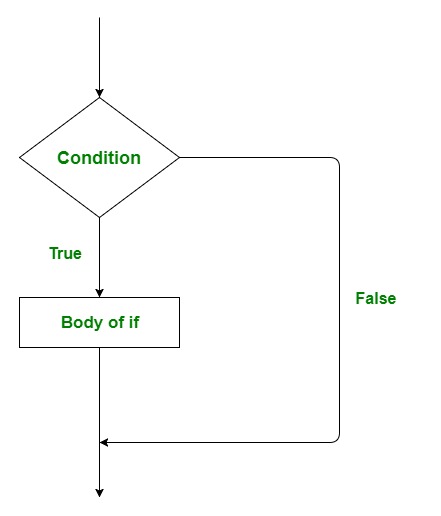 Example: Scala
 // Scala program to illustrate the if statement object Test { // Main Method def main(args: Array[String]) { // taking a variable var a: Int = 50 if (a > 30) { // This statement will execute as a > 30 println("GeeksforGeeks") } } } GeeksforGeeks
if-else statement
The if statement alone tells us that if a condition is true it will execute a block of statements and if the condition is false it won’t. But what if we want to do something else if the condition is false. Here comes the else statement. We can use the else statement with if statement to execute a block of code when the condition is false.
Syntax: if (condition) { // Executes this block if // condition is true } else { // Executes this block if // condition is false } Flow Chart: 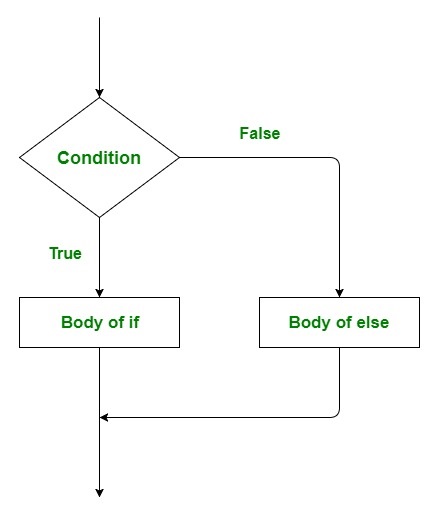 Example: Scala
 // Scala program to illustrate the if-else statement object Test { // Main Method def main(args: Array[String]) { // taking a variable var a: Int = 650 if (a > 698) { // This statement will not // execute as a > 698 is false println("GeeksforGeeks") } else { // This statement will execute println("Sudo Placement") } } } Sudo Placement
Nested if-else statement
A
nested if is an
if statement that is the target of another
if-else statement. Nested
if-else statement means an
if-else statement inside an if statement or in a else statement. Scala allows us to nest
if-else statements within
if-else statement.
Syntax: // Executes when condition_1 is true if (condition_1) { if (condition_2) { // Executes when condition_2 is true } else { // Executes when condition_2 is false } } // Executes when condition_1 is false else { if (condition_3) { // Executes when condition_3 is true } else { // Executes when condition_3 is false } } Flow Chart: 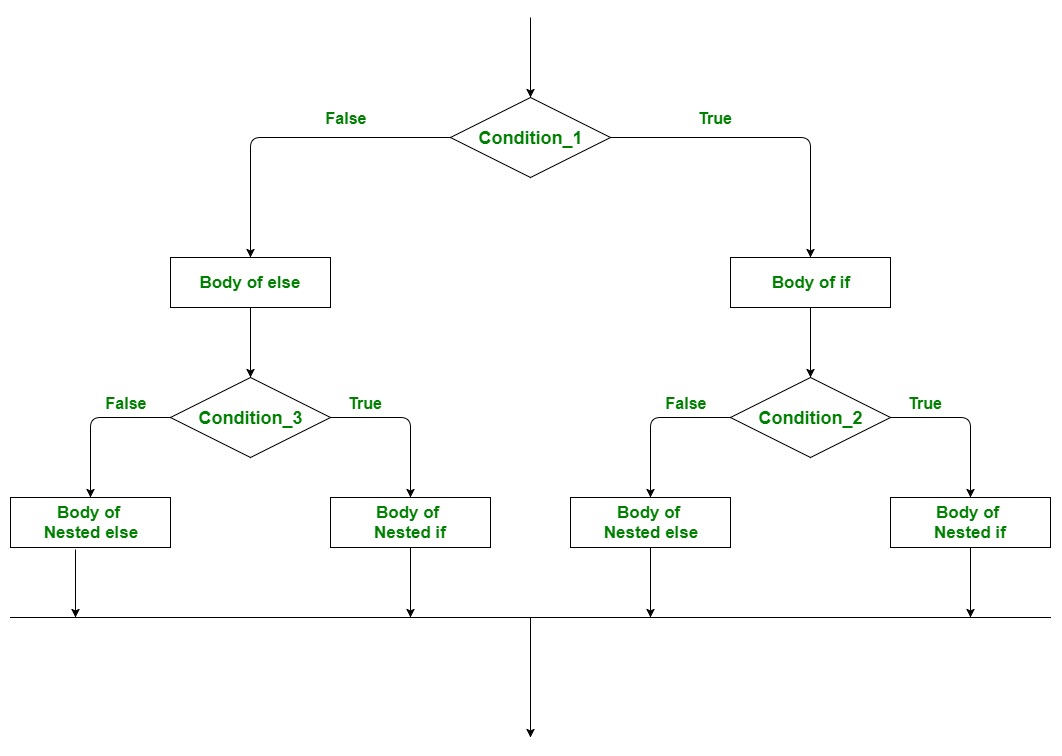 Example: Scala
 // Scala program to illustrate // the nested if-else statement object Test { // Main Method def main(args: Array[String]) { // taking three variables var a: Int = 70 var b: Int = 40 var c: Int = 100 // condition_1 if (a > b) { // condition_2 if(a > c) { println("a is largest"); } else { println("c is largest") } } else { // condition_3 if(b > c) { println("b is largest") } else { println("c is largest") } } } } c is largest
if-else if Ladder
Here, a user can decide among multiple options. The
if statements are executed from the top down. As soon as one of the conditions controlling the
if is true, the statement associated with that
if is executed, and the rest of the ladder is bypassed. If none of the conditions is true, then the final
else statement will be executed.
Syntax: if(condition_1) { // this block will execute // when condition_1 is true } else if(condition_2) { // this block will execute // when condition2 is true } . . . else { // this block will execute when none // of the condition is true } Flow Chart: 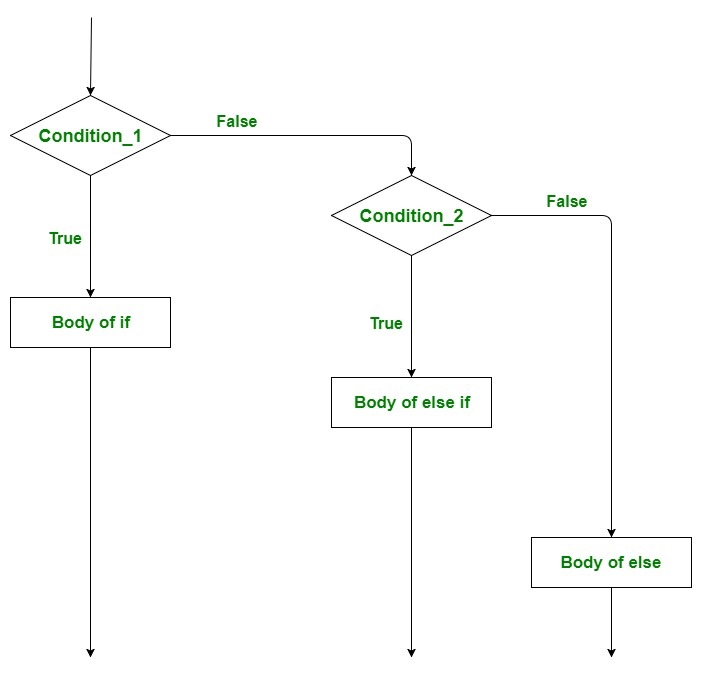 Example: Scala
 // Scala program to illustrate // the if-else-if ladder object Test { // Main Method def main(args: Array[String]) { // Taking a variable var value: Int = 50 if (value == 20) { // print "value is 20" when // above condition is true println("Value is 20") } else if (value == 25) { // print "value is 25" when // above condition is true println("Value is 25") } else if (value == 40) { // print "value is 40" when // above condition is true println("Value is 40") } else { // print "No Match Found" // when all condition is false println("No Match Found") } } } No Match Found
Explore
Overview
Basics
Control Statements
OOP Concepts
Methods
Strings
Scala Packages
Scala Trait
Collections
My Profile