Introduction of Deadlock in Operating System
Last Updated : 03 Sep, 2025
A deadlock is a situation in a computing environment where a set of processes gets permanently stuck because each process is waiting for a resource held by another process, and none of them can proceed.
How Does Deadlock Occur in OS?
A process in an operating system typically uses resources in the following sequence:
- Request a resource
- Use the resource
- Release the resource
Deadlock arises when processes hold some resources while waiting for others.
Example:
- Process P1 holds Resource R1 and requests R2.
- Process P2 holds Resource R2 and requests R1.
Neither process can proceed causing a deadlock.
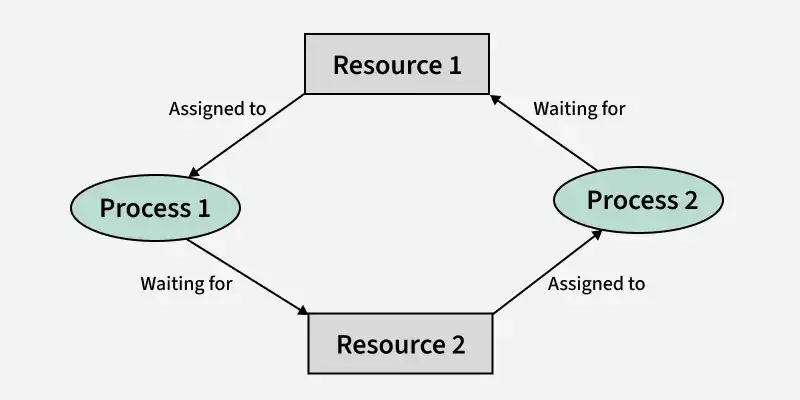
Examples of Deadlock
There are several examples of deadlock. Some of them are mentioned below.
1. The system has 2 tape drives. P0 and P1 each hold one tape drive and each needs another one.
2. Semaphores A and B, initialized to 1, P0, and P1 are in deadlock as follows:
- P0 executes wait(A) and preempts.
- P1 executes wait(B).
- Now P0 and P1 enter in deadlock.
P0 | P1 |
|---|
wait(A); | wait(B) |
wait(B); | wait(A) |
3. Assume the space is available for allocation of 200K bytes, and the following sequence of events occurs.
P0 | P1 |
Request 80KB; | Request 70KB; |
Request 60KB; | Request 80KB; |
Deadlock occurs if both processes progress to their second request.
Necessary Conditions for Deadlock in OS
Deadlock can arise if the following four conditions hold simultaneously (Necessary Conditions)
- Mutual Exclusion: Only one process can use a resource at any given time i.e. the resources are non-sharable.
- Hold and Wait: A process is holding at least one resource at a time and is waiting to acquire other resources held by some other process.
- No Preemption: A resource cannot be taken from a process unless the process releases the resource.
- Circular Wait: set of processes are waiting for each other in a circular fashion. For example, imagine four processes P1, P2, P3, and P4 and four resources R1, R2, R3, and R4.

The above image demonstrates a circular wait deadlock, here's how:
- P1 is holding R1 and waiting for R2 (which is held by P2).
- P2 is holding R2 and waiting for R3 (which is held by P3).
- P3 is holding R3 and waiting for R4 (which is held by P4).
- P4 is holding R4 and waiting for R1 (which is held by P1).
Explore
OS Basics
Process Management
Memory Management
I/O Management
Important Links
My Profile