Java Thread Priority in Multithreading
Last Updated : 22 Oct, 2025
Java allows multiple threads to run concurrently, and the Thread Scheduler decides the order of execution. Each thread has a priority between 1 and 10, which indicates its importance. Threads with higher priority are generally preferred by the scheduler, though execution order is not guaranteed.
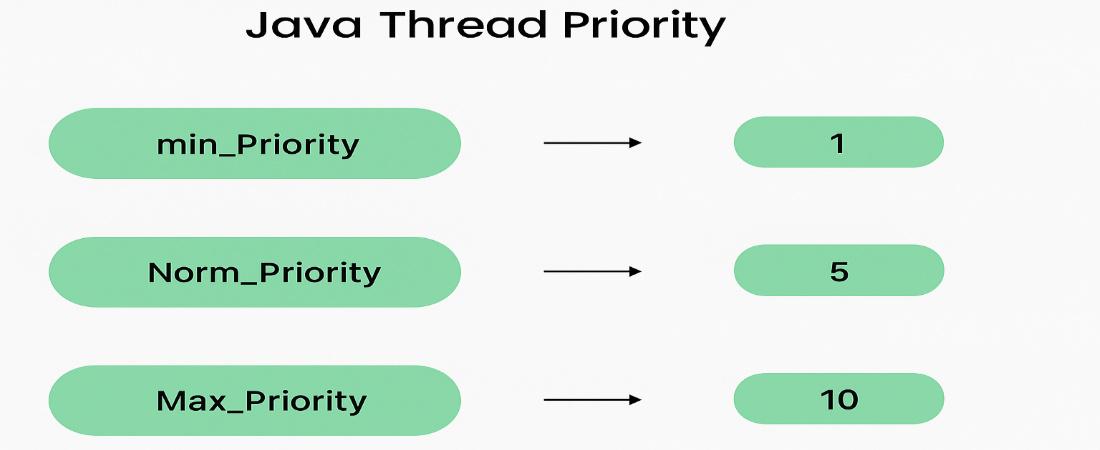 Thread-Priority
Java provides three constant values in the Thread class:
- Thread.MIN_PRIORITY (1): Lowest possible priority for a thread.
- Thread.NORM_PRIORITY (5): Default priority assigned to a thread.
- Thread.MAX_PRIORITY (10): Highest possible priority for a thread.
Setting and Getting Thread Priority
We can use the following methods of the Thread class to manage thread priority:
- setPriority(int newPriority): This method is used to sets the priority of a thread.
- getPriority(): This method is used to returns the current priority of the thread.
Java class MyThread extends Thread { public MyThread(String name){ super(name); } public void run() { System.out.println( Thread.currentThread().getName() + " with priority " + Thread.currentThread().getPriority()); } } public class Geeks{ public static void main(String[] args){ MyThread t1 = new MyThread("Thread-1"); MyThread t2 = new MyThread("Thread-2"); MyThread t3 = new MyThread("Thread-3"); // Setting thread priorities t1.setPriority(Thread.MIN_PRIORITY); // 1 t2.setPriority(Thread.NORM_PRIORITY); // 5 t3.setPriority(Thread.MAX_PRIORITY); // 10 // Start threads t1.start(); t2.start(); t3.start(); } } OutputThread-2 with priority 5 Thread-1 with priority 1 Thread-3 with priority 10
Explanation:
- MyThread extends Thread and overrides run(), which prints the thread’s name and priority.
- Threads have default priority 5, which can be changed between 1–10 using setPriority().
- The code sets t1=1, t2=5, t3=10 and prints their priorities.
- On calling start(), each thread runs concurrently; higher priority may get preference, but actual order depends on the OS thread scheduler.
Note: The output order may vary because thread scheduling depends on the JVM and the underlying operating system.
If multiple threads have the same priority, their execution order is decided by the thread scheduler. The example below demonstrates this, followed by an explanation of the output for better conceptual and practical understanding.
Java class MyThread extends Thread{ public void run(){ System.out.println(getName() + " is running with priority " + getPriority()); } public static void main(String[] args){ // Set main thread priority Thread.currentThread().setPriority(5); // Create two threads MyThread t1 = new MyThread(); MyThread t2 = new MyThread(); // Both threads inherit main thread priority (5) System.out.println("t1 priority: " + t1.getPriority()); System.out.println("t2 priority: " + t2.getPriority()); // Start threads t1.start(); t2.start(); } } OutputMain thread priority: 6 t1 thread priority: 6
Explanation:
- Both t1 and t2 inherit the main thread’s priority (5).
- Calling start() runs both threads concurrently.
- Threads with the same priority have equal chance of execution; order depends on the OS scheduler.
What is a thread's priority used for in Java?
-
To determine the thread's execution speed
-
To specify the thread's name
-
To set the thread's stack size
-
To control the order of thread execution
What is the valid range of thread priority values in Java?
Explanation:
Java thread priorities range from 1 (MIN_PRIORITY) to 10 (MAX_PRIORITY).
Which constant represents the default priority of a Java thread?
Explanation:
Thread.NORM_PRIORITY has a value of 5, which is the default priority.
Quiz Completed Successfully
Your Score : 2/3
Accuracy : 0%
Login to View Explanation
1/3 1/3 < Previous Next >
Explore
Java Basics
OOP & Interfaces
Collections
Exception Handling
Java Advanced
Practice Java
My Profile