
The rapid adoption of data cloud platforms like Snowflake, Databricks and BigQuery has transformed how organizations harness analytics and AI. By enabling real-time data sharing, scalable compute and unified access to diverse data sources, data clouds allow organizations to accelerate insights, deploy AI models at scale and break down silos between business units—driving faster innovation and more agile decision making.
But with this transformation comes new cost-management complexity recognized by the FinOps Foundation. Their recent Data Cloud Scopes highlight that billing models based on queries, data scanned and transient workloads require new approaches to cost control.That’s why we’re excited to release a new capability for Flexera One Cloud Cost Optimization (CCO)—FinOps for data clouds—designed to help FinOps and cloud teams meet these challenges.
The use case: Bring FinOps cost transparency to data clouds
Why is visualizing and optimizing the impact of data clouds so difficult? Data clouds introduce unique hurdles:
- Ephemeral and shared compute: Unlike persistent VMs, data clouds use transient workloads and shared clusters, making attribution and allocation difficult.
- Non-standard billing units: Costs are tied to abstract units like DBUs, credits or slots, complicating forecasting and budgeting.
- Limited visibility: Without job-level tracking and custom metadata, it’s hard to link spending to specific teams or make it visible on actionable dashboards.
- AI workload complexity: AI models often run on top of data clouds, introducing additional layers of cost (e.g., token usage, inference compute) that are not easily separated from analytics spending.
The result: FinOps leaders and business stakeholders are often left with more questions than answers, and the risk of unplanned spending is real.
These challenges are not theoretical. According to the 2025 Flexera State of the Cloud Report, 84% of companies struggle to manage cloud spend, and Forrester Research found that 72% of global enterprises exceeded their cloud budget last fiscal year—and data clouds add further complexity.
Meeting the need: Actionable visibility for data cloud optimization
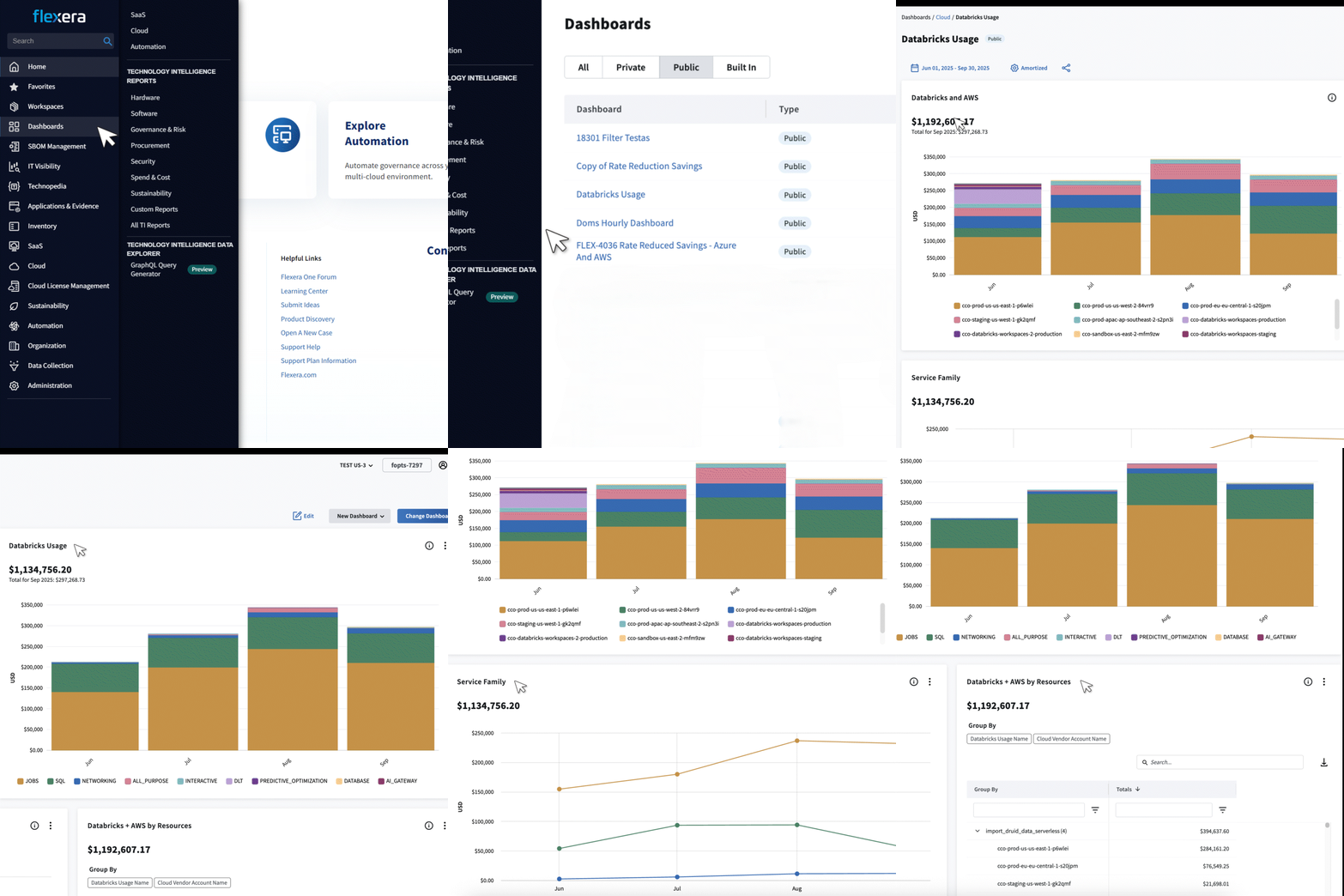
The new CCO capability is engineered to address these challenges head-on, starting with Databricks. Nowenterprises can gain detailed, actionable insights into data cloud and platform as a service (PaaS) spending, including:
- Granular visibility and cost allocation: CCO now enables job-level tracking and custom metadata tagging, moving beyond project-level attribution. This means FinOps teams can finally see which workloads, teams or business units are driving data cloud costs—even in highly dynamic, shared environments.
- Integrated dashboards for actionable insights: Think of these not just as visualizations—they’re decision centers. FinOps leaders can monitor PaaS spend and usage trends across teams and services, making it easier to track the impact of optimization actions and align cost management with business objectives.
- Governance and de-risking over time: These new optimization actions are tracked over time, improving accountability and providing a view into data cloud FinOps initiatives.
Business value: From cost control to strategic advantage
The business case for maturing FinOps for data clouds is compelling and interwoven with the rise in AI use across the enterprise.Gartner notes that “…by 2030, over 80% of enterprises will deploy industry-specific AI agents in support of critical business objectives, up from less than 10% today, and more than 60% will conduct intensive AI model activity across multiple clouds.”
Given the use of data clouds for scaling AI, this new CCO capability will empower both technical and business stakeholders to better collaborate towards value realization:
- Control costs and reduce waste: Granular allocation models will help organizations eliminate idle resources, optimize commitments and avoid unnecessary expenses.
- Drive accountability: With transparency and job-level attribution, teams are incentivized to take ownership of their spending, fostering a culture of financial discipline.
- Prepare for an AI-centric future: As data cloud workloads grow, CCO’s integrated governance and forecasting capabilities enable organizations to invest in analytics and AI while reducing the risks of budget overruns or financial surprises.
Going beyond cost control, savings can be redeployed to support innovation—and turn data cloud cost optimization into a strategic advantage.
Why Flexera: Customer value delivered, analyst validation, industry alignment
Organizations and partners that have adopted CCO are seeing tangible benefits—and with new visibility and control into data clouds, they’re ready for an AI-intensive future.
Carlsberg, a global leader in the beverage industry, implemented Flexera CCO to support their digital transformation and manage explosive cloud spend.
The result: New application and resource-level visibility, multi-cloud cost control and over $400,000 in savings within the first year.
Bayer, a global enterprise with core competencies in life sciences, needed to scale cloud optimization across a complex hybrid cloud environment, and CCO was a key element.
The result: Processes to identify wasteful non-production resources are delivering $2M in annual savings.
Flexera’s leadership in cloud cost optimization is recognized by industry analysts. In 2024 and 2025, Flexera was named a Leader in the Gartner® Magic Quadrant™ for Cloud Financial Management Tools, and the Forrester Wave™ for Cloud Cost Management and Optimization Solutions highlighted Flexera’s flexible platform and integration of IT asset management (ITAM) with FinOps.
The FinOps Foundation has formally expanded its framework to include data clouds, and Flexera—a FinOps Foundation Certified Platform—adopted the FOCUS 1.0 specification to ensure that cost data is normalized, enabling better ingestion and mapping of commitment dimensions.
Flexera uniquely brings a single pane of glass approach via Flexera One to FinOps for data clouds, FinOps for AI, multi‑cloud commitment automation and automated workload optimization for K8s and virtual machines. The Flexera One platform also enables optimization for extended FinOps Scopes ITAM, SaaS, and sustainability. This shortens time‑to‑value, reduces vendor sprawl and directly optimizes spending via automation.
Ready to see how CCO and Flexera FinOps solutions can help you meet your challenges?
Contact us for a demo or connect with our experts to learn more.