We at the MoinMoin Wiki software development team had a wonderful time with our participation in Google Summer of Code™ 2009. We greatly enjoyed collaborating with our students, hacking Python and Javascript code for the wiki engine. Thanks to Google's support, we had four student projects total, and three of them were successfully completed:
Christopher Denter, whom I mentored, worked on making MoinMoin's modular storage code production-ready by adding an access control middleware. Christopher's work in this area made MoinMoin safer and more flexible. He also worked on a router middleware - think of it as a kind of a wiki
"mount/fstab" - and a SQLAlchemy backend. Our users can now enjoy MoinMoin with MySQL, PostgreSQL, SQLite, etc. Christopher's work was done directly in the repo that will become the 2.0 release of MoinMoin.
Alexandre Martani, mentored by Bastian Blank, worked on a realtime collaborative wiki editor based on Google's mobwrite. Multiple people can now choose to edit the same wiki page at the same time and they all see each other's changes shortly after typing. We hope that we can merge his code into the MoinMoin 2.0 repository soon.
Dmitrijs Milajevs, mentored by Reimar Bauer, worked on groups and dictionary code with modular backends. You can now fetch group definitions from wiki pages or a wiki, and preparations have been made to make an LDAP group backend possible as part of future development. Dmitrijs also refactored the search code to get rid of the unmaintained xapwrap library and use the new xappy library. All his work has already merged into the MoinMoin 1.9 main repo.
Thanks also to Alexander Schremmer for his contributions as a mentor. Unfortunately, his student's project did not work out, but in true community fashion he provided valuable help and feedback for the other students.
In case you're curious about when all this nice code will be released:
MoinMoin 1.9 will be released later in 2009 (likely in November). Please help us beta testing, translating and generally making the release ready.
MoinMoin 2.0 will not just 1.9 + 0.1, but a major rewrite of big parts of the code base. Right now, it's like a big construction site, so it'll naturally take some time until the release will be ready, likely 2010 or 2011. We'd be happy to have your help with it; if you enjoy coding in Python, playing with new features, cleanly refactoring code and working with a fun team, then do join us to make MoinMoin an even better wiki. Check out the MoinMoin 2.0 page for more details.
Many thanks to all the students and mentors as well as everyone in the community who helped or supported the process. It was a very productive summer and we are greatly looking forward to continued work with our new contributors!
SIP Communicator's Summer of Code Adventures: Part Two
Tuesday, October 6, 2009
Ed. Note: You may recall that last week we published the first installment of Emil Ivov's report on SIP Communicator's participation in Google Summer of Code™. This week, Emil shares more of the project's 2009 success stories and lessons learned by the project over the past three instances of the program.
Geek Communicator
Linus Wallgren from Sweden completed a task that many of us have been dreaming about for a long time now: handling SIP Communicator entirely through the command line. So what exactly does this mean? Well, now, you can exit the application, hide or show it, send or receive messages, make or answer phone calls and open or close chats, entirely through the command line. So, you remember that super script that you always wanted to do? The one that sends a message to all your online friends at 3 o'clock every morning? You can now do it thanks to Linus! His work is going to be integrated into SIP Communicator some time this year so stay tuned!
 Geek Communicator: Using SIP Communicator through the Console
Setting Your Own Avatar
Shashank Tyagi from India was accepted for the "Dude, checkout my photo!" project. His work consisted of making sure that it was possible for SIP Communicator users to upload a new photo/avatar with popular protocols like XMPP, MSN, Yahoo! Messenger, ICQ and AIM. He first started by exploring the mechanisms supported by the various protocol stacks that allowed this, discovering a few glitches on the way. He then worked on the glue that allows the SIP Communicator protocol modules to export this functionality to the rest of the application, and the GUI. Finally, with some help from his mentor, he also managed to wrap up a module that allowed users to take a picture of themselves using their webcam right before uploading it. Cool, isn't it?
Shashank's work is definitely going to get integrated into our trunk as soon as possible. However, until then you can either test it through his SVN branch or at least sneak a peek here:
 Setting Your Own Avatar via SIP Communicator
DTMF with RTP
Romain Philibert from France worked with us on the project "DTMF with RTP" which had the goal of providing an alternative transport for DTMF tones in audio RTP streams in addition to the existing SIP INFO method. The first phase of the development consisted of research on the possible approaches to solving the problem and the viability of each of the approaches was explored with proof-of-concept implementations. The second phase was the actual implementation of the chosen solution and involved refactoring existing source code to generalize it enough to also serve the goal of the project, employing the rearchitected design for the sake of sending and receiving DTMF tones as part of audio RTP streams, writing new UI to allow switching between the alternative DTMF transports, and creating unit tests to assure the correct operation of the functionality. Romain was exposed to communicating on our development mailing list where he reported his progress throughout the program, gathered feedback from members of our community and helped another contributor in resolving a common problem related to the unit tests. The source code he produced has been reviewed and currently awaits for a major redesign of the media service of our project to be finished in order to be updated and integrated into trunk.
 DTMF with RTP
Impressive list, right? We're quite happy with it :)
So, let's now get to the final part and look through the three most important lessons we've learned throughout the past three years.
Lesson 1: You've Got to Have the Time
Google Summer of Code is a two-way process. Really! You take a lot so you have to be prepared to give as much. This is not a subcontracting deal where you could simply expect work to get done by itself because it is being paid for (not that this ever happens in subcontracting, anyway). Having a dedicated mentor for a student's project is almost as important as having a dedicated student. I've seen very few exceptions to this and it actually comes down to the following:
Lesson 2: Less is More
I know, I know ... what a cliché! Still, it took us some time to actually realize it so I think it's important to note this lesson. I already mentioned that in 2008 we took 15 students and that this was not our best year. Mentoring resources were of course part of the issue. We had 4 of our most active developers take up two students each. First, this proved to be quite hard for the mentors themselves. Dedicating two hours a day to mentoring may turn out to be an issue when this is not part of your day job. Second, it was also a problem for the other students and their mentors. Given that our most active mentors had their hands full with their own students, they had little time to spare giving advice to other mentor-student pairs when they needed it. This turned out to be a blocking factor on more than one occasion and there was no one happy with the situation.
In addition to mentoring resources, a higher number of students are also hard to handle by the community itself. This means that people would be less aware of the progress of every project, there would be hence less interest, less encouragement, less acknowledgment and community integration for the students.
At the end of the day, we did manage to handle things and we only had a single failed project in 2008. However, the experience was far from the pleasing memories we had from 2007. It was therefore a good lesson to learn because taking less students was one of the main reasons for a successful 2009.
Lesson 3: One Committer per Student
I believe the one-mentor-for-one-student ratio is now commonly accepted practice for Google Summer of Code and that most projects are striving for it. We definitely have done our best to avoid mentor sharing since 2008. Having more than one (non-shared) mentor per student is even better but unfortunately not always possible. Another ratio that is just as important, and probably not that popular, is the number of committers involved as mentors. Code integration represents a significant part of the effort that projects spend over Google Summer of Code. It is quite obvious that if the developer committing the work of a particular student is also their mentor, integration is going to be a lot easier than if it were someone else.
For example, we had some very valuable stuff written during 2008, like support for proxies from Atul Aggarwal. Atul did a good job, but, his only mentor, despite being very technically savvy and knowing the project quite well, did not have committer access. Proxy support is quite important for SIP Communicator, although not necessarily critical. Committing Atul's work however, would require an existing committer to study all his work, and there always seems to be something in the critical path for development that must be reviewed. Things would have been a lot easier if one of the people that were expert in this field had been following the project right from the start.
We therefore decided to add pair each student with a committer in 2009, and each committer only had to take care of one student. The results were excellent, and as I already mentioned, we already have approx 30% of the GSoC code committed barely a week after the end of the program!
Lesson 4: Specific Tasks and Clear Conditions (Learning in Progress ...)
Ok ... this case is not really that straightforward and we have more learning to do before we really get it. Here's the problem:
In 2007 and 2008, we had a couple of students who would get to 50% or 60% of their work and then get distracted with unimportant stuff or simply disappear for a while. At a point their mentors would remind them that they have more to do and this would cause the students to feel uneasy, panic, or start arguing about things, such as:
"Oh, I didn't know I had to do unit testing!" or "I was never told this feature was part of the job!"
The statements weren't completely false. It could indeed happen that a task would seem obvious to a mentor and in the same time feel utterly unnatural to a student. In one case, it was actually the mentor who didn't request a task that was considered important by other community members.
So either way, in order to try and limit the surprises we decided that we needed to start every project with a list of clearly defined sub-tasks. This way, we thought, students would know exactly what they need to do and organize better. It would also help make sure that everyone on our side was well aware of the "official" project vision. Sounds neat, right?
Well, it didn't really work out that way.. Most of the students didn't have a problem with the new system, but then again, most of the students didn't have problems without it either. One of the students we failed, however, claimed the requirements list had been misleading and had made them believe they could plan a few weeks off. When we told them that this would be risky they complained it was too late to cancel the reservations, so they didn't listen ... and eventually failed.
So it appears that a list of what we believe to be specific requirements doesn't seem to change much in terms of understanding the goals of a particular project since there's always something that could be misunderstood. Clearly, continued mentor-student communication is crucial here but it seems that we'd also need explicit there-may-be-more-to-this-than-you-think notes.
Phew, that sums it all up! Hope the lessons we've learned above would help others in similar situations. Good luck to all of you future Google Summer of Coders!
Geek Communicator
Linus Wallgren from Sweden completed a task that many of us have been dreaming about for a long time now: handling SIP Communicator entirely through the command line. So what exactly does this mean? Well, now, you can exit the application, hide or show it, send or receive messages, make or answer phone calls and open or close chats, entirely through the command line. So, you remember that super script that you always wanted to do? The one that sends a message to all your online friends at 3 o'clock every morning? You can now do it thanks to Linus! His work is going to be integrated into SIP Communicator some time this year so stay tuned!
Geek Communicator: Using SIP Communicator through the ConsoleSetting Your Own Avatar
Shashank Tyagi from India was accepted for the "Dude, checkout my photo!" project. His work consisted of making sure that it was possible for SIP Communicator users to upload a new photo/avatar with popular protocols like XMPP, MSN, Yahoo! Messenger, ICQ and AIM. He first started by exploring the mechanisms supported by the various protocol stacks that allowed this, discovering a few glitches on the way. He then worked on the glue that allows the SIP Communicator protocol modules to export this functionality to the rest of the application, and the GUI. Finally, with some help from his mentor, he also managed to wrap up a module that allowed users to take a picture of themselves using their webcam right before uploading it. Cool, isn't it?
Shashank's work is definitely going to get integrated into our trunk as soon as possible. However, until then you can either test it through his SVN branch or at least sneak a peek here:
Setting Your Own Avatar via SIP CommunicatorDTMF with RTP
Romain Philibert from France worked with us on the project "DTMF with RTP" which had the goal of providing an alternative transport for DTMF tones in audio RTP streams in addition to the existing SIP INFO method. The first phase of the development consisted of research on the possible approaches to solving the problem and the viability of each of the approaches was explored with proof-of-concept implementations. The second phase was the actual implementation of the chosen solution and involved refactoring existing source code to generalize it enough to also serve the goal of the project, employing the rearchitected design for the sake of sending and receiving DTMF tones as part of audio RTP streams, writing new UI to allow switching between the alternative DTMF transports, and creating unit tests to assure the correct operation of the functionality. Romain was exposed to communicating on our development mailing list where he reported his progress throughout the program, gathered feedback from members of our community and helped another contributor in resolving a common problem related to the unit tests. The source code he produced has been reviewed and currently awaits for a major redesign of the media service of our project to be finished in order to be updated and integrated into trunk.
DTMF with RTPImpressive list, right? We're quite happy with it :)
So, let's now get to the final part and look through the three most important lessons we've learned throughout the past three years.
Lesson 1: You've Got to Have the Time
Google Summer of Code is a two-way process. Really! You take a lot so you have to be prepared to give as much. This is not a subcontracting deal where you could simply expect work to get done by itself because it is being paid for (not that this ever happens in subcontracting, anyway). Having a dedicated mentor for a student's project is almost as important as having a dedicated student. I've seen very few exceptions to this and it actually comes down to the following:
- We are dealing with students who are still learning. As eager as they are to get things done, most of them have little development experience. Therefore if left to themselves, students would tend to over-engineer, go for a dirty hack, overlook existing documentation, misunderstand the goal of the project or a bunch of other things that seem so natural to experienced project developers.
- Three months is hardly enough time even for experienced developers to fully grasp the internals of a mature project that they've never seen before. It is therefore naive to expect that a student would be able to come up with a usable and integratable contribution without a fair amount of guidance.
Lesson 2: Less is More
I know, I know ... what a cliché! Still, it took us some time to actually realize it so I think it's important to note this lesson. I already mentioned that in 2008 we took 15 students and that this was not our best year. Mentoring resources were of course part of the issue. We had 4 of our most active developers take up two students each. First, this proved to be quite hard for the mentors themselves. Dedicating two hours a day to mentoring may turn out to be an issue when this is not part of your day job. Second, it was also a problem for the other students and their mentors. Given that our most active mentors had their hands full with their own students, they had little time to spare giving advice to other mentor-student pairs when they needed it. This turned out to be a blocking factor on more than one occasion and there was no one happy with the situation.
In addition to mentoring resources, a higher number of students are also hard to handle by the community itself. This means that people would be less aware of the progress of every project, there would be hence less interest, less encouragement, less acknowledgment and community integration for the students.
At the end of the day, we did manage to handle things and we only had a single failed project in 2008. However, the experience was far from the pleasing memories we had from 2007. It was therefore a good lesson to learn because taking less students was one of the main reasons for a successful 2009.
Lesson 3: One Committer per Student
I believe the one-mentor-for-one-student ratio is now commonly accepted practice for Google Summer of Code and that most projects are striving for it. We definitely have done our best to avoid mentor sharing since 2008. Having more than one (non-shared) mentor per student is even better but unfortunately not always possible. Another ratio that is just as important, and probably not that popular, is the number of committers involved as mentors. Code integration represents a significant part of the effort that projects spend over Google Summer of Code. It is quite obvious that if the developer committing the work of a particular student is also their mentor, integration is going to be a lot easier than if it were someone else.
For example, we had some very valuable stuff written during 2008, like support for proxies from Atul Aggarwal. Atul did a good job, but, his only mentor, despite being very technically savvy and knowing the project quite well, did not have committer access. Proxy support is quite important for SIP Communicator, although not necessarily critical. Committing Atul's work however, would require an existing committer to study all his work, and there always seems to be something in the critical path for development that must be reviewed. Things would have been a lot easier if one of the people that were expert in this field had been following the project right from the start.
We therefore decided to add pair each student with a committer in 2009, and each committer only had to take care of one student. The results were excellent, and as I already mentioned, we already have approx 30% of the GSoC code committed barely a week after the end of the program!
Lesson 4: Specific Tasks and Clear Conditions (Learning in Progress ...)
Ok ... this case is not really that straightforward and we have more learning to do before we really get it. Here's the problem:
In 2007 and 2008, we had a couple of students who would get to 50% or 60% of their work and then get distracted with unimportant stuff or simply disappear for a while. At a point their mentors would remind them that they have more to do and this would cause the students to feel uneasy, panic, or start arguing about things, such as:
"Oh, I didn't know I had to do unit testing!" or "I was never told this feature was part of the job!"
The statements weren't completely false. It could indeed happen that a task would seem obvious to a mentor and in the same time feel utterly unnatural to a student. In one case, it was actually the mentor who didn't request a task that was considered important by other community members.
So either way, in order to try and limit the surprises we decided that we needed to start every project with a list of clearly defined sub-tasks. This way, we thought, students would know exactly what they need to do and organize better. It would also help make sure that everyone on our side was well aware of the "official" project vision. Sounds neat, right?
Well, it didn't really work out that way.. Most of the students didn't have a problem with the new system, but then again, most of the students didn't have problems without it either. One of the students we failed, however, claimed the requirements list had been misleading and had made them believe they could plan a few weeks off. When we told them that this would be risky they complained it was too late to cancel the reservations, so they didn't listen ... and eventually failed.
So it appears that a list of what we believe to be specific requirements doesn't seem to change much in terms of understanding the goals of a particular project since there's always something that could be misunderstood. Clearly, continued mentor-student communication is crucial here but it seems that we'd also need explicit there-may-be-more-to-this-than-you-think notes.
Phew, that sums it all up! Hope the lessons we've learned above would help others in similar situations. Good luck to all of you future Google Summer of Coders!
Ed. note: Post title corrected.
Perls of Wisdom: The Perl Foundation & Parrot's Google Summer of Code
Monday, October 5, 2009
Google Summer of Code™ 2009 (GSoC) was filled with fresh faces and exciting new projects for The Perl Foundation (TPF). As I write this, we are currently in the final stage of the summer where students submit evidence of their work in a zip/tar.gz file by uploading it to a publicly viewable repository. I very much like that now anyone on the 'net can download a file containing the entire summer of work by the student, and there is even a download count next to each file for each student!
We started the summer with nine students, but Kevin Tew was not able to work on "A prototype LLVM JIT runcore for Parrot" in the program due to external issues. He is still a core Parrot Virtual Machine developer and I hope that he can find time to work on this awesome project some time in the near future. Since Parrot is currently redesigning its JIT framework from the ground up, a project similar to this would be great for next year.
The other Parrot VM project was Daniel Arbelo Arrocha working on "Decimal Arithmetic: BigInt, BigNum and BigRat for parrot" with Christoph Otto as a mentor. Big Decimal Arithmetic basically means storing arbitrary large/arbitrary precision numbers internally in a decimal format rather than the binary format usually used. Doing this can prevent catastrophic rounding errors. If you can store numbers internally with exactly NO error, then obviously this is A Very Good Thing. Daniel worked on making dynamic PMC's (Polymorphic Parrot Classes, or Parrot Magic cookies, take your pick) which wrap the mature and extensive IBM's libdecnumber library. What this means is that Parrot can do arithmetic on arbitrarily large integers (BigInt's) or floating point numbers with arbitrary precision (BigNum's.) Financial people are very interested in these as well, since no one wants to be short-changed on their interest due to rounding error. Daniel has also been contributing patches to many other parts of Parrot and will probably be getting a commit bit soon, which is great news to hear.
Devin Austin worked on "Refactoring Catalyst helper modules", with Kieren Diment as a mentor. This involved some "Moosification", which means refactoring home-rolled object-oriented code to use Moose (the post-modern Perl 5 object system), i.e. less code to maintain and more features at your fingertips.
I am excited to talk about our next student, who worked on a Perl 6-related project. Carl Mäsak mentored Hinrik Örn Sigurðsson on "Perl 6 End-User Documentation Tools" (github repo) . Hinrik is working on the grok command, which is the Perl 6 relative of perldoc. With it, you can get documentation for Perl 6 functions from the spec, read the Synopses and Apocalypses, and occasionally attain temporary enlightenment. If you have a properly installed CPAN client on your computer, you can install it with cpan App::Grok.
Our other exciting Perl 6 project was Paweł Murias working on "Multimethods for SMOP", mentored by Daniel Ruoso, the lead developer of SMOP. SMOP stands for Simple Meta Object Programming (or Simple Matter of Programming, if you are feeling snarky) and it is an implementation of Perl 6, a sister of Rakudo. Multimethods, short for Multiple Method Dispatch, is a feature where a language can determine which variant of a set of functions to call, based on the type of their arguments. One way that this becomes very powerful is that you can use wildcard arguments when you declare your multimethod, so you can essentially write many functions at once. Less code to maintain is a big WIN ! Paweł's code is being directly merged into the mainline SMOP codebase and from what I hear, he is and will continue to be a core contributor. That is what GSoC is all about. That and free t-shirts.

Pascal Gaudette worked on "HTTP/1.1 Compliance Testing and User-Agent Development for the Mojo Web Framework" with mentor Viacheslav Tykhanovskyi. This is important because Mojo, one of the newest and most exciting Perl Web frameworks did not have much testing for acting correctly according to HTTP/1.1 . Part of the work of this summer has become the CPAN module MojoX::UserAgent. He has a great blog post about "State Transitions in Mojo" wherein he explains how Mojo deals with state and generated some pretty cool transition diagrams by documenting when a state transition happens in the test suite and then feeding this data into Graph::Easy.
WebKit has become often-forked and very influential open source browser engine, so it is no surprise that Perl hackers want bindings to it. Ryan Jendoubi worked on "Cross-platform Perl Bindings for wxWebKit" with mentor Michael Peters, which allows WebKit and WxWigdets, a cross platform GUI library, to talk to each other via wxWebKit. I think this was one of the more difficult projects this year, not because of the programming/algorithms involved, but because it requires getting lots of cross-platform, constantly-changing and fickle pieces of software to get along with each other. This is often like inviting zebras and lions to the same party. Messy and dangerous. But Ryan prevailed and we give him much respect and hope that he continues to maintain and improve the Wx::WebKit bindings.
I had the pleasure of mentoring Robert (Bob) Kuo this summer on his work entitled "Implement BPSW algorithm as a Perl 5 CPAN module, Math::Primality with extensive test-suite." The Math::Primality module is already on CPAN and I am glad to announce that Bob is listed as co-maintainer and published the latest release. This module is important because the Perl 5 Cryptography CPAN modules (mostly in the Crypt::* namespace) have one, very large, very fragile dependency, called Math::Pari. Math::Pari is an amazing library that gives Perl access to the extensive state-of-the-art number theory library PARI, but to attain ultimate speed, Math::Pari pokes into undocumented internal-only Perl core internals, which means that changes to Perl internals that *shouldn't* have any effect on the outside world can cause the entire Crypt::* namespace to break. Also, most of the Crypt::* namespace require only 5-10 functions from Math::Pari, which provides an interface to thousands of functions. Math::Primality implements the few prime-checking (primality) functions that Crypt::* modules want from Math::Pari in a small, easy-to-maintain, pure-Perl CPAN module. Bob implemented the BPSW algorithm, a state of the art prime-number checking algorithm which allows you to check if an arbitrarily large number is prime in O( log(n) ) i.e. logarithmic running time. It is actually a combination of very different prime number checks, which weed out different types of non-prime numbers. So far, no one has found a counter-example to the BPSW algorithm (even though those pesky mathematicians say there probably are), so it is the best out there currently. It is estimated that because no one has seen this algorithm fail yet, and it being used extensively from within other algorithms, that the first counter-example must be at least 10,000 decimal digits long! Future steps for this module will be to work on its sister module, Math::Factoring, which implements the remaining factoring-related functions that Crypto modules want and then use both modules as new dependencies for the Crypt:: namespace, instead of Math::Pari.
Justin Hunter was mentored by Ash Berlin on the project "SQL::Translator Rewrite" (github repo). SQL::Translator is a very popular CPAN module for translating various "flavors" of SQL to and from each other, such as Postgres to MySQL. This involved more "Moosification", as described above. Justin also has some advice for hopeful GSoC students:
I wish someone had told me that about 10 years ago. I would not have wasted a lot of time worrying that people would think I was stupid and starting diving into Open Source projects much more earnestly.
In total, we had a success rate of 8/9 = 88.8%, just a bit above this year's all time high of 85%. Please join me in congratulating all these students and mentors for their top-notch work ! I can honestly say that I had much fun interacting with so many corners of the Perl community. This was my first year being an organization administrator, I learned a lot by my favorite method: sink or swim. I was handed over the magic rocket-powered surf board by Eric Wilhelm after successfully mentoring Thierry Moisan last year on the Math::GSL CPAN module. Organizing and communicating with people spread across a dozen time zones is definitely an art that I am still mastering. I think using as many mediums as possible to communication with people is key. I already use chat, email and IRC, but I wish I had done voice/skype and/or video chat with some of my students and mentors, so that everyone has a face to attach to a name.
I would also like to thank Jerry Gay for being The Perl Foundation co-pilot this year and welcoming me into the Parrot community. Your guidance in certain matters went a long way.
For anyone that would like to help/be involved in Google Summer of Code with The Perl Foundation next year, we cordially invite you to our IRC channel, #soc-help on irc.perl.org, and the mailing list.
By Jonathan Leto, Google Summer of Code Mentor and Organization Administrator
We started the summer with nine students, but Kevin Tew was not able to work on "A prototype LLVM JIT runcore for Parrot" in the program due to external issues. He is still a core Parrot Virtual Machine developer and I hope that he can find time to work on this awesome project some time in the near future. Since Parrot is currently redesigning its JIT framework from the ground up, a project similar to this would be great for next year.
The other Parrot VM project was Daniel Arbelo Arrocha working on "Decimal Arithmetic: BigInt, BigNum and BigRat for parrot" with Christoph Otto as a mentor. Big Decimal Arithmetic basically means storing arbitrary large/arbitrary precision numbers internally in a decimal format rather than the binary format usually used. Doing this can prevent catastrophic rounding errors. If you can store numbers internally with exactly NO error, then obviously this is A Very Good Thing. Daniel worked on making dynamic PMC's (Polymorphic Parrot Classes, or Parrot Magic cookies, take your pick) which wrap the mature and extensive IBM's libdecnumber library. What this means is that Parrot can do arithmetic on arbitrarily large integers (BigInt's) or floating point numbers with arbitrary precision (BigNum's.) Financial people are very interested in these as well, since no one wants to be short-changed on their interest due to rounding error. Daniel has also been contributing patches to many other parts of Parrot and will probably be getting a commit bit soon, which is great news to hear.
Devin Austin worked on "Refactoring Catalyst helper modules", with Kieren Diment as a mentor. This involved some "Moosification", which means refactoring home-rolled object-oriented code to use Moose (the post-modern Perl 5 object system), i.e. less code to maintain and more features at your fingertips.
I am excited to talk about our next student, who worked on a Perl 6-related project. Carl Mäsak mentored Hinrik Örn Sigurðsson on "Perl 6 End-User Documentation Tools" (github repo) . Hinrik is working on the grok command, which is the Perl 6 relative of perldoc. With it, you can get documentation for Perl 6 functions from the spec, read the Synopses and Apocalypses, and occasionally attain temporary enlightenment. If you have a properly installed CPAN client on your computer, you can install it with cpan App::Grok.
Our other exciting Perl 6 project was Paweł Murias working on "Multimethods for SMOP", mentored by Daniel Ruoso, the lead developer of SMOP. SMOP stands for Simple Meta Object Programming (or Simple Matter of Programming, if you are feeling snarky) and it is an implementation of Perl 6, a sister of Rakudo. Multimethods, short for Multiple Method Dispatch, is a feature where a language can determine which variant of a set of functions to call, based on the type of their arguments. One way that this becomes very powerful is that you can use wildcard arguments when you declare your multimethod, so you can essentially write many functions at once. Less code to maintain is a big WIN ! Paweł's code is being directly merged into the mainline SMOP codebase and from what I hear, he is and will continue to be a core contributor. That is what GSoC is all about. That and free t-shirts.
State Transitions in Mojo::Pipeline
Pascal Gaudette worked on "HTTP/1.1 Compliance Testing and User-Agent Development for the Mojo Web Framework" with mentor Viacheslav Tykhanovskyi. This is important because Mojo, one of the newest and most exciting Perl Web frameworks did not have much testing for acting correctly according to HTTP/1.1 . Part of the work of this summer has become the CPAN module MojoX::UserAgent. He has a great blog post about "State Transitions in Mojo" wherein he explains how Mojo deals with state and generated some pretty cool transition diagrams by documenting when a state transition happens in the test suite and then feeding this data into Graph::Easy.
WebKit has become often-forked and very influential open source browser engine, so it is no surprise that Perl hackers want bindings to it. Ryan Jendoubi worked on "Cross-platform Perl Bindings for wxWebKit" with mentor Michael Peters, which allows WebKit and WxWigdets, a cross platform GUI library, to talk to each other via wxWebKit. I think this was one of the more difficult projects this year, not because of the programming/algorithms involved, but because it requires getting lots of cross-platform, constantly-changing and fickle pieces of software to get along with each other. This is often like inviting zebras and lions to the same party. Messy and dangerous. But Ryan prevailed and we give him much respect and hope that he continues to maintain and improve the Wx::WebKit bindings.
I had the pleasure of mentoring Robert (Bob) Kuo this summer on his work entitled "Implement BPSW algorithm as a Perl 5 CPAN module, Math::Primality with extensive test-suite." The Math::Primality module is already on CPAN and I am glad to announce that Bob is listed as co-maintainer and published the latest release. This module is important because the Perl 5 Cryptography CPAN modules (mostly in the Crypt::* namespace) have one, very large, very fragile dependency, called Math::Pari. Math::Pari is an amazing library that gives Perl access to the extensive state-of-the-art number theory library PARI, but to attain ultimate speed, Math::Pari pokes into undocumented internal-only Perl core internals, which means that changes to Perl internals that *shouldn't* have any effect on the outside world can cause the entire Crypt::* namespace to break. Also, most of the Crypt::* namespace require only 5-10 functions from Math::Pari, which provides an interface to thousands of functions. Math::Primality implements the few prime-checking (primality) functions that Crypt::* modules want from Math::Pari in a small, easy-to-maintain, pure-Perl CPAN module. Bob implemented the BPSW algorithm, a state of the art prime-number checking algorithm which allows you to check if an arbitrarily large number is prime in O( log(n) ) i.e. logarithmic running time. It is actually a combination of very different prime number checks, which weed out different types of non-prime numbers. So far, no one has found a counter-example to the BPSW algorithm (even though those pesky mathematicians say there probably are), so it is the best out there currently. It is estimated that because no one has seen this algorithm fail yet, and it being used extensively from within other algorithms, that the first counter-example must be at least 10,000 decimal digits long! Future steps for this module will be to work on its sister module, Math::Factoring, which implements the remaining factoring-related functions that Crypto modules want and then use both modules as new dependencies for the Crypt:: namespace, instead of Math::Pari.
Justin Hunter was mentored by Ash Berlin on the project "SQL::Translator Rewrite" (github repo). SQL::Translator is a very popular CPAN module for translating various "flavors" of SQL to and from each other, such as Postgres to MySQL. This involved more "Moosification", as described above. Justin also has some advice for hopeful GSoC students:
- Get over yourself.
- Understand there are people smarter than you or people better at some things than you.
- Just the same, you're still needed.
- Just Go Ahead and Do It and find your niche.
I wish someone had told me that about 10 years ago. I would not have wasted a lot of time worrying that people would think I was stupid and starting diving into Open Source projects much more earnestly.
In total, we had a success rate of 8/9 = 88.8%, just a bit above this year's all time high of 85%. Please join me in congratulating all these students and mentors for their top-notch work ! I can honestly say that I had much fun interacting with so many corners of the Perl community. This was my first year being an organization administrator, I learned a lot by my favorite method: sink or swim. I was handed over the magic rocket-powered surf board by Eric Wilhelm after successfully mentoring Thierry Moisan last year on the Math::GSL CPAN module. Organizing and communicating with people spread across a dozen time zones is definitely an art that I am still mastering. I think using as many mediums as possible to communication with people is key. I already use chat, email and IRC, but I wish I had done voice/skype and/or video chat with some of my students and mentors, so that everyone has a face to attach to a name.
I would also like to thank Jerry Gay for being The Perl Foundation co-pilot this year and welcoming me into the Parrot community. Your guidance in certain matters went a long way.
For anyone that would like to help/be involved in Google Summer of Code with The Perl Foundation next year, we cordially invite you to our IRC channel, #soc-help on irc.perl.org, and the mailing list.
By Jonathan Leto, Google Summer of Code Mentor and Organization Administrator
SVG at Google and in Internet Explorer
Friday, October 2, 2009
At Google we are doing some exciting work with SVG, including hosting the SVG Open conference, helping SVG to work on Internet Explorer, and working with Wikipedia. Make sure to check out the Google Code Blog for all the details!
Report from EuroBSDCon 2009
I'm no stranger to EuroBSDCon. After attending several very successful conferences in the US, three FreeBSD contributors and I decided that Europe needed a BSD conference too. In November 2001 we were proud to host 160 or so delegates in the first European BSD Conference. Over the last couple of years I haven't been able to keep as up to date with the latest developments in the BSD world, so I was very interested to attend EuroBSDCon 2009, organised in collaboration with the UK Unix User Group.
With the conference split in to several tracks it was impossible to attend every talk, so I decided to focus primarily on those that talked about how BSD systems were helping people solve problems in the real world. Links to all the papers, slides, and in some cases audio from the presentations can be found at conference schedule page.
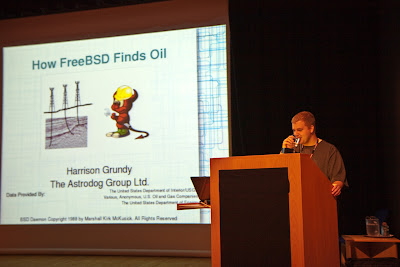
The first talk I attended was "How FreeBSD Finds Oil," given by Harrison Grundy. Harrison runs a consultancy company in the US providing clustered computing systems to oil and gas companies.
 |
| From EuroBSDCon 2009 |
He started with a run through of the economics of oil and gas exploration. It quickly became clear that the "Free" in "FreeBSD" is of no concern to these companies, as software licensing costs are such a tiny part of their overall expense. Features like stability and performance are far more important -- his customers frequently run lengthy computational jobs over terabytes of data. This is somewhat similar to what we do at Google, although obviously the data is very different. I asked whether the industry was moving in the direction of technologies like Hadoop (an open source implementation of MapReduce) but for the moment, at least, the answer seems to be no. "It's not broken, so why fix it?" appearing to be the prevailing view.
Next was Konrad Heuer, talking about "FreeBSD in a complex environment." Here he described some lessons learned from running a heterogeneous environment of systems - FreeBSD, Linux, Windows, Solaris, and issues that they faced and benefits they saw with FreeBSD. Chief amongst those benefits seemed to be the commitment by the project to continue to support APIs and higher level interfaces. Their print services have run on FreeBSD for more than 10 years, with very few modifications required. The biggest issue seemed to be commercial support; he described a number of hacks required to be able to use Tivoli Storage Manager (which they use on their other systems) to also back up their FreeBSD systems. In the discussion that followed there was a suggestion to create a mechanism where people could register things like this, so that vendors realise that many of their Linux sales are actually BSD sales, and have more incentive to create a native version of the application.
Peter Losher from the Internet Systems Consortium presented next. The ISC is a non-profit organisation that has, for years, developed, or funded the development of much of the core software the "runs" the Internet, including the DNS server BIND, and DHCP server software. ISC also provides hosting, connectivity, and mirroring services for several open source projects, including many of the BSDs. Peter talked in some detail about the mechanisms used to make the F root DNS server highly available, and features in FreeBSD that make this possible. He also talked a little about IPv6, and new features in DHCP v4.x to support IPv61.
After the lunch break Kirk McKusick talked about Superpage support in FreeBSD. He was quick to point out that he'd had no hand in the work himself, and was describing work carried out by Alan Cox et al as a result of their 2002 paper on superpages. Superpages are a method for solving a bottleneck in modern architectures.
 |
| From EuroBSDCon 2009 |
Right at the top of the memory access hierarchy is the Translation Lookaside Buffer, or TLB. The TLB is used to cache the mapping between page virtual addresses to page physical addresses, but has not grown in size at the same rate as available main memory has grown. A common maximum size is 1MB, which, when your page size is 4K, only allows for 4MB worth of virtual addresses to be in the TLB at any one time. With high-end systems these days approaching 32 or even 64GB of RAM, and typical working set sizes being much higher than 4MB the TLB undergoes significant churn. The solution is to use a page size that's larger than 4K -- a superpage. Some architectures have support for many different page sizes. The i386 architecture however is limited to either 4K or 2MB. A 2MB page size would allow the TLB to cache mappings for 2GB of RAM, and provide a large speed improvement to any program that processes a significant amount of data. Kirk went on to describe the work that Alan and others have done to implement superpage support on FreeBSD, and the heuristics the system uses to determine whether to collapse a 2MB contiguous chunk of RAM in to a superpage. He presented benchmark results that show superpages providing somewhere between a ~ 15 - 600% (!) speed improvement under typical workloads.
The next session was Chris Buechler giving an introduction to pfsense, and an overview of what new features will be in the upcoming 2.0 releases. pfsense is a FreeBSD distribution designed to run as an embedded firewall or router, although that description barely covers its capabilities. Amongst other things the 2.0 code includes is a major overhaul of the configuration UI, generalisation of interface support so that pfsense now works with any number of interfaces rather than 3, numerous new networking technologies, and an easy way to provide additional functionality via packages instead of bloating the base system.
Stanislav Sedov then described work that he had undertaken to build an embedded GPS navigation and tracking device designed to be deployed in harsh industrial environments. This included porting FreeBSD to an Atmel AT91RM9200 CPU, improving the device's bootloader support so it could boot from UFS, reducing the size of the image, and providing support for reliable in-the-field upgrades.
The final session of the day was an invited talk from Dr. Richard Clayton on the theme of "Evil on the Internet". I was fortunate enough to see Dr. Clayton give a version of this talk at Google about 18 months ago. Since then he's updated it to cover more examples of how people are using the internet to phish, scam, defraud, and otherwise attempt to part people from their money.
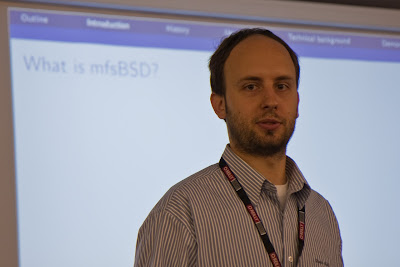
Sunday I joined the first session of the second track, an introduction to mfsBSD, a toolset to create memory filesystem based FreeBSD distributions. Martin Matuška explained his motivations behind the project, which was to find an easy way to replace Linux in the ISP-hosted environment he was using, but mfsBSD can now be used to make upgrades easier, provide a rescue partition, a USB bootable install of FreeBSD, and so on.
 |
| From EuroBSDCon 2009 |
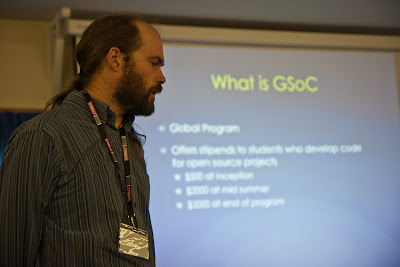
Next was Brooks Davis, presenting a roundup of the results of FreeBSD's participation in the 2009 Google Summer of Code. Of the 20 FreeBSD projects that were accepted as part of Summer of Code, 17 were successful. These included efforts that improved the performance of the ipfw firewall code, introduced support for stackable cryptographic filesystems, and enhanced the infrastructure for tracking software licenses in the ports tree, making it easier for users and distributors to ensure that they are using software that complies with their local licensing requirements.
 |
| From EuroBSDCon 2009 |
Alastair Crooks followed this with a discussion of his work on netPGP, a BSD licensed implementation of PGP that is configuration-compatible with gnuPG. As well as covering the ins and outs of the work Alastair's presentation was notable for employing some truly terrible (but memorable) visual puns. I was groaning too much through them to take pictures, but if I tell you that the slide titled "Use Cases" had as the accompanying illustration a picture of some sheep next to some hat boxes you might get an idea. Must have worked though, since I can still remember the slides.
Kris Moore from iXSystems then demonstrated the work that they've been doing on the PC-BSD distribution of FreeBSD. Apart from making the installation process considerably simpler and improving the initial user experience they've also developed an alternative binary package mechanism, which they call PBI. The PBI format works to avoid problems caused by upgrades to shared libraries that should be backwards compatible but aren't, and does this by bundling a copy of all the shared libraries required by the application in to the package directory, making each installed package completely self-contained and upgradeable without interfering with any other applications that are installed.
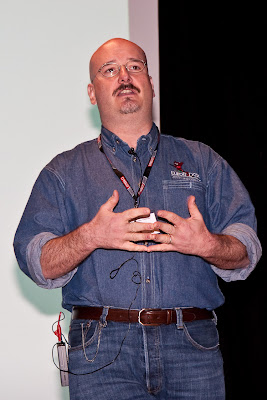
The "state of BSD" sessions at these conferences are always entertaining, and this year was no exception. Alastair Crooks for NetBSD, Owain Ainsworth and Henning Brauer for OpenBSD, and George Neville-Neil for FreeBSD presented updates on the current state and future plans of each of these systems.
 |
| From EuroBSDCon 2009 |
EuroBSDCon concluded with a number of lightning talks covering various works in progress (or WIPs), both large and small. The most interesting, for me, was the update by Pawel Jakub Dawidek on the state of ZFS support in FreeBSD. This is something that was just coming to FreeBSD around the time that I was running out of time to pay attention on a day-to-day basis. Since then support for ZFS has improved tremendously, and probably the comment I heard most repeatedly at the conference was how useful people are finding it.
And with that, the conference closed. Organizers were thanked, and delegates prepared themselves for the journey home.
1 The irony of v4 of the software being the first to support IPv6 is not lost on them.
By Nik Clayton, Site Reliability Engineer