Why Push A Button When A Machine Can Do It For You

Remote control is a wonder of the age, we press a button, and something happens as if by magic. But what happens if there is no remote control, and instead a real physical button must be pressed? [What Up TK Here], who regular Hackaday readers might just recognize, had just this problem, and made a remote control button presser.

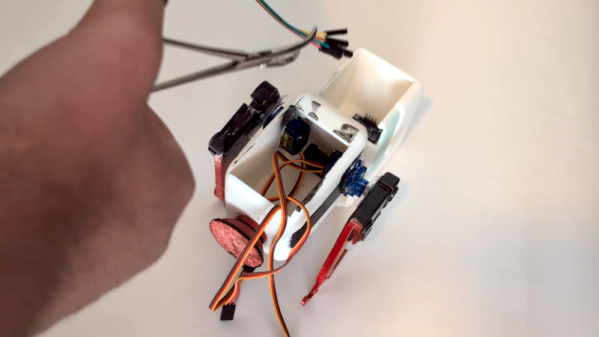
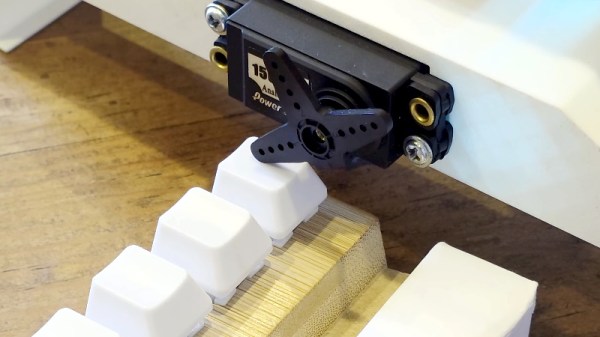
It’s a 3D printed frame which we’re told is designed for a specific item, on top of which is mounted a hobby servo. Rotating the servo brings the lever down on the button, and the job is done. At the user end there’s a button in a printed enclosure that’s definitely not a knock-off of a well-known franchise from a notoriously litigious console company.

This is all good, but the interest for other projects lies in how it works. It’s using a pair of ESP32 microcontrollers, and instead of connecting to an existing WiFi network it’s using ESP-NOW for simplicity and low latency. This is a good application for the protocol, but as we’ve seen, it’s useful for a lot more than just button pressing.

Continue reading “Why Push A Button When A Machine Can Do It For You”

Dark lab setup with scientific looking drink dispenser

Scared For A Drink?

Halloween is about tricks and treats, but who wouldn’t fancy a bit to drink with that? [John Sutley] decided to complete his Halloween party with a drink dispenser looking as though it was dumped by a backstreet laboratory. It’s not only an impressive looking separating funnel, it even runs on an Arduino. The setup combines lab glassware, servo motors, and an industrial control panel straight from a process plant.

The power management appeared the most challenging part. The three servos drew more current than one Arduino could handle. [John] overcame voltage sag, brownouts, and ghostly resets. A healthy 1000 µF capacitor across the 5-volt rail fixed it. With a bit of PWM control and some C++, [John] managed to finish up his interactive bar system where guests could seal their own doom by pressing simple buttons.

This combines the thrill of Halloween with ‘the ghost in the machine’. Going past the question whether you should ever drink from a test tube – what color would you pick? Lingonberry juice or aqua regia, who could tell? From this video, we wouldn’t trust the bartender on it – but build it yourself and see what it brings you!

Continue reading “Scared For A Drink?”

WALL-E’s Forgotten Sibling Rebuilt

Do you remember the movie WALL-E? Apparently, [Leviathan engineering] did, and he wasn’t as struck by the title character, or Eva, or even the Captain. He was captivated by BURN-E. His working model shows up in the video below.

We’ll be honest. BURN-E didn’t ring a bell for us, though we remember the movie. He grabbed a 3D design for the robot on the Internet and planned out holes for some servos and other hardware.

Continue reading “WALL-E’s Forgotten Sibling Rebuilt”

Mechanical 7-Segment Display Combines Servos And Lego

If you need a seven-segment display for a project, you could just grab some LED units off the shelf. Or you could build something big and electromechanical out of Lego. That’s precisely what [upir] did, with attractive results.

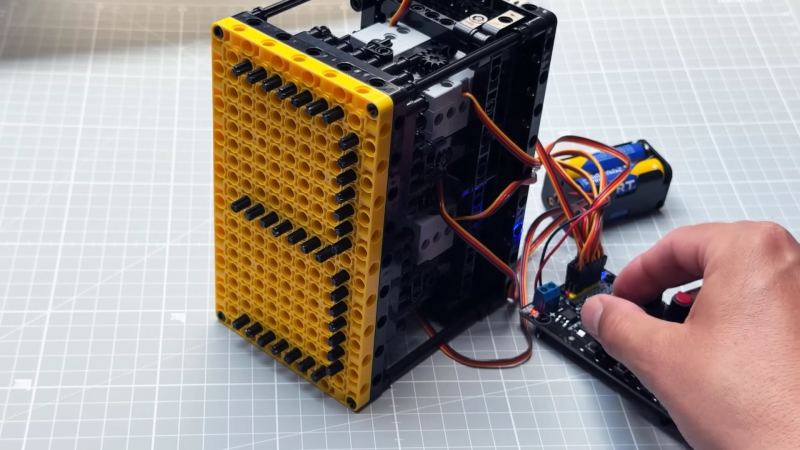
The build relies on Lego Technic parts, with numbers displayed by pushing small black axles through a large yellow faceplate. This creates a clear and easy to read display thanks to the high contrast. Each segment is made up of seven axles that move as a single unit, driven by a gear rack to extend and retract as needed. By extending and retracting the various segments in turn, it’s possible to display all the usual figures you’d expect of a seven-segment design.

It’s worth noting, though, that not everything in this build is Lego. The motors that drive the segments back and forth are third-party components. They’re Geekservo motors, which basically act as Lego-mountable servos you can drive with the electronics of your choice. They’re paired with an eight-channel servo driver board which controls each segment individually. Ideally, though, we’d see this display paired with a microcontroller for more flexibility. [upir] leaves that as an exercise for the viewer for now, with future plans to drive it with an Arduino Uno.

Design files are on Github for the curious. We’ve featured some similar work before, too, because you really can build anything out of Lego. Video after the break.

Continue reading “Mechanical 7-Segment Display Combines Servos And Lego”

Mark Setrakian and Adam Savage investigate a massive prop hand

17 Year Old Hellboy II Prop Still Amazes

The AI effects we know these days were once preceded by CGI, and those were once preceded by true hand-built physical props. If that makes you think of Muppets, this video will change your mind. In a behind-the-scenes look with [Adam Savage], effects designer [Mark Setrakian] reveals the full animatronic glory of Mr. Wink’s mechanical fist from Hellboy II: The Golden Army (2008) – and this beast still flexes.

Most of this arm was actually made in 2003, when 3D printing was very different than what we think of today. Printed on a Stratasys Titan – think: large refrigerator-sized machine, expensive as sin – the parts were then hand-textured with a Dremel for that war-scarred, brutalist feel. This wasn’t just basic animatronics for set dressing. This was a fully actuated prop with servo-driven finger joints, a retractable chain weapon, and bevel-geared mechanisms that scream mechanical craftsmanship.

Each finger is individually designed. The chain reel: powered by a DeWalt drill motor and custom bevel gear assembly. Every department: sculptors, CAD modelers, machinists, contributed to this hybrid of analog and digital magic. Props like this are becoming unicorns.

Continue reading “17 Year Old Hellboy II Prop Still Amazes”

[Austin Blake] sitting on line follower cart in garage

Honey, I Blew Up The Line Follower Robot

Some readers may recall building a line-following robot during their school days. Involving some IR LEDs, perhaps a bit of LEGO, and plenty of trial-and-error, it was fun on a tiny scale. Now imagine that—but rideable. That’s exactly what [Austin Blake] did, scaling up a classroom robotics staple into a full-size vehicle you can actually sit on.

The robot uses a whopping 32 IR sensors to follow a black line across a concrete workshop floor, adjusting its path using a steering motor salvaged from a power wheelchair. An Arduino Mega Pro Mini handles the logic, sending PWM signals to a DIY servo. The chassis consists of a modified Crazy Cart, selected for its absurdly tight turning radius. With each prototype iteration, [Blake] improved sensor precision and motor control, turning a bumpy ride into a smooth glide.

The IR sensor array, which on the palm-sized vehicle consisted of just a handful of components, evolved into a PCB-backed bar nearly 0.5 meters wide. Potentiometer tuning was a fiddly affair, but worth it. Crashes? Sure. But the kind that makes you grin like your teenage self. If it looks like fun, you could either build one yourself, or upgrade a similar LEGO project.
Continue reading “Honey, I Blew Up The Line Follower Robot”

Multifunctional USB controlled PCB on blue background

How A Tiny Relay Became A USB Swiss Army Knife

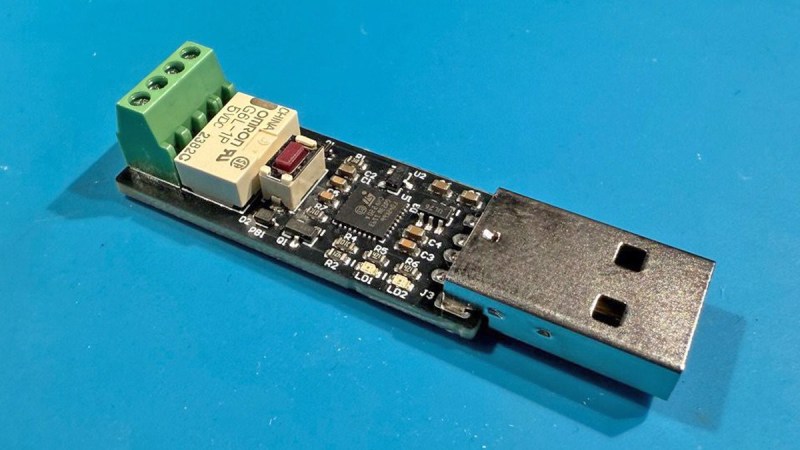
Meet the little board that could: [alcor6502]’s tiny USB relay controller, now evolved into a multifunction marvel. Originally built as a simple USB relay to probe the boundaries of JLCPCB’s production chops, it has become a compact utility belt for any hacker’s desk drawer. Not only has [alcor6502] actually built the thing, he even provided instructions. If you happened to be at Hackaday in Berlin, you now might even own one, as he handed out twenty of them during his visit. If not, read on and build it yourself.

This thing is not just a relay, and that is what makes it special. Depending on a few solder bridges and minimal components, it shape-shifts into six different tools: a fan controller (both 3- and 4-pin!), servo driver, UART interface, and of course, the classic relay. It even swaps out a crystal oscillator for USB self-sync using STM32F042‘s internal RC – no quartz, less cost, same precision. A dual-purpose BOOT0 button lets you flash firmware and toggle outputs, depending on timing. Clever reuse, just like our mothers taught us.

It’s the kind of design that makes you want to tinker again. Fewer parts. More function. And that little smile when it just works. If this kind of clever compactness excites you too, read [alcor6502]’s build log and instructions here.