Reverse-Engineering The Intel 8087 Stack Circuitry

Although something that’s taken for granted these days, the ability to perform floating-point operations in hardware was, for the longest time, something reserved for people with big wallets. This began to change around the time that Intel released the 8087 FPU coprocessor in 1980, featuring hardware support for floating-point arithmetic at a blistering 50 KFLOPS. Notably, the 8087 uses a stack-based architecture, a major departure from existing FPUs. Recently [Ken Shirriff] took a literal closer look at this stack circuitry to see what it looks like and how it works.

Nearly half of the 8087’s die is taken up by the microcode frontend and bus controller, with a block containing constants like π alongside the FP calculation-processing datapath section taking up much of the rest. Nestled along the side are the eight registers and the stack controller. At 80 bits per FP number, the required registers and related were pretty sizeable for the era, especially when you consider that the roughly 60,000 transistors in the 8087 were paired alongside the 29,000 transistors in the 16-bit 8086.

Each of the 8087’s registers is selected by the decoded instructions via a lot of wiring that can still be fairly easily traced despite the FPU’s die being larger than the CPU it accompanied. As for the unique stack-based register approach, this turned out to be mostly a hindrance, and the reason why the x87 FP instructions in the x86 ISA are still quite maligned today. Yet with careful use, providing a big boost over traditional code, this made it a success by that benchmark, even if MMX, SSE, and others reverted to a stackless design.

Using GIMP for visual analysis

Decapsulating A PIC12F683 To Examine Its CMOS Implementation

In a recent video, [Andrew Zonenberg] takes us through the process of decapsulating a PIC12F683 to take a peak at its CMOS implementation.

This is a multipart series with five parts done and more to come. The PIC12F683 is an 8-pin flash-based, 8-bit microcontroller from Microchip. [Andrew] picked the PIC12F683 for decapsulation because back in 2011 it was the first microcontroller he broke read-protection on and he wanted to go back and revisit this chip, given particularly that his resources and skills had advanced in the intervening period.

The five videos are a tour de force. He begins by taking a package cross section, then decapsulating and delayering. He collects high-resolution photos as he goes along. In the process, he takes some time to explain the dangers of working with acid and the risk mitigations he has in place. Then he does what he calls a “floorplan analysis” which takes stock of the entire chip before taking a close look at the SRAM implementation.

If you’re interested in decapsulating integrated circuits you might want to take a look at Laser Fault Injection, Now With Optional Decapping, A Particularly Festive Chip Decapping, or even read through the transcript of the Decapping Components Hack Chat With John McMaster.

Continue reading “Decapsulating A PIC12F683 To Examine Its CMOS Implementation”

Liberating AirPods With Bluetooth Spoofing

Apple’s AirPods can pair with their competitors’ devices and work as basic Bluetooth earbuds, but to no one’s surprise most of their really interesting features are reserved for Apple devices. What is surprising, though, is that simple Bluetooth device ID spoofing unlocks these features, a fact which [Kavish Devar] took advantage of to write LibrePods, an AirPods controller app for Android and Linux.

In particular, LibrePods lets you control noise reduction modes, use ear detection to pause and unpause audio, detect head gestures, reduce volume when the AirPods detect you’re speaking, work as configurable hearing aids, connect to two devices simultaneously, and configure a few other settings. The app needs an audiogram to let them work as hearing aids, and you’ll need an existing audiogram – creating an audiogram requires too much precision. Of particular interest to hackers, the app has a debug mode to send raw Bluetooth packets to the AirPods. Unfortunately, a bug in the Android Bluetooth stack means that LibrePods requires root on most devices.

This isn’t the first time we’ve seen a hack enable hearing aid functionality without official Apple approval. However, while we have some people alter the hardware, AirPorts can’t really be called hacker- or repair-friendly.

Thanks to [spiralbrain] for the tip!

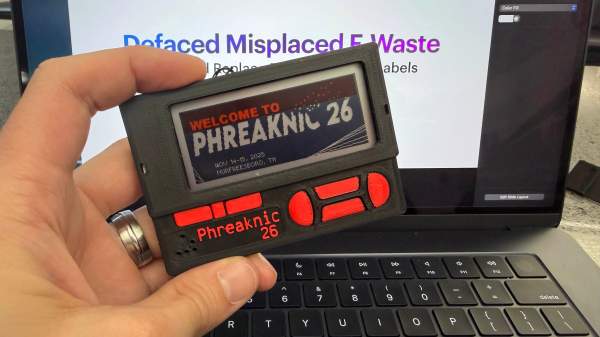
PN26 badge

Shelf Life Extended: Hacking E-Waste Tags Into Conference Badges

Ever wonder what happens to those digital price tags you see in stores once they run out of juice? In what is a prime example of e-waste, many of those digital price tags are made with non-replaceable batteries, so once their life is over they are discarded. Seeing an opportunity to breathe new life into these displays, [Tylercrumpton] went about converting them to be the official badge of the Phreaknic 26 conference.

Looking for a solution for a cheap display for the upcoming conference badge, [Tylercrumpton] recalled seeing the work [Aaron Christophel] did with reusing electronic shelf labels. Looking on eBay, he picked up a lot of 100 ZBD 55c-RB labels for just $0.70 a piece. When they arrived, he got to work liberating the displays from their plastic cases. The long-dead batteries in the devices ended up being easily removed, leaving behind just the display and the PCB that drives it.

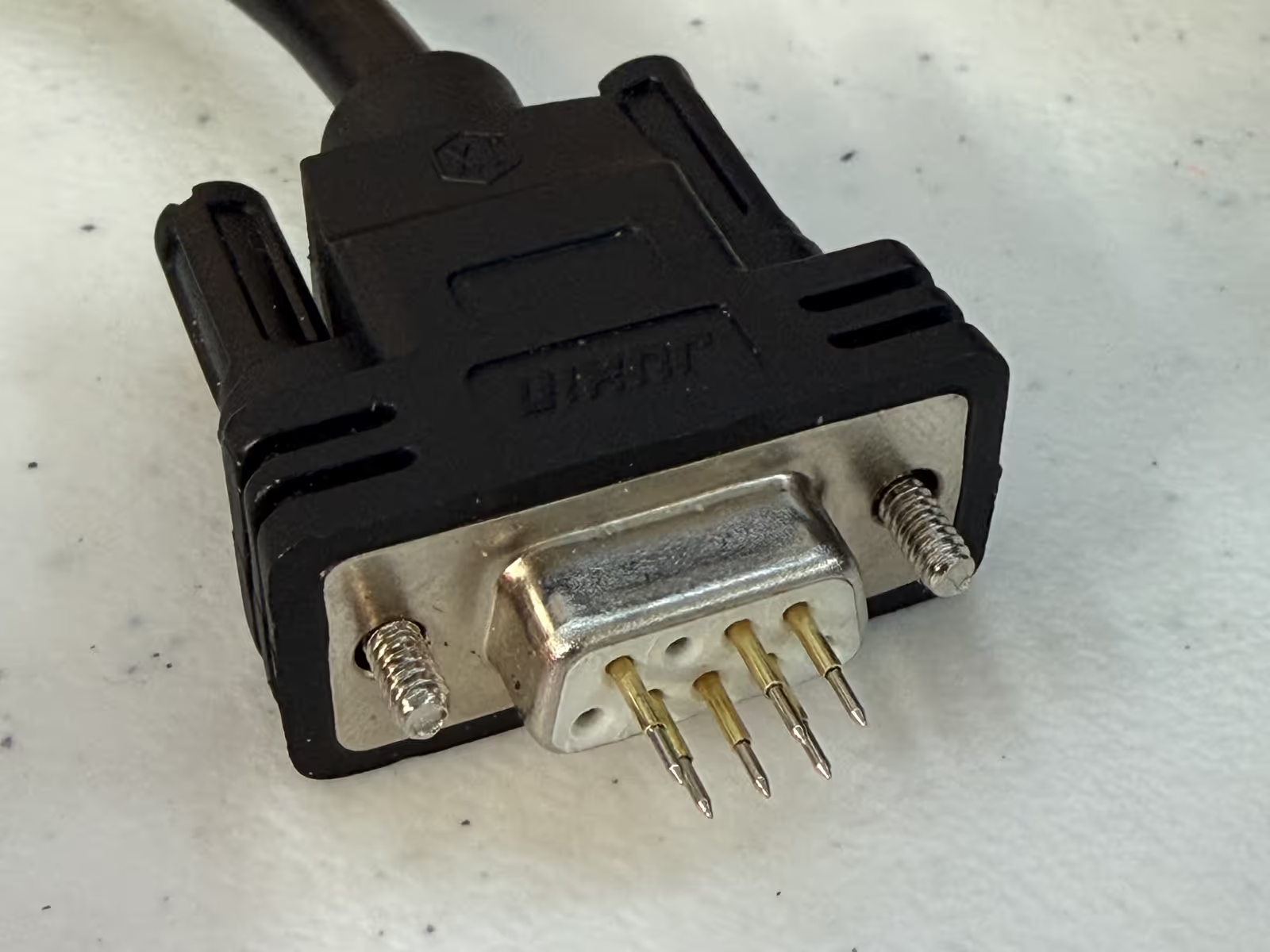
db9 programmerAnother hacker assisting with the badge project, [Mog], noticed that the spacing of the programming pads on the PCB was very close to the spacing of a DB9/DE9 cable. This gave way to a very clever hack for programming the badges: putting pogo pins into a female connector. The other end of the cable was connected to a TI CC Debugger which was used to program the firmware on the displays. But along the way, even this part of the project got an upgrade with moving to an ESP32 for flashing firmware, allowing for firmware updates without a host computer.
The next challenge was how to handle customizing 200 unique badges for the conference. For this, each badge had a unique QR code embedded in the back of the 3D printed case that pointed to an online customization tool. The tool allowed the user to change which of the images was used for the background, as well as input the name they wanted to be displayed on the badge. Once finished, the server would provide a patched firmware image suitable for flashing the badge. The original intent was to have stations where attendees could plug in their badge and it would update itself; however, due to some 11th hour hiccups, that didn’t pan out for this conference. Instead, [Tylercrumpton] ran the update script on his machine, and it gave him a great opportunity to interact with conference attendees as they stopped by to update their badges.

For the Phreaknic 27 badge, the plan is to once again use electronic shelf labels, but this time to utilize some of the advanced features of the tags such as the EEPROM and wireless communications. We’re eager to see what the team comes up with.

Continue reading “Shelf Life Extended: Hacking E-Waste Tags Into Conference Badges”

Reverse Engineering The Miele Diagnostic Interface

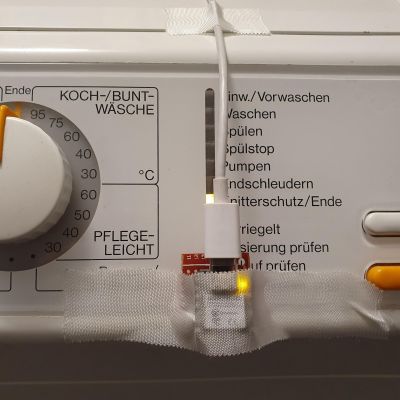
The infrared transceiver installed on the washing machine. (Credit: Severin)

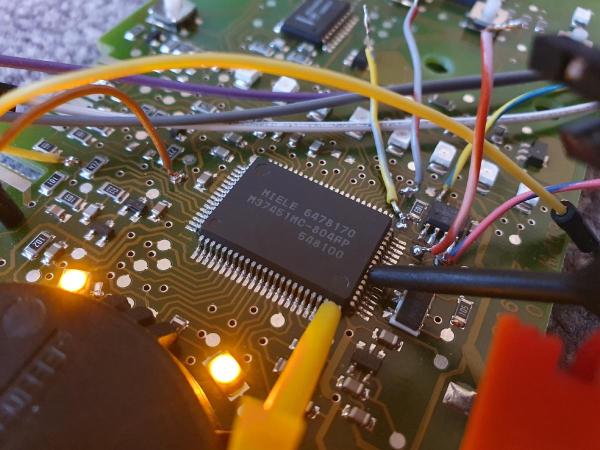
Since modern household appliances now have an MCU inside, they often have a diagnostic interface and — sometimes — more. Case in point: Miele washing machines, like the one that [Severin] recently fixed, leading to the firmware becoming unhappy and refusing to work. This fortunately turned out to be recoverable by clearing the MCU’s fault memory, but if you’re unlucky, you will have to recalibrate the machine, which requires very special and proprietary software.

Naturally, this led [Severin] down the path of investigating how exactly the Miele Diagnostic Utility (MDU) and the Program Correction (PC) interface communicate. Interestingly, the PC interface uses an infrared LED/receiver combination that’s often combined with a status LED, as indicated by a ‘PC’ symbol. This interface uses the well-known IrDA standard, but [Severin] still had to track down the serial protocol.

Continue reading “Reverse Engineering The Miele Diagnostic Interface”

Robot Phone Home…Or Else

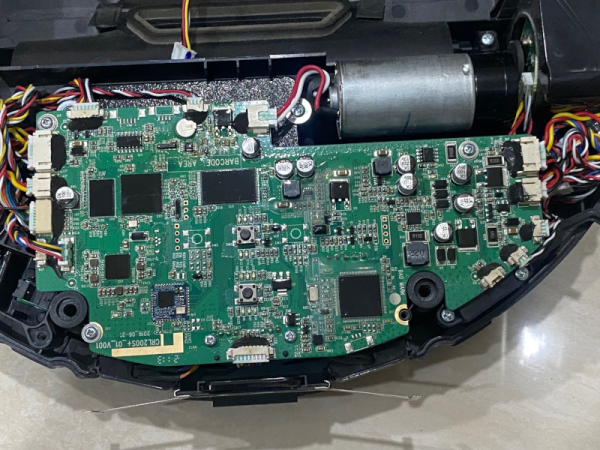
We would have enjoyed [Harishankar’s] tear down of a robot vacuum cleaner, even if it didn’t have a savage twist at the end. Turns out, the company deliberately bricked his smart vacuum.

Like many of us, [Harishankar] is suspicious of devices beaming data back to their makers. He noted a new vacuum cleaner was pinging a few IP address, including one that was spitting out logging or telemetry data frequently. Of course, he had the ability to block the IP address which he did. End of story, right?

No. After a few days of working perfectly, the robot wouldn’t turn on. He returned it under warranty, but the company declared it worked fine. They returned it and, indeed, it was working. A few days later, it quit again. This started a cycle of returning the device where it would work, it would come home and work for a few days, then quit again.

You can probably guess where this is going, but to be fair, we gave you a big hint. The fact that it would work for days after blocking the IP address wouldn’t seem like a smoking gun in real time.

Continue reading “Robot Phone Home…Or Else”

Simple Counter Mechanism In An Asthma Inhaler

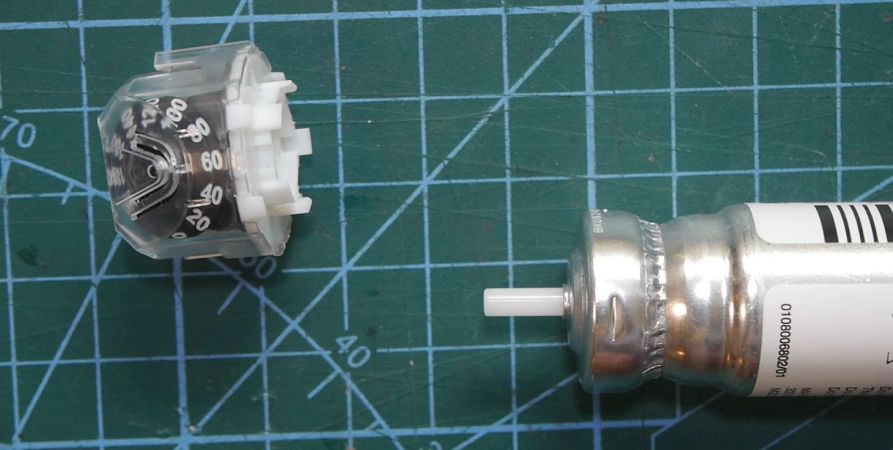
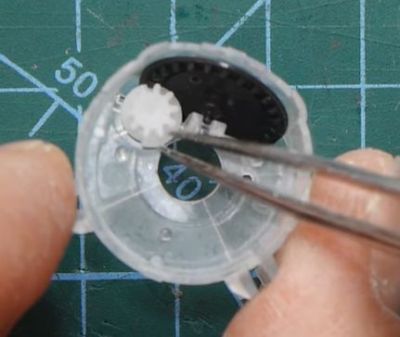
The counter wheel and white worm gear inside the counter. (Credit: Anthony Francis-Jones, YouTube)

Recently [Anthony Francis-Jones] decided to take a closer look at the inhaler that his son got prescribed for some mild breathing issues, specifically to teardown the mechanical counter on it. Commonly used with COPD conditions as well as asthma, these inhalers are designed to provide the person using it with an exact dose of medication that helps to relax the muscles of the airways. Considering the somewhat crucial nature of this in the case of extreme forms of COPD, the mechanical counter that existed on older versions of these inhalers is very helpful to know how many doses you have left.

Disassembling the inhaler is very easy, with the counter section easily extracted and further disassembled. The mechanism is both ingenious and simple, featuring the counter wheel that’s driven by a worm gear, itself engaged by a ratcheting mechanism that’s progressed every time the cylinder with the medication is pushed down against a metal spring.

After the counter wheel hits the 0 mark, a plastic tab prevents it from spinning any further, so that you know for certain that the medication has run out. In the video [Anthony] speculates that the newer, counter-less inhalers that they got with the latest prescription can perhaps be harvested for their medication cylinder to refill the old inhaler, followed by resetting the mechanical counter. Of course, this should absolutely not be taken as medical advice.

Continue reading “Simple Counter Mechanism In An Asthma Inhaler”