Molecular beam epitaxy system Veeco Gen II at the FZU – Institute of Physics of the Czech Academy of Sciences. The system is designed for growth of monocrystalline semiconductors, semiconducting heterostructures, materials for spintronics and other compound material systems containing Al, Ga, As, P, Mn, Cu, Si and C.

Germanium Semiconductor Made Superconductor By Gallium Doping

Over on ScienceDaily we learn that an international team of scientists have turned a common semiconductor germanium into a superconductor.

Researchers have been able to make the semiconductor germanium superconductive for the first time by incorporating gallium into its crystal lattice through the process of molecular-beam epitaxy (MBE). MBE is the same process which is used in the manufacture of semiconductor devices such as diodes and MOSFETs and it involves carefully growing crystal lattice in layers atop a substrate.

When the germanium is doped with gallium the crystalline structure, though weakened, is preserved. This allows for the structure to become superconducting when its temperature is reduced to 3.5 Kelvin.

It is of course wonderful that our material science capabilities continue to advance, but the breakthrough we’re really looking forward to is room-temperature superconductors, and we’re not there yet. If you’re interested in progress in superconductors you might like to read about Floquet Majorana Fermions which we covered earlier this year.

Underwater Jetpack Is Almost Practical

The jet pack is one of those pre-war sci-fi dreams that the cold light of rational consideration reveals to be a terrible idea. Who wants to cook their legs with hot exhaust while careening out of control? Nobody. Yet it’s such an iconic idea, we can’t get away from it. What if there was a better environment, one where your jetpack dreams could come true? [CPSdrone] has found one: the world’s oceans, and have taken that revelation to build the world’s fastest underwater jetpack.

Underwater? Yeah, water drag is worse than air drag. But there are two big advantages: one, humans are fairly buoyant, so you don’t need fight gravity with rocket thrust, and two, the high density of water makes small, electric props a reasonable proposition. The electric ducted fans on this “jetpack” each produce about 110 pounds of thrust, or just over 490 N. The first advantage is helped further by the buoyancy provided by the air-filled “hull” of the jetpack. That’s necessary because while the motors might be rated for submersion, but the rest of the electronics aren’t.

Alas, wearing the device on the back is considerably less hydrodynamic than hanging on behind in the standard ‘water scooter’ configuration. While they’re able to go faster than a swimming human, the ESCs weren’t able to handle the motors full power so we can’t tell you if this device would allow [CPSdrone] to outrun a shark with those 220 lbf on tap, which was the design goal. Apparently they’re working on it.

From the testing done on-screen, it’s safe to say that they’d at least need to hang on behind to get their desired speed goals, and abandon their jet pack dreams just as we landlubbers were forced to do long ago. Well, some of us, anyway.

Continue reading “Underwater Jetpack Is Almost Practical”

Building A Flying Blended Wing Body Aircraft Prototype

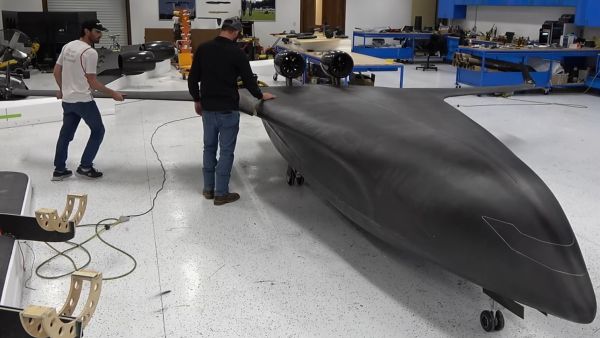
Anyone with an inkling of interest in super-sized remote control aircraft probably has at least seen some of the mind-blowing projects that [Ramy RC] has worked on over the years, with examples like the ongoing Airbus A380-800 build approaching the size of a full-sized business jet. That said, they recently got the offer to build a flying prototype of the Natilus Horizon, a blended wing body (BWB) aircraft that’s currently being developed into a full-sized production aircraft.

Suffice it to say that BWB RC aircraft isn’t something that they have built before, but as co-founder of Natilus, [Aleksey Matyushev], explains, they want to prove in this manner that building scale prototypes of future production aircraft is not nearly as complex as it’s often made out to be. Meaning that even two blokes in a shed as is the case here should be able to pull it off.

Natilus was founded in 2016 amidst strongly rising interest in these BWB aircraft designs that may one day threaten today’s tubes-with-wings. Their Kona design would be the cargo version and this Horizon prototype that [Ramy RC] is building the passenger version.

In this first video of two total, we can see the CAD project of the prototype and how the basic aircraft structure is being constructed out of carbon fiber composite, wood and foam. To this the engine nacelles, landing gear and wings are mounted, readying it for its maiden flight. The Natilus engineers have previously done all the simulations that should mean that it’ll fly like a glider, but we will have to wait until the next video to see whether that is the case.

Continue reading “Building A Flying Blended Wing Body Aircraft Prototype”

FLOSS Weekly Episode 859: OpenShot: Simple And Fast

This week Jonathan chats with Jonathan Thomas about OpenShot, the cross-platform video editor that aims to be simple to use, without sacrificing functionality. We did the video edit with OpenShot for this episode, and can confirm it gets the job done. What led to the creation of this project, and what’s the direction it’s going? Watch to find out!

Continue reading “FLOSS Weekly Episode 859: OpenShot: Simple And Fast”

The PediSedate: A Winning Combination Of Video Games And Anesthesia

One can understand that it would be nice to have something to focus on while trying to remain calm ahead of a medical procedure. Credit: PediSedate

Once upon a time, surgery was done on patients who were fully conscious and awake. As you might imagine, this was a nasty experience for all involved, and particularly the patients. Eventually, medical science developed the techniques of anaesthesia, which allowed patients to undergo surgery without feeling pain or even being conscious of it at all.

Adults are typically comfortable in the medical environment and tolerate anaesthesia well. For children, though, the experience can be altogether more daunting. Thus was invented the PediSedate—a device which was marketed almost like a Game Boy accessory intended to deliver anaesthetic treatment in order to safely and effectively prepare children for surgery.

Continue reading “The PediSedate: A Winning Combination Of Video Games And Anesthesia”

AI Picks Outfits With Abandon

Most of us choose our own outfits on a daily basis. [NeuroForge] decided that he’d instead offload this duty to artificial intelligence — perhaps more for the sake of a class project than outright fashion.

The concept involved first using an AI model to predict the weather. Those predictions would then be fed to a large language model (LLM), which would recommend an appropriate outfit for the conditions. The output from the LLM would be passed to a simple alarm clock which would wake [NeuroForge] and indicate what he should wear for the day. Amazon’s Chronos forecasting model was used for weather prediction based on past weather data, while Meta’s Llama3.1 LLM was used to make the clothing recommendations. [NeuroForge] notes that it was possible to set all this up to work without having to query external services once the historical weather data had been sourced.

While the AI choices often involved strange clashes and were not weather appropriate, [NeuroForge] nonetheless followed through and wore what he was told. This got tough when the outfit on a particularly cold day was a T-shirt and shorts, though the LLM did at least suggest a winter hat and gloves be part of the ensemble. Small wins, right?

We’ve seen machine learning systems applied to wardrobe-related tasks before. One wonders if a more advanced model could be trained to pick not just seasonally-appropriate clothes, but to also assemble actually fashionable outfits to boot. If you manage to whip that up, let us know on the tipsline. Bonus points if your ML system gets a gig on the reboot of America’s Next Top Model.

Continue reading “AI Picks Outfits With Abandon”

Catching Those Old Busses

The PC has had its fair share of bus slots. What started with the ISA bus has culminated, so far, in PCI Express slots, M.2 slots, and a few other mechanisms to connect devices to your computer internally. But if the 8-bit ISA card is the first bus you can remember, you are missing out. There were practically as many bus slots in computers as there were computers. Perhaps the most famous bus in early home computers was the Altair 8800’s bus, retroactively termed the S-100 bus, but that wasn’t the oldest standard.

There are more buses than we can cover in a single post, but to narrow it down, we’ll assume a bus is a standard that allows uniform cards to plug into the system in some meaningful way. A typical bus will provide power and access to the computer’s data bus, or at least to its I/O system. Some bus connectors also allow access to the computer’s memory. In a way, the term is overloaded. Not all buses are created equal. Since we are talking about old bus connectors, we’ll exclude new-fangled high speed serial buses, for the most part.

Tradeoffs

There are several trade-offs to consider when designing a bus. For example, it is tempting to provide regulated power via the bus connector. However, that also may limit the amount of power-hungry electronics you can put on a card and — even worse — on all the cards at one time. That’s why the S-100 bus, for example, provided unregulated power and expected each card to regulate it.

On the other hand, later buses, such as VME, will typically have regulated power supplies available. Switching power supplies were a big driver of this. Providing, for example, 100 W of 5 V power using a linear power supply was a headache and wasteful. With a switching power supply, you can easily and efficiently deliver regulated power on demand.

Some bus standards provide access to just the CPU’s I/O space. Others allow adding memory, and, of course, some processors only allow memory-mapped I/O. Depending on the CPU and the complexity of the bus, cards may be able to interrupt the processor or engage in direct memory access independent of the CPU.

In addition to power, there are several things that tend to differentiate traditional parallel buses. Of course, power is one of them, as well as the number of bits available for data or addresses. Many bus structures are synchronous. They operate at a fixed speed, and in general, devices need to keep up. This is simple, but it can impose tight requirements on devices.

Continue reading “Catching Those Old Busses”