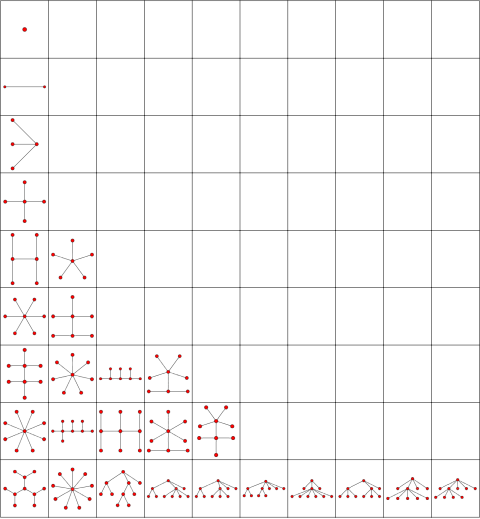
A series-reduced tree is a tree in which all nodes have degree other than 2 (in other words, no node merely allows a single edge to "pass through"). Series-reduced trees are also called homeomorphically irreducible (Harary and Palmer 1973, pp. 61-62) or topological trees (Bergeron et al. 1998). The numbers of series-reduced trees with 1, 2, ... nodes are 1, 1, 0, 1, 1, 2, 2, 4, 5, 10, 14, ... (OEIS A000014). Harary and Palmer (1973, p. 62, Fig. 3.3.3) illustrate the series-reduced trees on 8 and fewer nodes.
Series-reduced trees are best known in popular culture due to their appearance in the second blackboard problem in the 1997 film Good Will Hunting, which poses the problem of finding all (10) such trees on 10 nodes.
The numbers of series-reduced planted trees on , 2, ... nodes are 0, 1, 0, 1, 1, 2, 3, 6, 10, 19, 35, ... (OEIS A001678) and the numbers of series-reduced rooted trees are 1, 1, 0, 2, 2, 4, 6, 12, 20, 39, 71, ... (OEIS A001679).
The process of replacing edges adjacent to a degree-2 vertex by a single edges is known as graph smoothing.
Bergeron, F.; Leroux, P.; and Labelle, G. Combinatorial Species and Tree-Like Structures. Cambridge, England: Cambridge University Press, pp. 188, 283-284, 291, and 337, 1998.Cameron, P. J. "Some Treelike Objects." Quart. J. Math. Oxford38, 155-183, 1987.Finch, S. R. §5.6 in Mathematical Constants. Cambridge, England: Cambridge University Press, 2003.Harary, F. Graph Theory. Reading, MA: Addison-Wesley, p. 232, 1994.Harary, F. and Palmer, E. M. Graphical Enumeration. New York: Academic Press, p. 61-62, 1973.Harary, F. and Palmer, E. M. "Probability that a Point of a Tree Is Fixed." Math. Proc. Camb. Phil. Soc.85, 407-415, 1979.Harary, F. and Prins, G. "The Number of Homeomorphically Irreducible Trees, and Other Species." Acta Math.101, 141-162, 1959.Harary, F.; Robinson, R. W. and Schwenk, A. J. "Twenty- Step Algorithm for Determining the Asymptotic Number of Trees of Various Species." J. Austral. Math. Soc., Ser. A20, 483-503, 1975.Sloane, N. J. A. Sequences A000014/M0320, A001678/M0768, and A001679/M0327 in "The On-Line Encyclopedia of Integer Sequences."


 on
on  nodes.
  , 2, ... nodes are 0, 1, 0, 1, 1, 2, 3, 6, 10, 19, 35, ... (OEIS A001678) and the numbers of series-reduced rooted trees are 1, 1, 0, 2, 2, 4, 6, 12, 20, 39, 71, ... (OEIS A001679).
  adjacent to a degree-2 vertex
  by a single edges
  is known as graph smoothing.